Dominic Tiano: Torey Krug- the Wonder of You

Torey-Krug-1

Posted by Dominic Tiano

No, we’re not talking about the 1970 hit by Elvis Presley. We’re talking about Boston Bruins defenceman Torey Krug, otherwise known to hockey diehards as TK47.

Sports, like the rest of the world, is in a period like we’ve never seen before because of the COVID-19 Pandemic. The NHL is facing question after question about how they are going to return to the days that saw record revenues for the league and record salaries for the players.

Luckily, the NHL and the Players Association have reached an agreement on a new CBA that will ensure financial stability for the next six years. Krug is set to become an unrestricted free agent once the Stanley Cup is awarded, and for him and others on expiring contracts, everyone is wondering what kind of deal he could get from the Bruins or the open market because of the flat cap negotiated by the league and the players.

There is a growing theme on social media, and that is: TK47 has taken team friendly deals in the past and now is the time to get paid.

Well, that is not entirely true, although it would appear that way.

TK47 signed his first NHL contract on March 25, 2012 for the maximum allowable under the CBA. Furthermore, he had the ability to attain over $2.3 million in performance bonuses over the three-year life of the contract. While it’s almost common practice nowadays with NCAA free agents, TK47 was one of the first to be allowed to “burn a year” off his deal.  That is the price the Bruins had to pay to get TK47 to put pen to paper, but it’s certainly not team friendly.

TK47 signed his second deal on October 5, 2014. At the time, the Bruins were having cap issues and Krug signed a one-year deal for $900,000 in base salary with a half-million dollar signing bonus for a cap hit of $1.4 million. But was it a team friendly deal or market value?

At that point TK47 had played in 82 games and recording 42 points. He was paid more then other defencemen that signed deals that summer such as: David Savard ($1.3 million, 105 GP, 25 pts), Sami Vatanen ($1.262 million, 56 GP, 23 pts), Mattias Ekholm ($1.037 million, 65 GP, 9 pts). The major difference between TK47 and these three is that Krug’s deal was for one year while theirs was for two, allowing Krug to reach a bigger payday one year prior to them.

The 2014 offseason saw Krug sign the fifth highest deal among defencemen in his age group of the over 25 defenders to sign deals.

Krug’s current deal was signed on June 30, 2016 and was a 4-year deal with an AAV of $5.25 million. Does that seem undervalued today? Sure. Was it when he signed and was it team friendly? You be the judge. As of today, Krug has appeared in 241 NHL games with 125 points.

That same summer, Hampus Lindholm (236 GP, 92 pts) signed for the same AAV, but for 6 years. Tyson Barrie (264 GP 153 pts) signed for the same 4 years at 250K more. Vatanen (194 GP, 98 pts) signed for 4 years as well at 400K less then Krug. Seth Jones (240 GP, 83 pts) signed for 6 years and a $5.4 AAV.

It would appear that Krug is paid on par with some of the other defenders when he signs his deals, and in most cases, his contract expires earlier allowing him for a bigger deal before the others. Can we really consider them team friendly deals that he has signed to date?

Sure, there are contracts out there that are bigger, but some of them are deemed mistakes. Hello P.K. Subban? Was Subban ever a $9 million a year defenceman? Sure. Is he one today? Probably not. But both NHL General Managers and yes, even agents, overlook those deals that are above market value.

So, what is TK47’s worth? Good question.

Is he worth more than Josh Morrisey, who signed for an AAV of $6.25 million in 2019? Yes. Is he worth more then the $8 million AAV given to Jacob Trouba or more then the $8 million per year Thomas Chabot receives after signing his deal a year ago? You could make an argument in both cases, but the difference is Krug will be on the wrong side of 30 in the first year of his next deal while those three are 25 and under.

According to CapFriendly, the Bruins have $16,359,409 in cap space for next season (barring any bonus overages still yet to be determined) and with Anders Bjork signing his new deal for three years have Jake DeBrusk, Zdeno Chara Matt Grzelcyk and Joakim Nordstrom [I don’t expect an extension here] remaining to be signed and a full roster.

Is $16 million enough to ink the four, including Krug? It certainly is.

I don’t believe this is going to come down to dollars, but term and I have made no secret about it for several months. TK47 probably wants this to be his last contract and wants term at close to market value. At the same time, I would think the Bruins are not interested in a 7-year deal at which time Krug will be 36 going on 37 in the final year. You have to also believe that there is a GM out there that is willing to throw out a 7-year deal without thinking. We’ve seen it too many times in the NHL and they can’t save themselves from themselves.

Will the Bruins and Krug be able to find a middle ground? As mentioned earlier, this is a different world and there are new negotiating tactics both sides could use. One of those tactics is backloading deals. (we are all to familiar with front-loaded deals). Because of the limits placed on escrow in the new CBA, it benefits the player to be paid more in the latter years of his deal then at the beginning because they pay less in escrow – meaning more money in their pockets. And the Bruins could use that tactic to entice TK47.

There is a lot of speculating out there but the truth is only the Bruins and Krug know how this is going to end. The only thing we know for certain is that Krug is on a mission to win a Stanley Cup after two failed Final series appearances.

Torey Krug should do what he believes is best for he and his family and no ill-will should be held against him if he chooses to move on. He’s bled black and gold through 7 full seasons with the Bruins and he has earned the right to do what he thinks is best. We should be thankful we had the opportunity to watch him pull on the Bruins jersey and every last fan should wish him nothing but the best if he moves on (except against the Bruins of course).

If he chooses to stay, then viva Torey Krug!
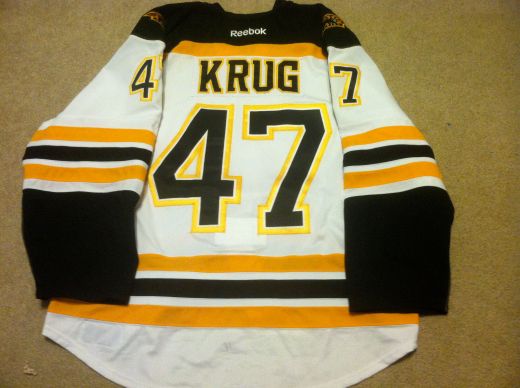
Torey Krug 12-13 Playoffs Away Back


Bruins playoff roster quick hits: Forwards (Pt 1)

We’re back with another post about the Boston Bruins’ playoff roster. These are thoughts, observations and insights based on what’s out there, but much more to come as we have an exhibition game on the docket now late this month against Columbus before the B’s round robin schedule begins on August 2nd.

The B’s remain in camp on home practice ice through July 25, then travel to hub city Toronto for the next phase and (hopefully) resumption of NHL hockey.

Here’s a breakdown of the 1st nine forwards (in alphabetical order) and we’ll post up the others tomorrow. We appropriately lead with the most senior Bruin, Mssr. Bergeron…

Bergeron3

Patrice Bergeron- Former Bruin Chris Kelly liked to call the B’s longest-tenured player Mr. Everything, and nine years after first hearing him say it in a soundbite, it’s holding up better than ever. Though Bergeron will turn 35 next week, he’s on a similar career arc to another famous (and former) New England sports icon Tom Brady, in that his most productive years in the NHL have come after he turned 30. His 31 goals in 61 games this season marked the third consecutive year he hit the 30-goal mark, and 4th in five seasons dating back to 2016. Had it not been for the season pause, he would’ve easily beaten his single-season best of 32 goals.

What more can you say about Bergeron that hasn’t been covered already? Though not an elite scorer, he’s productive and has always had a knack for scoring big goals in big moments (Hey, Toronto- we see you!). His defensive play has known no peer for years, and it is only the biased voting of sportswriters who would rather elevate other players around the league to the Frank J. Selke Trophy rather than see Bergeron win his fifth or sixth awards. No disrespect to the recent winners, but they aren’t in Bergeron’s class when it comes to defensive play, but they put up enough offense to justify the voters feeling good enough about themselves to cast the vote. We won’t talk about some of the dishonest Montreal and Chicago reporters who purposefully left him off their ballots in 2013 so that Jonathan Toews would win in a razor-close vote. But, given Bergeron’s class, he wouldn’t dwell on that, so we’ll channel Idina Menzel here and…let it go.

Bottom line- Bergeron has gotten better with age, and when he’s healthy, he’s the glue that makes Boston’s top line go. He’s got over 130 playoff games worth of experience, has a genius-level hockey IQ and oh, did we mention that he’s fully rested and healthy? Sounds like a recipe for some good times.

Anders Bjork- “Maybe the best player,” as described by B’s head coach Bruce Cassidy after day 1 of practice this week, will be in position to deliver on the promise that has surrounded him since he turned pro three years ago. As a reward, he slotted into David Pastrnak’s spot on the right wing with Bergeron and Brad Marchand. Inexperience and injuries have prevented the former Notre Dame Fighting Irish star from demonstrating the offensive talent the B’s have always felt he possesses, and while he’s not likely to develop into a frontline NHL scorer, his speed and intelligence make him a threat to become a solid complementary piece, the kind you win with. The offensive numbers to date belie the ability Bjork has to potentially get hot and provide some key offense at crunch time- he was one of the most valuable, if unheralded, members of a high-flying U.S. NTDP team from the stacked 1996 birth year.

Anton Blidh- If 2014 was a bonanza of a draft year, then the Bruins wouldn’t mind a redo of 2013. Only Blidh and fringe prospect D Wiley Sherman remain from that class, and Blidh was a late pick projected to be a role player/grinder at the NHL level if he could get there. He’s played at least one game with Boston in every NHL season since 16-17, with the most coming in a 19-game span that year. He brings speed and energy with some jam, but there’s very little skill and beyond being a depth guy to use in a pinch, you’re not likely to see him as a long-term option for the B’s.

Paul Carey- The Massachusetts native and longtime pro journeyman after four years at Boston College is the Trent Whitfield of this playoff roster. A solid all-around pro, Carey is a classic NHL ‘tweener- effective AHL player who is good enough to play NHL games, but is missing that element to carve out a niche for himself in the show beyond one full year on the non-playoff New York Rangers in 2017-18. This is not a diss- he’s seen NHL stints with every organization he’s been a part of- he’s a veteran, character guy who boosts the culture and has the experience to be a Swiss Army knife-type when pressed into duty. Having said that, with the B’s as a legitimate contender, it would be an extreme scenario indeed to see Carey on game night.

Charlie Coyle- One of Don Sweeney’s more savvy acquisitions a year ago at the trade deadline, the East Weymouth product delivered some important playoff contributions in 2019, and was having the second-best offensive campaign of his career when the music stopped in March. At 28 and fully rested and healed, he’s in his prime to be the anchor of a hard-to-play-against third line and is at his best when employed up the middle. It’s hard to believe it’s been a full decade since the San Jose Sharks drafted him 28th overall, but he’s continued to grow and flourish as a heavy, complementary center who is versatile enough to play any role and excels in the possession game. The best is yet to come offensively from Mr. Coyle, whose 9 goals and 16 points in the 2019 playoffs put him well ahead of his regular season points-per-game average. He’s a crunch-time player and the B’s were smart to extend him and keep him home in Boston.

Jake DeBrusk- Although streaky like many young forwards, DeBrusk’s skill and IQ make him one of Boston’s few pure scorers, and when he gets hot, look out. He’s up for a new contract after this postseason run, but the Bruins might be the ultimate beneficiaries up his up-and-down scoring, as a breakthrough year for him would have driven up the price of his second contract. Having said that, DeBrusk plays with pace and high energy- he’s been nothing if consistent in his three NHL seasons in terms of point production, so you know he’s going to do something. If he can get going in the postseason, he could be a major wild card for Boston’s playoff hopes. He’s been kind of a forgotten man without meeting the higher expectations coming into 19-20, but that could change quickly if he turns a few speedy rushes into red lights early on.

Frederic1

Trent Frederic was Boston’s 2nd choice, 29th overall, in the 2016 NHL Entry Draft

Trent Frederic- It’s not yet time for the second of two 1st-rounders in 2016 with the Bruins, but Frederic is close. He’s big, fast and has some skill, but will be more of a Charlie Coyle-lite as he works his way into more of an NHL role. For now, he’s here to soak up the experience and culture and benefit from being around the best Boston has to offer.

Ondrej Kase- Although not back on the ice yet, the most recent B’s acquisition is close to practicing with the team, and it will be interesting to see where and how he is employed after a very limited post-trade sample size before the pause. The 24-year-old posted just one assist in 6 games with the B’s, and while he didn’t play poorly, nor did he establish himself off the hop as a player ready to establish himself in the top-six. With his hands and offensive instincts there’s a lot to like, and with the benefit of the extended rest coming off an upper-body injury and a training camp to better acclimate himself and practice with the rest of the Boston team, we expect to see a different player come August.

Krejci2

David Krejci- He’s an appropriate bookend to Bergeron on this post, because the two are the top active playoff scorers for the franchise (they both have 103 points but Krejci has played in four fewer game to Bergeron’s 136). He was well off his regular season pace of 73 points from a year ago when the season stopped, but if we’ve learned anything about the crafty Krejci over his long career with the B’s, it’s that he usually saves his best for the postseason.

Now 34, he is a part of an aging core that must maximize their chances at taking advantage of a current championship window, so the added rest and recuperation has been critical for Krejci and the rest of the Bruins who were the regular season’s best club, and now have a chance to go for the jugular with the unprecedented break in schedule that has allowed an older, veteran club to get the kind of recharge that will benefit them better than many of the other younger teams.

With Krejci, we could see a return to the player who twice led the club in scoring en route to a Stanley Cup win in 2011 and the close-but-no-cigar run in 2013.


Off the top of the head: Jakub Zboril

Jakub Zboril, D

6’/201

Boston’s 1st choice, 13th overall in 2015 NHL Entry Draft

Current Team: Providence Bruins (AHL)

Previous Team: Saint John Sea Dogs (QMJHL)

Strengths: Outstanding, NHL-caliber skater with speed, balance, agility; can get off the mark quickly, has a powerful glide and exhibits nifty foot work to change direction efficiently. Good puckhandler who can make the first pass and uses his feet and stick to break pucks out of his own end consistently. Hard shot- a missile that he can drive from the point through traffic on net. Enjoys the physical aspect of his position: engages with opposing puck carriers and will put his body through their hands to disrupt the rush. A willing hitter who opened eyes in his draft season for his embrace of physicality, and as he gains experience, is getting smarter and more effective in his ability to end plays along the walls.

Weaknesses: Vision/hockey instincts are pretty average; doesn’t always make the right reads/decisions and not an overly creative puck distributor. Play away from puck is a continued work in progress; still developing 360-degree awareness and d-zone coverages to prevent opponents from finding soft seams and exploiting time/space.

Overall analysis: Boston’s top pick five years ago has been slow to develop and might not ever get there (at least with the organization that drafted him), which makes him one of the more polarizing prospects in the system. Like others who have come before him and those who will surely follow, he is a victim more of expectations than out of a failure to perform. While his development has not been as rapid as other 2015 peers who were chosen after he was, Zboril has taken positive steps, even if he’s been unable to do more than play sparingly in just two NHL games with the B’s.

As part of a very strong draft class, Zboril was solidly in the second tier of defensemen available after Noah Hanifin, Ivan Provorov and Zach Werenski, all of whom were drafted in the first eight selections and have gone on to become established NHL players. Zboril’s junior teammate, Thomas Chabot, was drafted five spots later at 18th overall, and has emerged as a top tier player, which has added to the disappointment of a slow development process in Providence.

Luckily for the Bruins, Brandon Carlo is the defender from the 2015 draft who has been able to become a staple supporting cast member, and while Zboril doesn’t have Carlo’s size, he’s more of a 2-way threat and hybrid style player that it is hard to account for why things have not come together for him. The irony in the criticism Zboril gets on Internet message boards and Twitter is that at the time he was drafted, he was the one player of Boston’s three first-round selections at 13-15 who was the accepted commodity at his draft slot, while Jake DeBrusk and Zach Senyshyn were the players who raised the most controversy given where they were projected.

Five years later, it is obvious that Boston should have gotten more production out of those three selections, with only DeBrusk currently a full-time roster player, while others selected after 15 have gone on to become stars. Having said that, Zboril just turned 23 in February- he has time to establish himself as an NHL player with the B’s, even if time is running out. He just played out the third year of his entry-level contract, and should receive a qualifying offer. He’s been consistent in Providence- posting 19 points in each of his three AHL seasons. The offensive production that looked to translate from junior play probably isn’t going to be there, but he’s shown improvement as a defender since turning pro, and he can leverage that into a decent NHL role in the right situation.

Projection: The days of projecting the left-shot Zboril as a top-3 NHL D are long over, but barring some kind of miracle, he has the tools to be a solid 5/6/7 and role player at the top level. Granted, that’s not going to make many celebrate him given who Boston could’ve had at 13, but he still has it in him to establish himself in the NHL as a solid complementary/depth player who could enhance any defense with his mobility and skills.

His playing style and game reminds us of another heralded junior defenseman who put up points and was expected to be a 2-way NHL star. After being a top-10 pick in his first draft, Nick Boynton had to reinvent himself as more of a defense-first, supporting D, going on to play more than 600 NHL games and raising the Stanley Cup at the end of his career with the Chicago Blackhawks. We’re not saying Zboril is the next Boynton, but there are some similarities here, and at age 23, he’s far from washed up- Boynton was 22 when he finally cracked Boston’s lineup to stay. For a more modern example, Matt Grzelcyk was 23 when he became an NHL regular, but he did it after playing just one full season of pro in the AHL before making the jump to Boston to stay.

Right now- Zboril is at a personal and professional crossroads: can he finally make the cut in his fourth season, or will he go back down to the AHL, and essentially see the window close on a possible Bruins career? When you look at his physical gifts and playing style, there isn’t any clear explanation for why Zboril has failed to develop into an every day NHL player by now, but nevertheless, this is where we are.

At the very least, he’s shown improvement in each of his three seasons, so he’s got a chance to make it in year four- he can absolutely skate, pass and shoot- if he can put it all together, the ability is there to be a player in the NHL.


SportsNet pre-draft clip of Zboril- “expected to go in the middle of the first round”- yes, that was the projection, and that’s where he went.


TSP friend Anthony Kwetkowski/Bruins Network is a believer in Zboril, and talked about him at length in arecent podcast at around the 1:07:45 mark. Here’s a video interview he did with him last season:


Dominic Tiano: Lyle, Messner, Voyer- Why AHL Contracts vs NHL?

Dom is back with a follow-up to his post yesterday announcing the signing of two 20-year-olds to AHL contracts, and to clarify what these signings mean. Major point 1- these players are NOT on NHL deals, so none of the trio are eligible to play games for the Boston Bruins this season without a NHL contract in place. However- as he explains below, there are specific benefits to having these players in the fold under AHL agreements. It’s well worth reading all the way to the end. -KL

When Boston Bruins General Manager Don Sweeney announced that they had signed Alex-Olivier Voyer and Brady Lyle to two-year American Hockey League contracts and extended Joel Messner to a one-year AHL deal, Bruins fans took to social media asking why AHL deals?

The obvious answer is that the Bruins have traded away draft picks over the past couple of seasons and are trying to keep the prospect pool filled. But the truth of the matter is this is more of a balancing act then anything.

Under the current Collective Bargaining Agreement, NHL teams are only allowed to have 50 individual player contracts signed at any one time, with the exception of junior eligible players returned to Canadian Major Junior, those contracts can “slide” and not count against the 50-contract limit.

After signing Nick Wolff, Jack Ahcan and Jeremy Swayman last month, the Bruins sat at 31 contracts for next season.

The Bruins have two unrestricted free agent netminders in Jaroslav Halak and Maxime Lagace, and unless they intend on giving Daniel Vladar (RFA) the full-time backup role in Boston, one of them could be back or maybe a different goaltender that has more experience then Vladar. But Vladar needs a contract as well.

That could bring the number of contracts to 33.

Then the Bruins have six unrestricted free agent skaters: Zdeno Chara, Torey Krug, Kevan Miller, Joakim Nordstrom, Alex Petrovic and Ryan Fitzgerald (who is a group 6 UFA). It’s reasonable to assume from that group the Bruins are likely to make offers to Chara, Krug and Miller to retain their services and even more likely that just two of them will be back. But if they truly want to bring three of them back, they need a contract spot.

That could bring the number to 36 contracts.

The list of restricted free agents is even longer. Jake DeBrusk, Anders Bjork, Matt Grzelcyk, Brett Ritchie, Zach Senyshyn, Karson Kuhlman, Brendan Gaunce, Peter Cehlarik, Jakub Zboril, Wiley Sherman and Vladar all become RFA. It’s likely that all of them will receive their qualifying offers if only to retain their rights. We are sure DeBrusk, Bjork and Grzelcyk will be back. The rest are likely to get two-way contracts.

That could bring us to 46 contracts.

Then the Bruins will have to make a decision on Cameron Clarke who they must sign before August 15 or he becomes an unrestricted free agent. That could bring the Bruins to 47 contracts. They also have Cooper Zech on an AHL contract and may want to lock him up before another NHL team swoops in and signs him. That could push the total to 48 contracts.

What these three deals do is two-fold. 1) It locks players up and takes them out of the hands of other NHL teams while providing you three players who at least have a shot of playing in the NHL. 2) By signing them to AHL deals, it allows them the maneuverability to make other roster moves while staying under the 50-contract limit.


Tribute to Colby Cave 1994-2020

Boston Bruins graphic courtesy of BostonBruins.com

Colby Cave

Today came the devastating news that days after emergency surgery for a brain bleed, Edmonton Oilers forward and former Boston Bruin Colby Cave passed away at age 25.

Words can’t even begin to convey the depth of loss and tragedy that the player affectionately known as “Caver” meant to his family, friends, fans and all who were touched by him in one way or another.

I didn’t know him all that well or cover him closely during his time in the Bruins organization, but the times I did interact with him were indicative of a former junior team captain and underdog who worked and willed himself to the big show after being passed over in the NHL draft. Despite modest expectations, Cave achieved far more than so many players drafted in 2013 and 2014, the two years any one of the NHL’s 30 clubs could have selected him. Here are a few honest observations and anecdotes about a player who is gone well before his time.

Continue reading

Off the top of the head: Quinn Olson

Back with the B’s prospect series on this April Saturday- hope everyone is staying safe/healthy.

Quinn Olson, LW

5-11/175

Boston’s 2nd choice, 92nd overall (3rd round) in 2019 NHL Entry Draft

Current team: University of Minnesota-Duluth Bulldogs (NCHC)

Previous team: Okotoks Oilers (AJHL)

Strengths: Nifty-quick skater whose vision and top-end hockey IQ allow him to exploit time and space all over the ice. Excellent wheels and hands allow him to make plays offensively and be effective and disruptive on the forecheck. Terrific vision; sees the ice and can feather, rifle or sauce pucks to linemates for grade A scoring chances. Goes hard to the net and battles for loose pucks in the corners and along the walls- feisty. Plays with a lot of pace and energy- shows very good balance/edging with the ability to change direction instantly to shake away from defenders and maintain puck possession.

Weaknesses: Lacks ideal height and strength- a work in progress who will need time to physically mature and grow his game experiences in a top NCAA program after making the jump to college from tier 2 hockey in Alberta. Has room to improve the mechanics of his shot/release going forward- more of a puck distributor/playmaker on the wing than a finisher.

Overall analysis: We thought the selection of Olson late in the 3rd round was a sneaky-good pick last June, and after watching him in one of college hockey’s best conferences, we’re even higher on him a year later. His numbers for a true freshman- 7-8-15 in 31 games- nearly .5 per game- are solid if not spectacular, but bode well for him going forward, as he will earn more ice and have an expanded role going forward. He’s a buzzsaw forward- comparable to Karson Kuhlman– in the style of hockey he plays. Because he is a product of the AJHL, Olson is far from a household name, but that league continues to become a better option for players on the NCAA path; his USHL rights were owned by Sioux City and there is absolutely no doubt that he could have spent his draft season playing in the USA’s top junior league, but Okotoks is a respected program and prepared him well for the next step.

Projection: High floor prospect…ceiling as yet TBD- he could emerge as more of an offensive threat in the NCHC. We see Olson as a solid middle-of-the-roster winger who has the ability to play up and down in the lineup and could develop into a lower-end, but serviceable 2nd-line NHL forward in time. We compared him to Kuhlman earlier, but Olson also has some Jake DeBrusk in his game, although he lacks the shot/goal-scoring skills is No. 74- he’s more of a passer who makes his linemates better. It will take some time to see Olson in a Bruins sweater- we expect him to play another two years at Duluth minimum, and then will likely need another 2 full years in the AHL (not ruling out some games in Boston on a recall basis), but the payoff for the wait should be worth it- he’s a nice fit for the Bruins and the style of hockey they play.

Quinn Olson (#11- white) opens the scoring in this AJHL highlight package from the playoffs against Brooks a year ago at about the 0:22 second mark; at 4:33 he feeds 2020 1st-round draft prospect Dylan Holloway on the PP for a goal.

Podcast: Anthony Kwetkowski/Bruins Network breaks down B’s prospects

The Scouting Post is pleased to present a 2-hour and change discussion with Anthony Kwetkowski– Bruins Network on his excellent work as a Boston Bruins prospect analyst.

You can follow his work and observations on Twitter at: @BruinsNetwork

In the podcast, we cover a lot of topics, starting out with a look back at the 2010 NHL draft, where Anthony caught the B’s prospects bug with the Tyler Seguin draft. We then  take a macro look at the Boston Bruins’ ability to draft (Jake DeBrusk) and sign impact players as undrafted free agents (Torey Krug, Noel Acciari, Karson Kuhlman), following up with an assessment of the 2019-20 AHL Providence Bruins. We then drill down to key AHL prospects, with AK breaking down detailed notes on Providence players  Jack Studnicka, Trent Frederic, Jakub Zboril, Jeremy Lauzon and Zach Senyshyn.

We also talk about organizational rankings around the NHL- how they are done and why the Bruins are consistently down near the bottom of rankings from the last two years.

Players also covered/analyzed in the podcast: John Beecher, Nick Wolff, Jack Ahcan, Cooper Zech, Victor Berglund and Quinn Olson.

It was a fun discussion and we’ll have him back again- thanks again to him for coming on and providing such depth of knowledge of these players. Here’s the file:

BruinsNetwork

Best and Worst Bruins Draft Picks 1-30; 1963-2019

Thornton

I recently posted this to the Bruins sub-Reddit- and thought it deserved a place on my blog.

Took a swing at the Boston Bruins historical draft choices, analyzing the team’s selections since the NHL implemented a rudimentary draft system 56 years ago. Bear in mind that in the pre-1969 years, the draft was different- starting in 1963 thru 1978 it was called the amateur draft before changing to the NHL Entry Draft in 1979 when the teams were allowed to draft 18-year-olds. With fewer teams in the 60’s, 70’s & 80’s, selections outside of 10-20 were 2nd round or later, but for purpose of exercise, I’m going to look at picks 1-30 and call it like I see it.

I’m bucking convention by starting out with 1st overall and work up to 30- in a lot of cases, the early selections for the B’s have not been kind, but in full context- most of the time the team was picking 3-7, it came in the days before the current draft system. And because the B’s had made the playoffs from 1968-97, unless they owned bad teams’ 1st rounders, they rarely got a chance to pick inside the top-10 during that time frame.

1- Best: Joe Thornton, 1997: 1st ballot HHOFer- nuf ced; Trading him opened the door for Zdeno Chara and Marc Savard to join the B’s in 2006, but he’s been everything Jumbo Joe was projected to be as a teen titan with the Soo Greyhounds in 1997. He just turned 40 in July, which, given the shaggy, golden-locked kid who showed up in Boston 22 years ago at not quite 18, seems impossible to square with the grizzled graybeard who has been with the San Jose Sharks for nearly a decade and a half.

Worst: Barry Gibbs, 1966: Journeyman defenseman. He at least played in the NHL to the tune of 796 career games, most of them not with the Bruins. However, Gibbs leads the No. 1 overall bust hit parade not because of what he did, but because of the player who was selected right behind him at No. 2 in ’66 by the NY Rangers. Wait for it…Brad Park. Can you imagine Bobby Orr and Brad Park together on the Boston blue line? It actually happened for a handful of games right before Orr left for the Windy City, but had they been able to play together in their primes, we’re talking at least 2 more Stanley Cups in that era. Yikes. (H/T to Reddit user Timeless_Watch for pointing this out- I moved Kluzak down to HM)

HM: Gord Kluzak, 1982: Oh what could have been? What if…B’s had drafted Brian Bellows or Scott Stevens there instead of Kluzak? Kluzak had knee injuries in junior hockey days and then got blown up in his 2nd NHL season- without the technology to repair knees that we have today, it doomed him to being day-to-day for the rest of his career and an early retirement. He should have been a long-tenured NHL defenseman, but it didn’t happen for him, and unfortunately, he’s more of a footnote in Bruins lore, which is unfortunate.

Continue reading

Don Sweeney named NHL GM of Year

The 2019 NHL Awards Show happened tonight in Las Vegas and Don Sweeney captured the hardware as the league’s General Manager of the Year as voted on by his peers and a smaller/more select panel of media broadcasters.

Sweeney earned it with a steady, methodical build of the Bruins from an organization that was in disarray at the end of the 2015 season, to coming within one game of a Stanley Cup championship four years later.

To be sure, it hasn’t been perfect- you had the Zac Rinaldo misstep right out of the gate, followed by the well-intentioned but ultimately fruitless Jimmy Hayes trade that sent Reilly Smith to Florida. And of course- you still have people twitching online about the 2015 draft, when  the B’s could’ve had Mathew Barzal and Kyle Connor. Or is it Thomas Chabot? Or Travis Konecny or Sebastian Aho or (insert the name of every player taken after the B’s sandwiched Jake DeBrusk between Jakub Zboril and Zach Senyshyn who has had some NHL success to date) but we digress…

The successes, by and large, have been prolific.

Continue reading

Bruins in their 3rd Stanley Cup Final since 2011

The Boston Bruins are back to playing for Lord Stanley’s glittering prize- they defeated the Vancouver Canucks in 2011 for the first NHL championship parade in Boston since 1972, came up short in 2013 against the Chicago Blackhawks and now join the Windy City team as the only the second team this decade to reach the SCF three times.

How did we get here?

Tampa Bay and Washington both flamed out in the first round, opening the door for the B’s (or as old Blue Eyes used to croon “Luck be a lady tonight…”) to handily defeat Columbus and Carolina after battling it out with the Toronto Maple Leafs in a second consecutive 1st-round seven-game barn-burner of a series. Out West, wagons like Calgary and 2018 SCF runner-up Vegas were knocked out in the first round as well. Not a bad draw when all is said and done, but no matter who you have to play- winning a championship is never easy.

Now, onto some thoughts on the players:

Continue reading