Dominic Tiano: Mason Lohrei and the Evolution of the NHL Draft

Dominic Tiano is back with a new piece on Boston Bruins prospect Mason Lohrei and how he represents a trend for NHL clubs who are investing more and more entry draft selections on second- and third-year eligible players. Dom has watched a lot of the criticisms of Boston’s selection of Lohrei center around the misconception that he’s older- and somehow inferior- to the 2002 and late 2001-born players who were eligible for the first time this past October. This is food for thought- if you learn something new in the piece and it changes your perspective, then we’ll consider it mission accomplished. If not, that’s okay too.- KL

Before I begin my deep dive, let me preface things with this: When the Boston Bruins selected Mason Lohrei in the second round with the 58th overall pick in the 2020 National Hockey League Draft, I readily admit, he wasn’t my first choice. However, he is now, a member of the Bruins organization and I wish him nothing but the best. There will be no comparing him to what could have been, no sulking, and no excuses. Just a simple eye test on what he is and might be when he is ready to turn pro after junior and college hockey at Ohio State University.

I’m surprised yet I shouldn’t be, by some of the comments being made on social media, especially now that Lohrei has gotten off to such a good start with the Green Bay Gamblers of the United States Hockey League. At the time of this article, Lohrei, a forward turned defenceman, has 5 goals and 10 assists in just 10 games.

But comments such as: “he’s an ‘overager’ so he’s just going up against younger players” or “he was picked in his second draft year so there must be something wrong”, or “how many players picked in their second drafts make it to the NHL?” and the one that really gets under my skin “comparing him to a CHL player” (I can say that because I cover the OHL exclusively), should be kept to one’s self unless you are prepared to provide some context and willing to accept some criticism.

In reality, and I am trying to be polite here, what it shows is a lack of knowledge of the changing methodology NHL teams employ, differences and nuances in the demographics of the various junior leagues or even a lack of effort to obtain the knowledge to know what that really means. I hope to bring you some context and maybe, just maybe shed some light on things and you can change your opinion (or not).

Let me begin with the term that gets thrown around a lot these days: ‘overager’. Many fans think Lohrei is an older player in the USHL and should be piling up points because he has a significant advantage in terms of physical maturity and experience. The fact is, Lohrei is 19 years of age (turns 20 on January 17, 2021). Considering that 16 and 17-year old players are a minority in the USHL and teams are limited to just 4 twenty-year old players (2000 birth year) on the roster for the current season, Lohrei isn’t much older than the majority of players he faces every single night on the ice. The USHL does require each member club to keep a minimum of three 16- or 17-year-old players on every roster to ensure that there is a developmental path for the youngest players on the junior spectrum, but the majority of the average ages of each USHL club is 18+. Lohrei is on the higher side of that average this season, but it isn’t like he is a 2000 birth year competing against a league full of 2003 and 2004-born players. In fact, the 2001 and 2002 birth years comprise the bulk of USHL rosters this season.

The mistake some casual observers make is in asserting that the demographics between the CHL, which comprises the three major junior leagues in Canada, and the USHL plus other Tier 2 junior leagues like the North American (NAHL) and Canadian British Columbia (BCHL), Alberta (AJHL), Manitoba (MJHL), Ontario (OJHL) and Quebec (QJHL) and other regional T2 subset leagues are the same, when in fact, they are not. Because the NCAA track tends to develop players over a longer timeline, whereas CHL-drafted players must be signed within two years/before June 1 of the season they turn 20 (and one year to receive a bona fide offer), those Tier 2 feeder leagues tend to have older rosters on average than CHL clubs.

I ask you to replace the word overager with experience for some context. Lohrei was playing high school/prep hockey at Culver Military Academy until the age of 18, and is now in his second full season in the USHL. That compares to a 17 or mostly 18-year old players in the CHL, their first year of draft eligibility. Let’s take it a step further. In 2017, the Bruins selected a QMJHL rookie in the name of Cedric Pare (an 18-year-old in his draft year) with not even a full season of Major Junior experience. It wasn’t until Pare’s fourth season that he broke out with 37 goals and 51 assists in 64 contests. The Bruins didn’t sign Pare and he is now playing in the East Coast Hockey League without an NHL contract.

To be fair, Pare was a seventh-round pick, and as I mentioned, didn’t have a season worthy of being drafted until his fourth season. I suggest you ask yourself this question: If Pare had been skipped over in his first draft, would he have been selected in his second draft? And you could ask yourself the same question about any player selected in rounds two through seven. Obviously, the Bruins (and maybe others) saw something in his first year to think he was worthy of selection his second time around.

Because Lohrei was passed over in 2019 does not mean he should not have been selected in 2020. You might be surprised to find out that in fact, statistics show he should have been selected the second time around, and that second-year players being selected in the NHL draft is becoming more and more prevalent going back a decade.

I looked at the six NHL Drafts from 2010 to 2015 to measure NHL success. I didn’t use 2016 or later as a lot of those players are still at the developmental stage. To measure success, I used 100 NHL games or more as the benchmark and included all players, even goaltenders. I think you’ll be surprised by what you find.

In the chart below, you’ll see I’ve broken down each draft by round. In each round you will see the number of picks used to select first time draft eligible players and those picked in their second or third drafts as well as how many went on to play 100+ games in the NHL. At the bottom, you’ll see the total number of players selected as well as the total number that went on to play 100+ games in the NHL and the success rate by percentage. At the far right, you will notice the total picks by draft year and those that went on to play 100+ games in the NHL and the success rate by percentage.

The numbers are a bit skewed because only one player from 2010 to 2016, who was a draft re-entry, was selected in the first round when the Los Angeles Kings selected Tanner Pearson with the 30th pick in 2012. Still, only 76% of first round picks selected have played in 100 or more contests. Do I need to remind everybody that 3 of those first round picks not to play 100 games all belong to the Bruins? Malcolm Subban in 2012, Jakub Zboril and Zachary Senyshyn in 2015.

Beyond the first round however, statistically speaking, there is a greater chance for success at the NHL level if you are a draft re-entry player, and in some cases a drastically better chance. And there are a greater number of draft re-entry players approaching the 100-game plateau then first-time eligible players. But we had to draw the line somewhere.

That said, in the second round where Lohrei was selected, there have only been seven players selected that have re-entered the draft. Still, they’ve shown to have a 42.9% success rate as opposed to 38.4% of first timers. Although 177 first timers were selected in those 6 years, 61.6% did not have the success. So, I ask you, which gives you the better chance of finding a successful player?

These are just statistics and are no indication of success. Maybe it suggests a trend. More radically, maybe it suggests the NHL change the draft and allow 18-year-old players be selected in only the first round, maybe the second round.

But to me, it suggests that we as fans, are too quick to jump to conclusions. We do after all, have a fast-food mentality when it comes to our beloved Bruins. Everything has to be served up on a black and gold platter- hot, fresh and now. There is for lack of a better term, no patience. No patience to wait and see how a player who isn”t on a public list around where the Bruins were supposed to select him actually plays and develops.

As I said in the opening, Lohrei is a member of the Bruins organization. The only comparisons we should be making is to Mason Lohrei from a season ago and asking ourselves how far has he come in regards to his development? Shouldn’t we be asking what his strengths are and what areas does he need to improve on more than what other player who is one year younger the Bruins could have chosen instead?

There is a very small group out there that wants to see a player fail just so they can say “I told you so.” That’s sad, yet but true. I know because some people have actually come out and say it to me. While its just noise on the internet, it is a reflection of where some are as fans- the new class of self-appointed pundits who think they know far more than they actually do and find it more important to be validated on social media by other low-information people. Rather than educate themselves on the evolving nature of the NHL draft and how the changing CBA has caused teams do things differently than were done in the past when a hard salary cap did not exist, some are stuck relying on inaccurate perceptions about junior league demographics to justify their own disappointment that the player(s) of choice based on public lists that bear no resemblance to those generated by the NHL teams themselves, were not drafted by the B’s.

I can’t speak for everyone, but I will only cheer for a prospect in the organization and hope they find success. No harping on who could have been, as that ship has sailed. Time will tell on Lohrei, but given that his two-way game has taken positive strides in one of the top junior leagues in the world, things are setting up for him to be an impact player in the Big-10 conference and beyond when the time comes for him to turn pro.

Dominic Tiano: Can the Bruins Fit Mike Hoffman Under the Cap?

Dominic Tiano is on fire, and brings us another intriguing piece laying out a scenario in which the Boston Bruins could potentially work a 1-year contract with unrestricted free agent Mike Hoffman into their current cap crunch (while also making a Zdeno Chara extension work). No one does cap maneuvering like Dom does, so sit back and enjoy his latest. -KL

The COVID-19 pandemic has affected all of us individually in one form or another. It has also affected the arts, entertainment and the sports world.

Unless you’ve been living under a rock for the past 9 months, there is no need for me to explain how the pandemic has affected the National Hockey League, your favorite team, or your favorite player so, we won’t go there.  

When it comes to unrestricted free agents in the NHL, maybe no one has been more negatively impacted then one Mike Hoffman. While the likes of Taylor Hall, Alex Pietrangelo and others signed contracts relatively quickly, Hoffman waited. It’s not that there weren’t offers on the table for him.

But why wait in a world with as many financial question marks as the NHL has? Were there only one-year offers being thrown his way? Was he adamant that any contract be a long-term deal? Not according to his agent Robert Hooper who made it clear they’d be willing to accept a one-year offer. (By the way, it must be noted that Hooper is also the agent for David Krejci.)

Could we see the two Hooper clients skating side-by-side on TD Garden ice (or wherever they may be playing) for the 2021 NHL season? When free agency began, Hoffman was being linked to the Bruins by many in the hockey world. Over the last couple of days, those links to Boston have been resurrected. As they say “where there’s smoke, there’s fire.”

As free agency moved along, we saw the cap space the Bruins had begin to evaporate after signing Kevan Miller, Matt Grzelcyk, Craig Smith and Jake DeBrusk all while waiting on a decision by Captain and future Hall of Famer Zdeno Chara and his plans.

The independent website CapFriendly currently shows the Bruins with $2,982,686 in cap space for the upcoming season. So how could the Bruins possibly fit a player of Hoffman’s caliber with the little wiggle room they have? It’s doable. And they could even fit Zdeno Chara in.

At the top of the list is what the Chara decides to do. You could almost bet that if Chara was to return, that he would eat up the majority of the cap space the Bruins have remaining. Would Chara be open to returning on a deal with a $1.5 million cap hit with performance bonuses? (I believe we’ll have an answer to the Chara questions before the holidays, if not sooner.)

Assume that he would. Would Hoffman agree to a one-year deal with a $5 million cap hit?

Under normal circumstances, the answer would be a resounding no. And I will be the first to admit that is a lowball offer for Hoffman. But we’ve seen in these uncertain times, players take less money on short term deals and wait out the ugly financial uncertainty that sits over the NHL’s head.

Many players took pay cuts. Braden Holtby, Justin Schultz, Tyson Barrie, Craig Smith, Tyler Toffoli, just to name a few. Not that they are on the same level as Hoffman but it’s the sign of the times. Under normal circumstances, most, if not all those players would have earned more.

What about term? Of the 278 non-entry level contracts signed since October 8, 2020: 167 were one-year deals (60%), 76 were two-year deals (27.3%), 21 were three-year deals (7.5%), 8 were 4 years deals (2.8%) and 6 were for 5 or more years (2.1%).

How does that compare to the 2019 free agency period beginning on July 1, 2019 through to October 1, 2019? There were 265 contracts through the free agency period, just 13 less than the current period. That breaks down as follows: 159 were 1-year deals (60%), 63 were 2-year deals (23.8%), 15 were 3-year deals (5.7%), 8 were 4-year deals (3.0%) and 20 were 5+ year deals (7.5%).

While 1-year contracts went unchanged percentage wise, there is a clear trend that suggests players and owners both moved away from long term deals in favor of 2-year deals, suggesting financial uncertainty plays a role.

Even if Chara and Hoffman did accept those terms, the Bruins would still be short roughly $3.5 million. Where could they possibly make that up?

In the short term, Long Term Injury Reserve could be an answer as they await the status of David Pastrnak, Brad Marchand and Miller. That would at least buy them some time to get the cap in order.

But what about long term?

Since CapFriendly is the most trusted resource available when it comes to the NHL’s salary cap. Let’s continue by working off of their numbers.

Firstly, we need to add a defenceman in the form of Jakub Zboril if the Bruins are serious about giving him an opportunity. That reduces the cap space available to $2,257,686.

Secondly, we remove the Anton Blidh ($700,000) and Par Lindholm ($850,000) cap hits by sending them to Providence. That cap space now becomes $3,807,686 and a roster that resembles this:

Marchand – Bergeron – Pastrnak

DeBrusk – Krejci – Kase

Bjork – Coyle – Smith

McKegg/Ritchie – Kuraly – Wagner

Grzelcyk – McAvoy

Moore – Carlo

Lauzon – Miller

Zboril – Clifton

The most obvious answer if you ask Bruins fans in general would be to move Nick Ritchie and John Moore via trade. Combined, that would clear $4,248,925 in cap space but likely would require taking a salary back in return.

That brings us to Anders Bjork. Signed for three more seasons and a controllable $1.6 million cap hit, he would be more enticing to other teams since he would still be a restricted free agent when his deal expires and much easier to move without having to take salary back in the return.

That would leave a roster that would look like this:

Marchand – Bergeron – Pastrnak

Hoffman – Krejci – Kase

DeBrusk – Coyle – Smith

McKegg/Ritchie – Kuraly – Wagner

Grzelcyk – McAvoy

Moore – Carlo

Lauzon – Miller

Zboril – Clifton

That roster would leave the Bruins with $407,686 in cap space. So, how would you fit Chara in while still adding Hoffman?

It’s likely that any Chara contract would come with some sort of performance bonus. Here’s the issue: Both Jaroslav Halak and Kevan Miller deals include performance bonuses with easily attainable numbers totalling $2 million. The Bruins could use the bonus overage and defer that to the 2021-22 season when David Backes’$1.5 million retained cap hit comes off the books. That’s just replacing Backes’ “dead money” with even more “dead money”. A Chara performance bonus just makes that even greater. And they’re already deferring $964,222 from the 2019-20 season.

No one really knows which direction Bruins cap genius Evan Gold will take. One thing I have faith in is that he will figure it all out. Back to the subject at hand.

Unless the Bruins plan on moving out one of their core players with big cap hits, the only viable solution to these eyes is moving Moore. And to move him without taking any salary back may just mean that you are going to have to move a prospect or a pick to entice a team. That’s where I look at a team like Detroit, who are rebuilding, stockpiling draft picks and prospects and have cap space. And Detroit only has two defencemen signed beyond this upcoming season, and just five if you’re counting prospects. Maybe you could package Bjork and Moore together to a team like Detroit. Bjork would certainly fit into what Steve Yzerman is trying to accomplish in Motown.

If the Bruins can make that happen then we have a roster that will look like this:

Marchand – Bergeron – Pastrnak

Hoffman – Krejci – Kase

DeBrusk – Coyle – Smith

McKegg/Ritchie – Kuraly – Wagner

Grzelcyk – McAvoy

Chara – Carlo

Lauzon – Miller

Zboril – Clifton

That would leave the Bruins with $1,657,686 in cap space and a 23-man roster. That space can be used to eat up performance bonuses, or be used at trade deadline or more likely to get Chara and Hoffman signed to deals they could likely get somewhere else. Especially Hoffman as $5 million is going to be on the light side. Then again, no other contender can afford much more than that.

The purpose here isn’t intended to suggest any or all of this is going to happen. Its intention is to suggest that there are options and that financially, the Bruins could make it work. There’s been plenty of negativity on social media about the handling of the cap when it comes to the Bruins, especially after GM Don Sweeney signed Miller to his contract.

Time after time after time we’ve seen NHL GM’s work themselves out of a cap issue. We’ve even seen Sweeney do it himself with Matt Beleskey and Backes. Hindsight is 20/20 but he was able to do what he needed to do to rid himself of those deals. Yes, of course, they came at a cost. At the same time, Sweeney recognized it was a misjudgement and did what was best for the Boston Bruins.

Dominic Tiano: What Does the Expansion Draft Mean for the Bruins?

It’s been a while, but Dominic Tiano is back with a timely piece on the next expansion draft as it applies to the newest NHL franchise, the Seattle Kraken and how that eventuality will impact the Boston Bruins. Settle in and read what Dom has to say on the matter- KL

As the NHL and the NHLPA move closer and closer to reaching an agreement on the 2020-21 season (from this moment forward we will refer to it as the 2021 season), NHL General Mangers will certainly move forward looking to clear cap space, while others will look to add to their roster in the form of free agent signings and bailing out those teams that need to move out dollars.

But every move they make will be done with one eye kept on the expansion draft as the Seattle Kraken are set to join the NHL for the 2021-22 season.

Thirty of the thirty-one current NHL teams (Vegas is exempt) have the option of protecting 7 forwards, 3 defencemen and 1 goaltender or 8 skaters and 1 goaltender. Bruins GM Don Sweeney will no doubt be looking to add whether it’s prior to the season beginning or a trade deadline.

We take a look here at where the Bruins stand, some of the rules and how the Bruins roster sits.

UNSIGNED DRAFTED PROSPECTS ARE EXEMPT This Is pretty straight forward. Prospects that have yet to sign an NHL entry level contract are exempt from the draft. For the Bruins, that means Linus Arnesson, Jack Becker, John Beecher, Roman Bychkov, Riley Duran, Curtis Hall, Trevor Kuntar, Mason Langenbrunner, Mason Lohrei, Matias Mantykivi, Dustyn McFaul, Quinn Olson, and Jake Schmaltz are untouchable.

FIRST- AND SECOND-YEAR PLAYERS ARE EXEMPT For players just completing their first or second year of professional hockey (this includes the American Hockey League – which is the only other professional league in this situation) it’s the same situation – they are exempt from the draft. For the Bruins this includes Matt Filipe, Oskar Steen, Pavel Shen, Jack Studnicka, Jakub Lauko, Robert Lantosi, Jack Ahcan, Urho Vaakanainen, Victor Berglund, Nick Wolff, Jeremy Swayman and Kyle Keyser.

PLAYERS WITH NO MOVEMENT CLAUSES MUST BE PROTECTED Unless a player waives his no movement clause, he must be protected by his squad. For the Bruins that means Patrice Bergeron, Brad Marchand and Charlie Coyle will be protected. It must be noted that players that are about to become unrestricted free agents with no movement clauses do not have to be protected. The Bruins have no player under those circumstances at the moment. But let’s say Zdeno Chara signs a one-year deal with the Bruins, likely with a no movement clause, the Bruins would not be required to protect him.

UNRESTRICTED FREE AGENTS Technically, in a non-COVID 19 year, a player is still under contract when the expansion draft takes place. Should a team leave a pending unrestricted free agent unprotected from the expansion draft, the Kraken would have a 3-day window of exclusivity to sign the player. Should the Kraken sign such a player, that pick will count as the player selected from the team. For the Bruins, David Krejci, Tuukka Rask, Jaroslav Halak, Sean Kuraly, Par Lindholm, Gregg McKegg, Kevan Miller and Steven Kampfer fall into this category.

WHAT THE BRUINS MUST MAKE AVAILABLE TO THE KRAKEN

GOALTENDING

The Bruins must make available one goaltender who is under contract for 2021-22 or, if they choose to expose a restricted free agent, that goaltender must receive his qualifying offer. And they can only protect 1 goaltender. As mentioned earlier, Swayman and Keyser are exempt so they are out of the picture. Rask and Halak are pending unrestricted free agents. If they choose to protect Rask and re-sign him, they would need to make a qualifying offer to Dan Vladar and Callum Booth, but both would be left for the Kraken to choose from. However, the Bruins could protect Vladar and gamble that Rask would not sign with Seattle and try to sign him once free agency opens up.

DEFENCEMEN

The Bruins must make available to Seattle one defenceman who has played in at least 40 games in the 2021 season or, 70 games combined in the 2019-20 and the 2021 season and is under contract for the 2021-22 season. Currently, the Bruins only have 3 defencemen that meet those requirements: Charlie McAvoy, Brandon Carlo and Matt Grzelcyk. Others that are close to reaching the minimum requirement (games required in brackets) are: Connor Clifton (31), Jeremy Lauzon (40), John Moore (40), Kevan Miller (40), Jakub Zboril (40) and Steven Kampfer (40). It must be noted that Seattle does not have to pick a player who meets minimum requirements, but can choose any player left unprotected. It must also be noted that just being on the active roster does not equal a game played. The player must actually play in the game. In a season that is expected to have 52 to 56 games, with many back-to-backs and the chance of injuries or, heaven forbid, a positive COVID-19 test, are the Bruins willing to risk the chance at any of those players playing in 40 games?

FORWARDS

The Bruins must make available to Seattle two forwards who has played in at least 40 games in the 2021 season or, 70 games combined in the 2019-20 and the 2021 season and is under contract for 2021-22. With Bergeron, Marchand and Coyle protected because of no movement clauses, the Bruins appear to be in excellent shape here as David Krejci, Chris Wagner, Sean Kuraly, David Pastrnak, Craig Smith and Jake DeBrusk meet the minimum requirements. Ondrej Kase (4), Anders Bjork (2), Nick Ritchie (14), Greg McKegg (14) and Par Lindholm (24) are close. The remaining forwards will require 40 games to be played to meet minimum exposure requirements and they include: Karson Kuhlman, Anton Blidh, Trent Frederic and Zach Senyshyn. As with the defencemen, Seattle does not have to pick a player that meets minimum requirements and can choose any player exposed.

Now that all of that is out of the way, you would have to figure that, with a reduced schedule, there are going to be changes made to the 40/70 rule right? That is going to require some negotiations between the NHL, the NHLPA and the Seattle Kraken. But if you’re Seattle, how open are you going to be to change considering you paid $650 million in franchise fees and were promised the same opportunity as Vegas? Is it even negotiable since it is written into the expansion agreement between the league and the Kraken?

As I said in the opening, I don’t believe Don Sweeney is finished adding at some point in the offseason or during the season. But with the roster as it stands today, what options are there for the Bruins in the expansion draft? I believe the Bruins will protect 7 forwards, 3 defencemen and 1 goaltender. This is my stab at it.

GOALTENDING

Protect: Dan Vladar

Expose: Tuukka Rask, Jaroslav Halak and Callum Booth

I never in a million years would have suggested protecting Vladar over Rask. But considering the season Vladar had a year ago in the AHL and his more than impressive start in Europe this season, you would think he’d be intriguing to both the Kraken and the Bruins. It’s a huge gamble doing this with hopes on being able to re-sign Rask once free agency comes. It’s a gamble I’d be willing to take. To meet minimum exposure requirements all Sweeney would have to do is give Booth his qualifying offer as an RFA.

DEFENCEMEN

Protect: Charlie McAvoy, Brandon Carlo, Matt Grzelcyk

Expose: John Moore, Kevan Miller, Connor Clifton, Jeremy Lauzon, Jakub Zboril and Steven Kampfer

Only Kampfer and Miller don’t meet the contractual status to meet the minimum requirements for exposure and all of them have a long way to go to meet the games played requirements.  

FORWARDS

Protect: Patrice Bergeron (NMC), Brad Marchand (NMC), Charlie Coyle (NMC), David Pastrnak, Jake DeBrusk, Trent Frederic and Craig Smith.

Expose: David Krejci, Ondrej Kase, Anders Bjork, Nick Ritchie, Sean Kuraly, Par Lindholm, Cameron Hughes, Karson Kuhlman, Anton Blidh, Zach Senyshyn, Paul Carey, Peter Cehlarik and Jakob Forsbacka-Karlsson

I take the same path here with Krejci as I do with Rask. Again, a huge gamble, but we know how much Krejci likes it in Boston and I have no fear that he would go finish his career in Seattle.

On this exposure list Wagner and Bjork are the only two on my unprotected list that meet the minimum contractual requirements. Wagner also meets the minimum games required and Bjork would have to play just two games and Kase 4 to meet them. It appears the exposure requirements will be met easily by the Bruins.

Once Sweeney makes a move on the roster, most of this still stands, but the names will be different.

Anthony Kwetkowski: Mason Lohrei Profile

Anthony Kwetkowski of the superb Bruins Network hockey prospect platform is writing profiles on all of the Boston Bruins’ 2020 draft choices and leads off with second-rounder Mason Lohrei. Anthony is the “4th Amigo” on the Scouting Post podcasts and does excellent work at http://www.bruinsnetwork.com/ He can also be heard on the Bruins Diehards podcasts and his influence is growing on multiple social media channels for his insightful commentary and analysis of B’s prospects and Boston Bruins hockey in general.

Mason Lohrei, left-shot, left-side defender

1st selection, 58th overall in 2020 NHL Entry Draft

Current team: Green Bay Gamblers (USHL)

Future team:   Ohio State University (NCAA)

Previous team: Culver Military Academy (USHS-P), Green Bay Gamblers (USHL)

Strengths: Standing at 6’4” and 200lbs, Lohrei’s biggest strength is having the rare combination of size, mobility, speed and skating all in one frame. And speaking of his frame, Lohrei is able to edge defenders out of the play with little to no effort against his current USHL competition— even the high-end prospects and players around the league. The term “fleet-footed” is usually reserved for speedy, small forward prospects around the NHL, however, it definitely applies to Lohrei despite his 6’4” frame. Stopping on a dime, he’s able to quickly and precisely change his direction on the ice when needed, giving him an advantage even against the smaller, more agile players on the opposite faction.

Lohrei is more of a two-way defender than he is a defensive defenseman or puck-mover because of his offensive instincts and ability to seamlessly join the rush or even better— jumpstart it from the backend. He’s shifty when carrying the puck and smart when selecting whether to pass or shoot. Great offensive awareness and IQ, which is to be expected from a forward turned defenseman. Lohrei is the type of defender to jump into the play, with the puck on his stick while saying “watch me.” He can defend at the level of a top-four defensemen, but also play the offensive game with the same authority.

Weaknesses: While Lohrei is undeniably smooth, silky and efficient, his skills sometimes get the better of him. In one-on-one contests, he’ll sometimes make one too many moves and commit an unforced turnover by attempting to be too fancy. Now, before people get all fired up over that assessment— chill. With high-skill players comes high-risk plays that sometimes wont be pulled off. It’s on Lohrei, however, to figure out his limits, timing and execution moving forward so that he’s still reliable on top of rewarding.

Now, it’s been stated before that Lohrei is a forward turned defenseman and that lines up in certain showings. Lohrei, while reading the play and defending very well, occasionally takes a somewhat weird approach on the back check. He’s able to keep up with the play due to his sheer range and mobility, but sometimes instead of pivoting and skating backwards, he’ll turn and skate parallel to the opposing player through center. This isn’t a big deal now, but in the NCAA (he’s committed to Ohio State for next season) and beyond, that could cause him to be exposed if he’s not careful. Pivoting and transitioning to back-skating is crucial for a defenseman’s gap-control and overall efficiency.

Overall analysis: Lohrei was undoubtedly “off the board” when selected at No. 58th OA by Boston, but that could be due to a number of reasons. One being his age as he’s already 19, turning 20 in January of 2021. There were definitely better options for Boston in terms of value at No. 58 OA, however, if there’s one thing clear it’s that Boston just doesn’t care about value, optics or perception. They identify their players and simply call their names in the draft when available.

Lohrei was the second-highest scoring defender in the USHL last season as a rookie in the league, so that’s very encouraging right away. He’s a tough out who provides size, mobility, skill, balance and excellent skating on the backend. Though he’s 6’4” — 200lbs and already a 19-year-old, he’s not winning battles or making plays based off those physical traits. Why does that matter? Simple, because he’s not a good defenseman in the USHL due to his size and age, instead he’s a good defenseman in the USHL because he’s a good defenseman.

He’s going to be dragged down a bit by the relentless critics on Twitter because of wher he’s drafted, but make no mistake— at 6’4” — 200lbs, Mason Lohrei can play and think the game at a high-level. I assume he wasn’t the shining star to many scouts and outlets given his age and their assignments to watch other high-profile draft eligibles, but maybe they should have paid more attention.

Projection: Mason Lohrei looks to fit the build of a modern, smooth, fleet-footed top-four defenseman. He already proved to be that much as a freshman in the USHL and is on track to be in the NCAA next year. I have no issues saying his projection that of a through and trough top-four defender in the NHL if he so makes it there. There simply aren’t many defensemen available outside of the first-round of the draft with this combination of speed, size, skating, skill and overall mobility. I mean, let alone defenders, but how many forwards fit that build at that size? Not too many.

Given the age of Lohrei and his trajectory to be playing in college, I don’t believe he’s going to do a four-year bid in college. Instead, I think after two seasons or so in the NCAA, he will be signing with Boston and climbing the ranks of the professional organization starting in providence. He’s a bit unrefined, but the skills and intangibles are there and that’s quite important for prospects, especially defensemen who usually take a little bit longer.

Lohrei might never be a big-time star in the NHL and I’m not suggesting that. However, I am projecting that after another year in the USHL and time in college, he could definitely blossom into a top-four defensemen capable of eating minutes and playing both sides of the puck. In closing, I really believe Bruins fans and media alike should start paying closer attention to his development instead of dwelling where he was ranked or drafted. The kid can flat-out play and he’s on pace to demonstrate that in the NCAA and beyond.

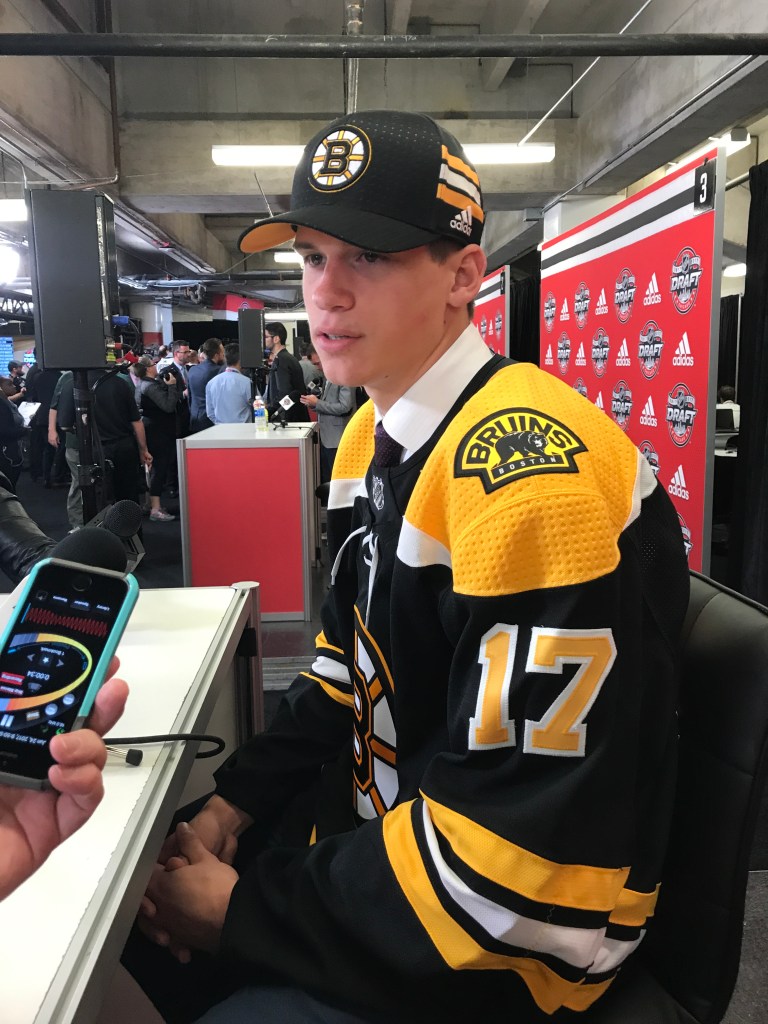
Here’s his post-draft interview with Boston sports media:

https://www.nhl.com/bruins/video/press-room-mason-lohrei/t-277437088/c-6794459

Reed Duthie: Breakout Bruins- 8 Who Could Make an Impact in Boston in 2021

Guest post by: Reed Duthie

After a tough Game 5 loss to the Tampa Bay Lightning eliminated the Boston Bruins from the 2020 NHL Playoffs thoughts immediately turned to what the roster would look like for the 2020-21 season. Many names have already been tossed about from outside the organization as fans look from their perspectives to who could improve the Bruins and push the team over the top to a Stanley Cup Championship.

With the attention on players coming from outside the Bruins organization, it should be equally of interest who could come from within the organization and have their breakout moments to improve this team.

The forward group will likely see the most potential turnover with Joakim Nordstrom unlikely to be back and questions surrounding the likes of where Nick Ritchie, Chris Wagner & Par Lindholm fit into next year’s lineup, if at all, and the RFA status of Jake DeBrusk.

Zachary Senyshyn – In the Tampa Bay series it became clear that the Bruins needed more size and physical presence in the offensive zone but that it can’t come at the sacrifice of speed. Enter Zach Senyshyn, the controversial 15th overall selection in the 2015 NHL Entry Draft recorded back to back 40+ goal seasons in the OHL with the Soo Greyhounds but since arriving full time in Providence has made it a mission to become better in his 200-foot game. Although the offensive numbers haven’t jumped off the page in the AHL, Senyshyn combines a 6’3”/193lbs frame with incredible straight line speeds and the knowledge of how to use both. Able to blow by defenders around the outside, Senyshyn brings the willingness to drive straight to goal with the puck and create in the dirty areas. The Bruins could have a breakout, forceful player on their hands as his professional development has come along but could also have a bigger, more physical version of former Merlot-line favourite Dan Paille, either way Senyshyn has earned a long look.

Trent Frederic – A player who just screams Boston Bruin, following in the tradition of the likes of Wayne Cashman, Terry O’Reilly & Stan Jonathan, Frederic loves to mix it up physically but also brings excellent offensive instincts and the knowledge of how to use a 6’2”/203lbs frame to his advantage. The 29th overall pick in the 2016 NHL Entry Draft, Frederic has garnered a lot of attention for posting 215 penalty minutes in his last 114 AHL games, becoming one of the more feared players in the American Hockey League. What has gone under the radar is the 57 points (22 goals) the hulking 2nd year pro has posted in the same time frame. Able to control the puck in a phone booth, Frederic’s size, whole ice game and cycle ability would appear to make him a perfect potential match for Charlie Coyle on a 3rd line that could become very hard to handle for bottom pairing defenders.

Jack Studnicka – He may well end up being the steal of the 2017 NHL Entry Draft, selected 53rd overall and Jack Studnicka has come a long way in a very short time. The rookie pro suited up in 60 games for the Providence Bruins recording 23 goals & 26 assists for 49 points while turning heads in the process. Playing with a super-computer between his ears it isn’t hard to see why the Windsor native has drawn many comparisons to current Bruins legend and future Hockey Hall of Famer Patrice Bergeron. Studnicka brings a far advanced defensive game for his age and offensive acumen, and showed in his 5-game playoff cameo for the Bruins in 2020 that he clearly belongs in the National Hockey League. Likely to start his career on the right-wing, it won’t be long before Studnicka patrols the middle of the ice as a key player for the Bruins.

On the blueline, the Bruins may not wind up with an obvious opening but do have at least a trio of young players pushing to open one with all three players bringing different styles to the table.

Jakub Zboril – Having spent the last three seasons with the Providence Bruins, the former 13th overall selection in the 2015 NHL Entry Draft has had injuries derail a potential run with the NHL team on more than one occasion. Despite the potential for frustration, the physical rearguard has kept working, consistently improving his game over his three seasons in the AHL and by the time the 2019-20 season was put on hiatus Zboril was pushing for another opportunity in Boston. Fleet of foot with the ability to move the puck quickly and confidently from his own zone, the left-hand shot defender plays with a mean streak that would make you think he’d just stepped in the wasp’s nest. At 6’0”/200lbs, Zboril brings strength to the back end and would be more than able to move attackers from the front of the net which is what the Bruins came out of their series against Tampa Bay looking for more of. Zboril will also have a running start at the 2020-21 season beginning his year in the Czech Extraliga.

Urho Vaakanainen – Another defender who has seen opportunities to stick in Boston cast aside due to unfortunate injury, the 17th overall selection in the 2017 NHL Entry Draft is a tremendous skater who can get up and down the ice effortlessly while combining with a 6’1”/185lbs frame that allows Vaakanainen to win his share of board and net battles and excellent hockey IQ to see and read the game. While in Finland, Vaakanainen showed an appetite to consistently improve and moved from Blues to JYP to SaIPa to get the kind of ice time he felt he would need to be able to take those steps. Vaakanainen has now played 84 in Providence and an additional 5 in Boston and while his offensive output hasn’t taken a step forward the rest of his game has. An opportunity with the big club combined with some luck on the health side could see the left-hand shot Finnish rearguard become a trusted piece at even strength and the Bruins penalty kill and at just 21 years of age could be a Bruin for a long time to come.

Nick Wolff – As Kirk Luedeke has mentioned on the Amigos Podcast many times before, “Winners Win” and Nick Wolff is a bonafide winner. The towering 6’5”/230lbs left-hander has won 2 NCHC Championships and 2 NCAA National Championship while being a key piece of the on & off ice leadership for the UMD Bulldogs, including serving as the captain for the 2019-20 team. As mean and nasty as they come, Wolff won’t provide the fleet footed skating of a Zboril or Vaakanainen but will remind fans of a new age Adam McQuaid. Able to get by on his skating, uses his off the charts size and strength to make life miserable for opposing attackers and is able to clog both shooting and passing lanes with his massive frame. If the Bruins are just simply looking to get meaner and nastier in their own end, they may uncage a Wolff and let him loose on their opposition.

With Tuukka Rask & Jaroslav Halak both under contract there doesn’t appear to be any room for another goaltender to make his name on the 2020-21 Boston Bruins, however any crack in the window may provide the real opportunity for 1 talented keeper of the cage to make his mark in the NHL.

Daniel Vladar – Originally drafted in the 3rd round, 75th overall in the 2015 NHL Entry Draft, Vladar has taken his time moving through the Bruins system but the 2019-20 season appeared to be the lightbulb moment for the 6’5”/185 netminder. Over the course of 25 games with the Providence Bruins, Vladar would post an incredible 1.73 GAA & .936 SV%. Thrust into a tough spot in the playoff series against the Lightning, the greater hockey world didn’t get a fair look at the potential Czech star and any injury to Rask or Halak that could allow Vladar an opportunity in the 2020-21 season could see Bruins fans potentially have a look into the future of the crease.

Every year there appears to be a surprise at training camp or at some point in the season when a player seems to find themselves and goes from dark-horse to stud. If the Bruins have a dark-horse in camp it very well could be a talented Slovakian.

Robert Lantosi – An older prospect at 24, Lantosi arrived with the Providence Bruins for the 2019-20 season where he really impressed posting 11 goals & 21 assists for 31 points over 50 games in his rookie season in North America and was rewarded by the Boston Bruins with an NHL contract (albeit 2-way) but with the potential he could see time on the RW for the NHL squad. Leaving Slovakia at 17 for the Vasteras program in Sweden before returning 5 years later and subsequently becoming a star for HK Nitra, Lantosi is well travelled and has blended natural talent with a responsibility to a three-zone game and a very mature outlook for a 24-year old. While he may never be an NHL superstar, Lantosi could provide offense in a bottom-6 role where his talents would make him a solid addition to a Bruins team that likes to roll 4 lines.

TSP Podcast: 4 Amigos Boston Bruins Playoff Preview

Got the gang together this week to discuss the Boston Bruins, return to play and their chances in the 2020 NHL Playoffs.

Unfortunately, we had some glitches in the recording and some good stuff was lost- apologies for that, but you still get nearly an hour of solid hockey talk.

Plus, there’s a brief commentary at the end on the Anders Bjork 3-year extension at $1.6M AAV- which broke after we recorded. Once again, Don Sweeney’s cap maneuvering is serving as an example for the rest of the league to get in line with.

So, away we go with Dom, Reed, Anthony & Kirk- Welcome Back, NHL…