Time to go- Bruins raise curtains on 93rd season with new faces, youth movement

New Englanders tend to be realistic (pessimistic?) by nature, so while the focus has been on the defense and the potential for gaping lanes that skill teams will find available to them, as the 2016-17 NHL season begins for the Boston Bruins tonight in Columbus, Ohio, there’s some excitement swirling around the big league debuts of four players in the lineup.

Injuries to Patrice Bergeron, Adam McQuaid and Kevan Miller have opened the door for a pair of forwards in Austin Czarnik and Danton Heinen, and a defense duo of Brandon Carlo and Rob O’Gara to get their first taste of NHL action against the Blue Jackets. Bergeron is expected back in the lineup for the weekend action versus Toronto and rookie sensation Auston Matthews, who last night became the only player ever to score four goals in his first NHL game. McQuaid and Miller will be out a little (in the former’s case, a lot for the latter) longer, so we temper the eagerness with which we greet the young rookies with the belief that perhaps half of them have a realistic chance of staying on Boston’s roster for the duration of the season.

In Czarnik, the B’s have a fast and skilled little (emphasis needed) center who was snubbed in the NHL draft, but looks like a pretty savvy pickup after four years at Miami University, the last two of which he wore the captain’s ‘C’. He took a high hit from behind that targeted the head in the final preseason game by Philadelphia defenseman Radko Gudas (he got a six-game layoff from the NHL’s department of player safety) but cleared the concussion protocol in time to play in his first big league game. Czarnik is a classic little engine that could as a player who always had to overcome size bias to work harder than just about everyone else to hone his skills and three zone game. After a 61-point first year in the AHL, he’s made the initial cut to stick in Boston, and that’s the stuff NHL dreams are truly made of. Czarnik is an exciting buzzsaw of a forward- he zips in and out of lanes and can put the shake n’ bake on less-agile defenders. When the puck is on his stick, he brings a similar kind of playing style to that of Brad Marchand. Note- we’re not saying he is the next Marchand, but you can see it in the way he uses his speed, vision and hands to create and give opponents fits. He’s not the abrasive agitator Marchand is, but Czarnik is a big man trapped in a little man’s body who plays the game with heart and energy. Fans love an underdog, and when coupled with Czarnik’s electrifying offensive element, it’s not hard to understand why so many are jumping on the AC Train.

More was expected of Heinen and he entered training camp as a prohibitive favorite to win a spot with the big club, but he is also a feel-good story. Passed over in his first year of NHL draft eligibility in 2013, the British Columbia native hit a significant growth spurt and then opened eyes as captain of the BCHL’s Surrey Eagles. The Bruins liked Heinen enough to snatch him in the 2014 draft’s fourth round despite his being an almost complete unknown in NHL draft pubs. The rumor at the time was that several other teams were hoping to steal Heinen later on, not the least of which was none other than the Montreal Canadiens. That story isn’t verified, but damn- it feels good to B’s fans to hear it. Heinen is a thinking fan’s hockey player- he’s not especially fast or dazzling in the way he handles the puck, but he goes to the right spots, moves it to the correct spaces and plays a quietly effective and productive three-zone game. He’s the quintessential Claude Julien-style forward because he’s both intelligent and efficient. If you’re expecting to be entertained by Heinen, you’ll probably wonder what the hype is about, but if you watch the wall work, the way he slices through layers of defenses and puts himself in position to make plays at both ends of the ice, you’ll gain an appreciation for him.

On the defensive side of things, Carlo is a favorite of those B’s fans who religiously follow the NHL draft and Boston’s prospect development system. Picked 37th overall in 2015, he looks like a brilliant pick in hindsight as his natural 6-foot-5-inch size, mobility and reach instantly jump out at you. Back in 1997, a young Hal Gill caught the eye of fans because he was 6-7, and was the biggest cat in the NHL before some guy named Zdeno Chara showed up on Long Island about a year later. The thing about Carlo is that while he’s not quite as tall as Gill, he’s a better skater and has long arms, therefore brings a similar reach. Fans are excited about Carlo because he’s big and fluid and does a real good job of keeping opposing forwards from walking straight to the net…a turnstile he is not. The jury is out on how much offensive hockey sense/creativity Carlo has, but he’s certainly not limited in terms of being able to handle the puck and join the rush. Having said all that, there will be natural growing pains as is with the case with any 19-year-old defenseman, but to the Coloradan’s credit, he impressed a year ago in his first NHL training camp and exhibition season and then carried that forward to make the Boston Bruins before age 20. He’s not a snarly, intimidating beast on the physical side, but he will rub guys out and is sure to be well-liked in the dressing room because he’s got an even-keeled personality.

Last but not least is O’Gara- a TSP personal favorite going back to 2010-11 when he left the Long Island Royals AAA midget program to win a prep championship with the Milton Academy Mustangs. The B’s drafted him with the final selection of the fifth round, and he was described by then-assistant GM Don Sweeney as a “big piece of clay” that required a great deal of molding and shaping. Five years later, the 23-year-old Yale grad might not be a finished product, but he’s close enough and tonight will earn a status no one can take away from him- NHL player. O’Gara is a good skater- it’s less about speed and stride with him than it is fluid and agile footwork, which allows him to pivot and change direction quickly and efficiently. He’s got size and reach…and he can make an effective outlet pass to aid in the transition game. Like Carlo, there are sure to be mistakes and mishaps, but O’Gara is smart and motivated- he’s a quick study and character guy who has been around long enough that he understands the system and is ready to prove himself. It might mean more of an apprenticeship in Providence when other players return, but for now, O’Gara has earned the opportunity and will begin on the second pairing with Torey Krug on the right side (ROG shoots left, so it speaks volumes about the level of trust he’s earned that the Boston coaching staff is fine with him playing his “off” side).

David Backes will skate on a line tonight with Marchand and David Pastrnak if nothing changes between now and puck drop, and with Bergeron out (albeit temporarily), maybe bringing in an experienced veteran center wasn’t such a bad idea after all. David Krejci has a great deal to prove, and with Heinen and Ryan Spooner flanking him, there’s no shortage of offensive creativity on that unit. Spooner’s speed is a welcome addition to the lessened pace of Krejci and Heinen, but the trio provide quite an intriguing matchup on paper. All three of them are or have been centers before, so that’s a line that gives Julien a lot of flexibility and versatility.

Czarnik will likely test his NHL mettle with Matt Beleskey and Jimmy Hayes. Beleskey doesn’t have the high-end skill to put up big numbers (and he’d be on the top two lines in any event if that were the case) but he’s gritty and should develop some chemistry with Czarnik. Hayes is the wild card- the B’s desperately need a revival from him this season much like Reilly Smith had with Florida a year ago. It would be foolish to think that Hayes doesn’t want to make it work in Boston, but he’ll have to shrug off the external pressures and get down to the basics by just doing what he does best. He doesn’t have either of his linemates’ wheels, so it will be interesting to see if they have some set plays to leverage Hayes as a trailer into the zone with his soft hands and big shot.

Tim Schaller is back up with Boston with Bergeron out and may get a chance to skate with Noel Acciari and Dominic Moore, but the guess here is that Riley Nash will round out the fourth line. It’s not a nasty unit in terms of abundant physicality, but they’ll all grind it out and bring some veteran smarts to go with Acciari’s exuberance.

Defensively, the Bruins need their veterans- Chara, Krug and John-Michael Liles– to provide some glue for the younger guys- Carlo (Chara), O’Gara (Krug) and Colin Miller (Liles) as they shake out the butterflies and deal with the immense difference in speed, skill and pace from what they are used to. Chiller got enough action in last year, and Joe Morrow is also around to step in should anyone get hurt or falter, but this is an untested bunch and the biggest source of consternation with the 2016-17 Bruins.

Tuukka Rask and Anton Khudobin were the tandem in Boston’s net the last time the B’s went to the Stanley Cup final series in 2013, so there are no concerns with the talent or experience. They can’t carry a team on their backs, though- so everyone will have to row hard in the same direction. If the talent gap becomes too great, then Sweeney will have to act at some point.

That’s all going to have to wait for the time being, because this is what the B’s are going with to begin the new season.

As the Dropkick Murphys so aptly like to belt out- drop the puck…it’s time to go. (Thanks BruinsBabe176)

2016-17 Boston Bruins preview series: the Centers

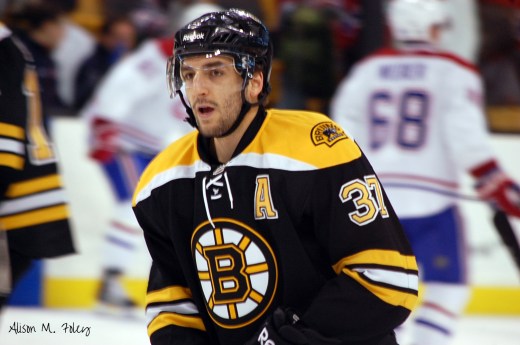
Patrice Bergeron is Boston's "Mr Everything" (Photo courtesy of Alison M. Foley)

Patrice Bergeron is Boston’s “Mr Everything” (Photo courtesy of Alison M. Foley)

The NHL season is around the corner, and for the second consecutive season, the Scouting Post blog is back to provide the season preview and deeper look at the Boston Bruins from a position-by-position perspective. The team will soon break training camp on the 2016-17 NHL season at a brand-spanking new practice facility- the Warrior Ice Arena- in Brighton, and although the World Cup of Hockey is up first, there is no shortage of subplots and storylines swirling around this Bruins club.

Given the optimism surrounding the team at forward, we’ll start with the centers. Now, some might take issue with beginning the series from what is Boston’s greatest area of strength, but I started with the goaltenders last year, so there is a method to the madness.

Unlike last year, I am including an audio component to each post, so that allows me to write less and talk a little more, which will save me from carpal tunnel, but will also go a little easier on your eyes. So, without any more foreplay- here we go.

The Bruins are strong at the center position up and down the roster. They don’t have any flashy, dynamic types, but in Patrice Bergeron, have the best two-way pivot in the game, despite what Selke Trophy voters last year would have you believe. David Krejci is the ole reliable playmaking center, but with offseason hip surgery casting his season in doubt, there are some concerns about his durability, especially as he is entering the new year on the wrong side of 30. The B’s big-money free agency ticket item from the summer, David Backes, will be previewed both as a center and a right wing- but we’ve yet to determine where the B’s will slot him, and that promises to be one of the more intriguing storylines as the team breaks camp. Ryan Spooner currently holds down the third center spot, and the fourth line pivot is wide open. Noel Acciari finished the final 19 games of the schedule after recovering from a shattered jaw in his rookie pro season, while fellow Providence College product Tim Schaller was brought in to provide competition in the offseason. The B’s also recently announced the signing of Dominic Moore to a one-year deal, and former 2006 eighth overall pick Peter Mueller, who is trying to make an NHL comeback after concussions and injuries derailed a promising start.

The B’s also have some interesting potential in the system. Whether you’re talking the tiny but ultra-skilled and feisty Austin Czarnik or the slick, cerebral 200-foot pivot in Boston University sophomore Jakob Forsbacka-Karlsson, the B’s have a couple of options that might not be as far off on the horizon as one might think. Neither is likely to have a great impact this year (though Czarnik is in the AHL and is a dark horse to make some noise and see some NHL action after his excellent rookie pro season), but both Czarnik and JFK are mature players who are likely to work their way into the mix sooner rather than later. The latter player has already drawn comparisons by people in the Bruins organization (as well as some outside the club) to Bergeron, which is a high bar to set for the Swede.

In addition to Czarnik, Colby Cave is an effective two-way center who had a scoring role as captain of the Swift Current Broncos (where he lined up with B’s 2015 1st-rounder Jake DeBrusk) and showed some flashes of ability as a rookie in 2015-16. Sean Kuraly was a center in college, but is expected to shift to wing in the pros, now that he’s expected to start out in the AHL at Providence.

The B’s stirred up some dust when they drafted U.S National (U18) Team center Trent Frederic with the 29th overall pick. Interestingly enough, management (to include the departed former chief scout Keith Gretzky to Edmonton to be Peter Chiarelli’s newest assistant GM) likened the St. Louis native and University of Wisconsin-bound power forward to none other than his childhood idol Backes, who gave up the captaincy of the Blues to sign with Boston a week after the 2016 draft. In Frederic, the B’s get a big slab of beef at the center position for down the road, and if you believe his various coaches who rave about his intelligence and work ethic, there’s more than meets the eye here- he could be a late-bloomer, though don’t expect all that much in terms of production. The B’s also added huge Finn Joona Koppanen (6-5), but he’s more of a defensive clampdown specialist, so even if he makes the NHL, it’s not going to be as a scorer.

A project who will be worth the wait in terms of ceiling and offensive potential is Harvard sophomore and 2014 2nd-rounder Ryan DonatoWatch for the South Shore (Scituate) product to make some noise- this kid is the real deal, and we think he’s going to break out in Cambridge now that Jimmy Vesey has moved on to Broadway. TSP has been a huge fan of Donato’s ever since watching him first dominate the New England prep circuit in 2012-13 and then raise the bar in his draft season. He’s as intelligent and skilled as they come, and knocks on his skating aren’t fair given that he’s bigger than his dad (he gets his size from his mother’s side of the family and a former NFL linebacker uncle), but the hockey sense and hands are elite. Wisconsin junior Cameron Hughes and rising freshman Jack Becker (6th and 7th picks in 2015) are also in the mix as potential payoffs, but will require time and patience, and even then- neither might not ever make it as viable pros.

Outlook: The Bruins have ability and depth up the middle. Bergeron and Krejci (when fully healthy) give the B’s as good a 1-2 punch as any team in the league, but how Backes will fit into that dynamic as the potential third-line center (or whether he moves up and plays a top-two line RW role) remains to be seen. We also have to see how Krejci fares at camp; now that he’s been ruled out of the WCOH for Team Czech Republic, he has some extra time to heal, but if he’s not ready to go, then it’s a no-brainer: Backes moves up to the second line behind Bergeron. Spooner is the source of quiet debate- he appears to be the odd-man out here, as he’s not an ideal fourth-line center if Backes is 3C, and he is one of Boston’s few real trade chips given his youth, skill level and cap-friendly deal (though he’s up for a new pact in 2017). Dominic Moore is a 36-year-old veteran who could mean that Acciari goes back to Providence for more seasoning, and of course- the B’s added Mueller to a PTO, though that is no sure bet that he will even sign or play center for them. Schaller is a wild card for the fourth line as well, but if he’s going to make the Boston roster, he’ll probably need to do it on the wing somewhere.

All in all- center will be the absolute least of Boston’s worries this season, as the team has talent, experience and a roster to weather injuries and unexpected setbacks.

Now, listen to the pod for more (and working on getting these exported to SoundCloud for those who want to do download and listen later- bear with me- it’s coming):


Jakob Forsbacka-Karlsson aka "JFK"

Jakob Forsbacka-Karlsson aka “JFK”


A look at the 10th Boston Bruins development camp Pt 1: the G and D

Boston Bruins GM Don Sweeney didn’t invent the idea of bringing young prospects in during July to acclimate them to the team’s systems, culture and begin the bonding process with their peers inside the organization, but he is the father of the development camp tradition in Boston, which began in the summer of 2007.

As the team’s top player development guru at the time, Sweeney’s vision has matured in the near-decade since the B’s brought in top picks Zach Hamill (ouch) and Tommy Cross, to mix in with the other prospects, five of whom went on to have fine NHL success and were a part of the 2011 Stanley Cup championship squad- David KrejciMilan Lucic and Brad Marchand, Adam McQuaid and Tuukka Rask. Here’s an old archive of that very first prospects camp, written by John Bishop– the recap provides a fascinating glimpse into the future at a time when so much was exciting and  new, including head coach Claude Julien.

10 years later, Cross is still with the organization and Marchand is coming off of his best NHL season to date, lighting the lamp 36 times for the Bruins and lining himself up for a lucrative extension that should see him earn about $6 million on an average annual value if the team can get something done with him before he becomes an unrestricted free agent next July 1. Krejci moved into the B’s all-time top-20 scorers this past season, and enters the new campaign in striking distance of 500 career points (he sits at 472). Krejci turned 30 in late April and there are concerns that his slight frame could be breaking down after the wear and tear he’s been subjected to since breaking into the NHL on a full-time basis midway through the 2007-08 season. A fourth member of that inaugural development camp- McQuaid- is another member of the championship team and has managed to carve out a solid NHL career with the Bruins after the team acquired him from Columbus (he was a second-round choice in 2005) before the 2007 draft for a fifth-round pick. Rask, who interestingly enough was outplayed by Kevin Regan in the final inaugural camp scrimmage, went on to earn the 2014 Vezina Trophy as the NHL’s top netminder and backstopped the B’s to the 2013 Stanley Cup final series after backing up Tim Thomas in 2011. That Rask gave up 7 goals on just 29 shots while Regan stood tall at the other end should serve as a reminder to everyone not to get too fixated on what happens during camp scrimmages.

Boston is middle of the pack when it comes to developing prospects, and in looking back on it, that very first development camp was the high-water mark for the B’s organization with five successful (impactful to Boston) graduates taking part. That number goes up if you include those camp participants who went on to see NHL success elsewhere (Vladimir Sobotka) or big league action at some point in their careers, some more than others (Matt Hunwick, Byron Bitz, Matt Lashoff, Martins Karsums, Andrew Bodnarchuk, Mikko Lehtonen, Hamill, Cross). When you consider that Lashoff and Karsums (and Bitz) were dealt for future Hall of Famer Mark Recchi and the pick that brought Dennis Seidenberg and Matt Bartkowski to the Bruins, it was a pretty impressive time for the B’s organization and foreshadowed that the team was on its way up, just four years from climbing to the summit of the NHL after being mired in the cellar.

Since 2007, development camp production has been a little more spotty- Joe Colborne, Mike Hutchinson, Jordan Caron, Tyler Randell, Tyler Seguin, Ryan Spooner, Craig Cunningham, Zach Trotman, Dougie Hamilton, Alexander Khokhlachev, Kevan Miller, Torey Krug, Seth Griffith, Joe Morrow, David Pastrnak, Noel Acciari and Frank Vatrano are all past Bruins prospects and camp attendees (2008-15) who saw NHL action in the 2015-16 season. There are more if you include players like Josh Jooris (Calgary) and Matt Read (Philadelphia) to name two, both of whom attended past Bruins camps as undrafted NCAA invites.

It is not lost on myriad fans that two of the most skilled and impactful players from that list- Seguin and Hamilton- are now skating and producing for the Dallas Stars and Calgary Flames. Krug, Pastrnak and Spooner are the biggest success stories as home grown players who all saw time in at least one summer development camp. Vatrano and Acciari might not be too far behind in terms of growing into regular contributors to Boston’s fortunes.

Since 2014, when the B’s drafted Pastrnak late in the first round and then saw him earn an NHL role at the tender age of 18, the draft process has looked up for the team and there is reason to look at some of the futures with more optimism than in the past.

Much has happened in the decade since Peter Chiarelli and Sweeney brought their first iteration of prospects to Wilmington, Mass. and not all of it good. However, that’s life- a series of ups and downs. The B’s lost their way during a critical period of unproductive drafts (2007-09) and then moved out some of their top young talent for nowhere near enough in return. The jury is still out on Dougie Hamilton, who turned into three promising picks in Zach Senyshyn, Jakob Forsbacka-Karlsson and Jeremy Lauzon (the first two of the trio will not be in attendance due to health and schedule conflicts).

While development camps are helpful to assisting the youngsters in preparing for the challenges that lie ahead as they transition from the amateur to pro ranks, they are not predictors of future NHL success. That remains largely up to the players themselves to beat out those ahead of them on the depth chart, or become footnotes in camp history the way T.J. Trevelyan, Levi Nelson, Chris Collins, Dennis Reul and Brock Bradford (among others) did from 2007.

2016 Boston Bruins development camp attendees at a glance (2015-16 club in parentheses)

The goaltenders:

Stephen Dhillon (Niagara- OHL): The lone invite this year as a player not drafted by Boston or under contract (he attended Detroit’s prospects camp this week, btw), the dual citizen from the Buffalo area is big, toolsy and was at one point projected as a top-90 pick in the 2016 NHL draft. He didn’t get much playing time and is still pretty raw, but might earn an NHL contract offer this summer if he can impress in his various tryouts. If not signed by the start of the new season, he’ll go back into the 2017 NHL draft.

Zane McIntyre (Providence- AHL): This is the former University of North Dakota star’s seventh Bruins development camp since he was drafted in 2010. After winning the 2015 Mike Richter award as the NCAA’s top netminder and finishing third in Hobey Baker voting as the top college player (behind Jack Eichel and Jimmy Vesey), McIntyre had a challenging transition to pro hockey. He was thrown into the fire early when Subban suffered a training camp injury and at times, McIntyre flashed the promise of a future NHL starter. He’s coachable and driven, so he’s going back to work on fundamentals and watch for him to bounce back in his second AHL campaign. Here’s a report on his Richter Award:

Malcolm Subban (Providence-AHL): Subban did not attend a year ago, but after suffering a fractured larynx during warmups in late January, he missed the rest of the season. This is an opportunity to help him get back into playing shape so that he’s not going into September training camp to face NHL shooters about 9 months after his injury. It’s more about helping him with his confidence and timing than anything else, and will give the Boston coaches additional time to help refine his technique.

Here’s his 2012 draft video from the YouTube :

https://www.youtube.com/watch?v=sNmXo0TqukI


Daniel Vladar (Chicago- USHL): The massive (6-5) Czech butterfly goalie and third-rounder in 2015 had a strong first North American season playing Jr. A hockey while splitting the Steel’s goaltending duties nearly down the middle. He’s so big and athletic that “Darth” Vladar is tough to beat on the first shot, but he’s got work to do with his technique (sensing a trend here?). At times, he appears slow to read the play and seems to be guessing about where the shot is coming from, so this is something B’s goalie coach Bob Essensa will likely work on with him. When on his game, Vladar is like a giant octopus who swallows pucks and impresses with his size and agility. He signed a three-year ELC last spring, so it remains to be seen whether he will play pro hockey in the AHL or ECHL (or Europe) or try to work a loophole that might allow him to skirt the CHL’s ban on import goalies to play in the QMJHL. We’ll see.More draft on Vladar from USHL:

https://www.youtube.com/watch?v=sNmXo0TqukI

Vladar highlights from 2015 Bruins development camp courtesy of “Power Play with CJ”:

The defensemen:

Brandon Carlo (Tri-City- WHL/Providence- AHL): Colorado native is already a fan favorite after being drafted 37th overall in 2015 as a big (6-5), fluid-skating shutdown defenseman. As a late-born 1996 who has already signed with Boston, Carlo is eligible to play the full year in Providence of the AHL if he doesn’t make the NHL Bruins out of camp. He’s a solid bet to play for Boston at some point this season, just because of his impressive pro hockey attributes and a mature outlook. He’s very difficult to beat 1-on-1 because of his mobility and reach, and while rugged in his style, isn’t an overly nasty or intimidating player. He’s still a little on the light side given how tall he is, but John Whitesides will get him NHL-ready real soon. Whether Carlo can evolve into a legitimate two-way threat at the NHL level or he becomes a solid, minute-eating defensive mainstay is the question we most want to see answered…all in due time. Here’s a nice draft profile on him from the Tri-City Americans:

And an isolation video of Carlo from the 2015 WJC (HockeyPwns):

Cameron Clarke (Lone Star- NAHL): The NAHL’s top defenseman and Ferris State recruit racked up 50 points this season for the Brahmas. He’s got an athletic 6-foot-2 frame with room to pack on some muscle to be able to handle the more rugged play at the higher levels. Although raw, Clarke is a heady, creative defender who skates with fluidity and can make all of the requisite passes in a rapid transition attack. He’s especially effective on the power play, where he uses his deft puck skills and lateral agility to create space and set up the play. He doesn’t have an overpowering shot yet, but is smart about when to use it and will strike when the shooting lanes are there. Clarke is more dangerous as a set-up man, where he quarterbacks the play with the man advantage and also uses his mobility and reach to deny opponents from gaining the edge and attacking with speed.

Matt Grzelcyk (Boston University- NCAA): TSP just published a comprehensive Q & A on the former Terriers captain and native Townie, but to quickly recap- he’s coming off of two significant lower body injuries that hindered him in his senior season. Even with the wonky knees, he still managed to match a career-best in goals with 10 and when healthy, plays an effective transition game with an improving defensive mindset. Don’t count him out in his quest to earn NHL playing time this season, though he’s realistic in what lies ahead and is prepared to do an apprenticeship in the minors first. Here’s a BU-produced video from his freshman season:

Grzelcyk given too much time/space at the 2015 Beanpot in OT:

His draft video from USA Hockey (and you just might recognize the voice on that 1st question):

Emil Johansson (HV71- Sweden): The 2014 seventh-rounder is a mobile, two-way defender who raised eyebrows late in the season and Swedish pro league playoffs when his offense came alive (3 goals, 5 points in 6 playoff contests). He’s got pretty average size with a 6-0, 190-pound frame, but skates well and is showing off some intriguing puck skills and potential. The hockey IQ/vision/creativity is a question mark at this stage, but since being drafted, the all-around game is progressing. He will skate for Djurgårdens IF next season and if he can keep his developmental curve headed up, Johansson might prove to be a late-round get worth signing and putting into the system. If you can speak Swedish, here’s a HV71 video interview from early in 2014-15 (nice footwork in the limited look):

Jeremy Lauzon (Rouyn-Noranda- QMJHL): For TSP’s money, the 52nd overall pick in 2015 with the third of three draft choices Calgary gave up for Hamilton, was one of that draft’s more impressive values. Even with a spate of injuries throughout the season, which included a scary skate blade cut to the neck during the ‘Q’ playoffs, Lauzon put up career numbers as the Huskies’ go-to defender and bell cow in all situations. He’s big enough at 6-2, skilled enough- he was one of the final cuts on Team Canada’s WJC squad after not even being a summer camp and December invite- and he plays a solid 200-foot game as a smart positional player with some bite. Bruins fans will grow to love him, even if he may or may not project as a high-end true No. 1 defender. If he hits on that potential however, it would go a long way towards silencing the unhappiness surrounding the trade with Calgary. He’s probably at least three years away, but if his progress is any indication, Lauzon will be worth the wait.  Have posted this before, but John Moore’s early 2014-15 profile is quite good:

Ryan Lindgren (U.S. NTDP Under-18- USHL): The Team USA captain and two-way rearguard was a great get at 49th overall in Buffalo. He’s similar to Lauzon in that he has no discernible flaws in his game and has a promising offensive upside that may not have been that appreciated by NHL scouts in his draft season. Though not all that tall at a little under 6-1, Lindgren is thick through the torso and has strong lower leg drive, which allows him to generate impressive skating speed and separate opponents from the puck. He’s so smart and instinctive- he pinches at the right times and understands his limitations. Lindgren will help you a lot, but he rarely hurts you.  The University of Minnesota-bound 18-year-old has high-end character and will do a little bit of everything, including playing with an edge that has caught some opponents unawares. Had he been 6-2 or 6-3, Lindgren would have been a first-round pick, but don’t sell him short as a player who could be more than the sum of his parts as a versatile defender who minus the size and reach, has the key attributes NHL clubs covet.  Here are some Lindgren U18 highlights (bigwhite06):

Draft video courtesy of the USHL:

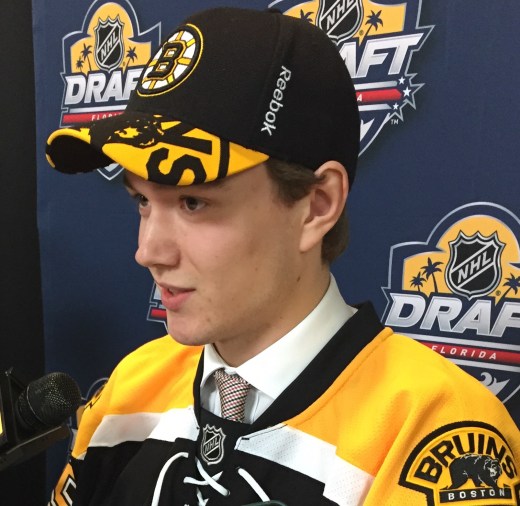
Charlie McAvoy (Boston University- NCAA): Boston’s top pick at 14 is generating a lot of buzz headed into camp and rightfully so. You can read more about him here, but the common thread for the youngest skater in college hockey last season is that he has both the skill and personality to be a fan favorite in the NHL if he hits on his potential. An excellent skater who likes to take the puck and run with it, McAvoy’s defensive game and awareness steadily improved over the course of the season. He still needs to work on his decision-making and not getting too aggressive, but with the B’s making a conscious effort to add speed and skill to their transition game, McAvoy immediately rises to the top of the organization’s prospect depth chart for the position, and is up there with 45-goal scorer Zach Senyshyn in terms of projected NHL impact one day. McAvoy will be the focus of development camp, and rightfully so- he’s earned that, and some NHL scouts have said that he is on the verge of a major breakout at BU in 2016-17. A pro contract with Boston might not be that far behind. Watch his selection on YouTube:

https://www.youtube.com/watch?v=5EexsIbRU3k

Wiley Sherman (Harvard University- NCAA): At about 6-7, Sherman is the tallest Bruins prospect, and he brings surprising agility and footwork for one so enormous. He’s still filling out that imposing frame and could tip the scales north of 240 pounds when all is said and done. The 2013 fifth-rounder is coming off of a solid sophomore season at Harvard, where he benefited from an expanded role with the Crimson under Ted Donato and showed off some intriguing flashes of two-way play. With his long reach and skating, he’s difficult to beat off the rush, but Sherman needs to make faster decisions in the face of a tenacious forecheck. The former Hotchkiss Bearcat was always going to be a long-term project, but you can see a payoff down the road as a lower-pairing defense-minded player who could form a nice tandem with a more skilled offensive partner. With the size you simply can’t teach, there’s enough raw material with the Connecticut native to wait for.

Jakub Zboril (Saint John- QMJHL): Boston’s top choice in 2015 has a nice opportunity to demonstrate that some of the concerns about him after taking a step backwards offensively are unwarranted. On the plus side- the 19-year-old Czech is big, skates well and plays with a physical edge that is not typical of many European teens that come over to North America. He showed more two-way promise in his draft season, but did settle into a more defensive role this year before coming out of the shell to impress with some key playoff production. The big knock TSP has on Zboril is not unique to 2015-16, however- too often, the effort and compete aren’t where they need to be. This is not a matter of trying to downplay his potential, and before pointing out his youth, the road to the NHL is paved with similar impressive talents who for whatever reason, simply did not have the requisite personal discipline and dedication to live up to where their talent got them drafted. With his skating, passing, shot and physicality, Zboril still has top-two NHL defense potential. He’s at a key personal crossroads this season: he’ll have to start showing everyone that he’s capable of more consistent execution and effort in all three zones and is willing to put in the work to round out the parts of his game that aren’t NHL-quality yet. If he can do that, there’s reason to believe that Zboril will succeed, but he was the 13th overall selection for a reason- he needs to start putting it together. As a 1997-born prospect, he cannot play in the AHL for Providence this season if he doesn’t make the NHL roster out of camp. Another John Moore profile from Zboril’s draft season:

Highlights package from the HockeyVidz:

Rob O’Gara is not in attendance- he has “graduated” and will focus on making the Boston Bruins roster in the fall after finishing a four-year NCAA career at Yale. TSP has a more in-depth profile on the Long Island native coming this week, so if you’re disappointed that he won’t be there, we’ve got you covered.

But before that- coming soon- TSP will break down all of the forwards at Bruins development camp.


3 Amigos Podcast: the Free Agency edition

The 3 Amigos ride again!

Dom, Reed and I are back with our 3rd podcast together, recapping the 1st week of NHL free agency with a decided Boston bent, covering David Backes, Anton Khudobin, Riley Nash, Tim Schaller and Alex Grant to name a few. Dom will tell you why he thinks Khudobin for two years, beyond the solid addition of a proven backup, has key implications for Malcolm Subban not getting snapped up in the expansion draft.

We also issue a Danger, Will Robinson! alert to fans of the Edmonton Oilers as we look at the impacts of recent signing and additions to that club’s cap picture and we see some eerie parallels to how it all came unraveled in Boston.

We also discuss (about 55 minutes in) the Bruins and Don Sweeney’s still pending move to upgrade the NHL talent on defense- that kind of a move to shore up the club’s right-shooting depth chart has been curiously lacking. Dom mentions an interesting name with Ontario connections and Reed has had plenty of looks and shares his thoughts on why this particular player (an RFA) might be a stealth target of the Bruins via trade.

All in all, it’s a little over 90 minutes of hockey talk, unvarnished and calling it like we see it. Ole!

Getting to know David Backes

When the news broke Friday in the NHL’s annual free agent extravaganza that the Boston Bruins agreed to terms with former St. Louis captain and center David Backes, any optimism that the team might be acquiring a player with a great deal of experience and an impressive body of work as a top two-way forward and leader was tempered with concerns about the 32-year-old’s five-year, $30 million pact.

Regardless of what side of the fence you come down on, the 6-foot-3, 225-pound veteran is a multiple 30-goal scorer who spent his entire career with the Blues after being the 62nd overall selection in the storied 2003 NHL Entry Draft, the same one that saw new teammate Patrice Bergeron selected 17 spots ahead by the Bruins in Nashville.Now, 13 years later, the most senior member of the B’s was credited by Backes as one of the key players who reached out to him this week and helped sell him on leaving the only NHL home he’s ever known to try and get Boston back on a winning track.

“He, personally, was one of the guys that I was able to talk to,” Backes said in an afternoon conference call. “I can maybe flatter a little bit now that he’s my teammate, but I hate giving players credit, giving them any edge, when I’m playing against them. But he’s a guy you were pissed at by the end of the game because he never made a mistake. That’s a good way to be successful defensively and then, by the end of the game he typically was producing something [on the] offensive side of the score sheet, too – just a guy that you can’t take a shift off because he’s going to make you pay.

“If you’re going to get anything done against him, he’s always in the right spots, he’s winning draws against you, he’s a fearless competitor, he just keeps going and keeps his mind focused on what he needs to achieve during the game. He’s a winner. He’s won a gold medal, to my dismay. He’s also won a Stanley Cup. You can’t discredit any of those great achievements that he’s had.”

That Backes would have such immense respect for a player of Bergeron’s caliber is not surprising in the least. Natural competitors and leaders gravitate towards one another, after all. And, as the Minnesota native would later reference in his various remarks, those leaders are the ones most responsible for instilling and maintaining a winning culture that everyone in the room gets on board with.

“We need a cohesive leadership group that’s made up of prominent players that have a loud voice and walk the walk and not just talk the talk,” he said. “If you have that – a good four to five guys with those qualities – the rest of the team has no option but to jump on board and fall in line. If that’s what you have, that pretty much cracks the whip on everyone else and that’s going to breed a ton of success.”

Leadership and character alone is not enough, however. Immediate concerns about the signing have cropped up primarily related to the newest Bruin’s age and diminishing returns in terms of his statistics, finishing the year with 21 goals- his lowest output since the lockout-shortened 2012-13 campaign.

“Feeling really well,” Backes replied when asked about the toll his rugged brand of hockey over more than a decade has taken on his body. “I think that physical style has been one of my calling cards for 10 years, and I think maybe if you start to slow down a little bit, and you get a little bit older, your intelligence and your hockey sense and your ability to think the game is accelerating maybe faster than you’re slowing down. And those types of efforts to be efficient I think make – in my world, I think it’s made me a better player, and been able to carry that physical play and pick my spots at key moments, rather than just hitting everything that moves like it’s a rugby match.”

In other words, the old horse isn’t ready for the glue factory quite yet.

“Being able to perhaps finish on certain guys on the other team and other ones, it’s not worth going the extra two, three steps out of your way to expend that energy and to go for that hit,” Backes said.  “I’m 32. I’m not 52. I think there’s plenty of legs and plenty of physicality and energy left in me and the term’s been something that maybe a few people have questioned, but for me, I expect to still be at the top of my game for that last year and be a contributing member for the Boston Bruins and training differences, being able to really take care of my body, listening to it and just give everything I’ve got and I think that’s the way I’m going about it and I would expect to be really good in that fifth year still.”

All the heart and want to in the world won’t matter if the machine breaks down or the player is unable to match the previously high-end performance that he was known for as a member of the Blues who spent the last five years wearing the captain’s ‘C’.

Boston GM Don Sweeney naturally sold his signature acquisition to date as someone who will be part of a winning formula going forward, even though the more pressing need of at least one defensive piece to upgrade the back end was conspicuously absent from his list of transactions today.

“We identified David from day one as the type of player that would play with and complement Patrice and David Krejci and allow us to have flexibility, be it this year with, you know, if he wants to move to the wing in a production role or a matchup role,” Sweeney said.  “You know if you look at the defensive zone starts that David Backes had over the course of his career, it’s phenomenal that he’s produced at the level he has. He’s now got the chance now to play either with Patrice or David Krejci or play amongst them in a balanced lineup that allows him to be in an offensive situation with Krejci and maybe even backup Bergeron from that standpoint. So I think it adds the balance to our group, you know. And if Ryan Spooner continues to emerge and play the way that he’s capable of playing on a consistent basis and David Backes moves to the wing we’re going to be a better organization.”

Despite some of the more advanced analytics that showed Backes’ effectiveness in positive puck possession declining, Sweeney pointed out that the veteran still represents a clear upgrade for the B’s going forward.

“We have on the horizon a number of young, skilled players that I think will benefit, as I mentioned, will continue to play with Marchand, with Bergeron, with Krejci, and now with a Backes type,” Sweeney said. “He can then slide into players that come in and identify themselves handling bigger roles, then he can slide into different positions. I just think the versatility of this player and the leadership qualities speak for themselves.

“And his production, we expect it to continue. It took a drop this year, but that’s the age-related studies that everybody looks at and realizes that you know what you’ve signed up for in this player, that if the commitment to the term and from the ownership standpoint, we were all on board. We’re trying to win. The number of players we have, as I mentioned, with the younger players, I think it’s going to be a good complement.”

Not always the most fleet of foot, Backes is one of those more powerful skaters who uses a full head of steam to drive the net and score goals through grit and will as opposed to generating a highlight reel package off the rush. As he gets older, the foot speed and quickness are sure to diminish, so Backes addressed what is likely in store with him in the lineup.

“I don’t think the game’s getting slower,” he said. “I think that it’s a fast game, but if you start to manage the puck in the right way, and you can occupy the offensive zone and do a lot of the things that teams that are heavy and control the puck and occupy zones do, it’s not a track meet up and down the ice.”

The track meet…something the Bruins have been ill-prepared to compete in for years, even as the NHL has undergone a clear paradigm shift to more of a speed/transition and skill game, is one of the chief concerns among observers and fans who saw the team often unable to match the pace and tempo of those higher-end clubs who were among those playing well into late May and June.

“With Pittsburgh winning the Cup, a team that was kind of designed on that track meet, let’s go, let’s see who can skate the fastest up and down the ice, there may be a trend or a tendency to start to build teams like that,” said Backes.  “But you’ve also seen other teams in the L.A. Kings, the Boston Bruins, in recent history, win playing that heavy game, and maybe not having the fastest team, but winning every battle that you get into, being able to control the puck once you get it and then owning the important areas of the ice which is in front of the net.”

The consistent net-front presence, which is something Backes is sure to provide, is another area the Bruins have been lacking in. They’ve also lacked a consistent set of forward lines, which is something the newest free agent vowed to address, even though there was discussion about what position might have been promised to him ahead of time.

“I’m into winning games, so if Claude (Julien) thinks that we’re going to win more games with me playing wing then I’m in,” Backes said.  “If he thinks that we’re going to win more games with me playing center, I’m in. Whatever he thinks, you know, I’ll do it to the best of my ability. And you know it’s one of those things where it may be schedule dependent, it may be opponent dependent, it may be dependent on a bunch of different variables, but we’re going to have a game plan to win and we’re going to go out there and execute it.”

Sweeney echoed the sentiment of being flexible and basing it on ideal matches, allowing the coaches to leverage the veteran’s flexibility.

“We’re going to let it play out,” he said. “We look at the fact that the penalty killing was an area that we needed to address. He’s really good at that.”

Center or wing? Wing or center? Don’t expect to have it figured out in July.

“The strength up the middle of the ice, as I mentioned. Ryan Spooner, it will be a great challenge for him to occupy that spot or play next to one of these centers,” Sweeney said. “The guys that emerge as being able to handle the minutes and the situations are the ones that are going to play. It’s just a real good opportunity for anybody, any younger player coming into this organization is going to be put in position to play with really unique players. And we’ll find the right complements.

“If that means David gets to move to the wall to play with one of the top two guys in a producing role, that’s okay. We’ve now been in a position where if we want to go four deep, which we generally have when we’ve had success, where’s the matchup come from the other side? The other teams may find it difficult to play against the top centers that we have. So we’re going to let it play out.”

Ultimately, there are those who will embrace Boston’s newest acquisition and what he could bring the team, even if they acknowledge that Sweeney and Co. are accepting risk by offering term and value on a player who is on the wrong side of 30. Those are entirely valid concerns, but at the same time- it is not a zero sum game. Backes is a hands-on leader who will complement Boston’s existing leadership core, several of whom tend to be a little more quiet and passive as opposed to direct and confrontational. The B’s have no problem with leaders who set the right example, but when players aren’t pulling their weight or doing the things necessary for team cohesion and success, Backes is the kind of guy who will likely get in someone’s face. He’s got the proper body of work and cachet to do it, too- whether he wears an ‘A’ on his Bruins sweater or not won’t matter one bit.

“You talk about the character piece, the leadership qualities and his willingness to want to win and it aligns with the guys that have won,” Sweeney said. “And the more we can surround our team and identify our team in that regard – now, this all being said, that our younger players have to step forward, emerge, have the opportunity to take a hold of it, and these guys are going to be the leading core to get us to where we want to go, and our younger players have to jump on board.”

Backes sees the world in relatively straight forward fashion, and that was evident when he addressed his desire to make Boston his new hockey home:

“Every time I had a conversation with someone from the organization, that kind of goosebump feeling on your arms and that emotional connection and thought process towards what it would be like to maybe have a different sweater and be able to join what they’re trying to do in Boston really just kept building,” Backes said. “And then the opportunity presented itself not too long after 11 (a.m.) struck. Once (the agent) and Don Sweeney figured out the numbers, it was let’s move on with this and sign the deal because it makes so much sense on so many levels.”

This signing might not make sense on as many levels to some, but one of Boston’s priorities in the offseason was to get tougher to play against, and they succeeded on paper with the Backes acquisition. Time will tell if it will work out as planned, but for now- one veteran is in the fold to help shore up an offense that lost Loui Eriksson’s 30 goals and strong two-way play to Vancouver.

There is still much work to be done, however, with a blue line that is still at least one key upgrade away from being playoff caliber.

The July 1st transactions were a start, but the offseason grade is still incomplete.


2015-16 Boston Bruins in Red Line over the years

I have every Red Line Report draft guide going back to 1999, the first year that the service issued the guide in its known format.

Periodically, I go back and look at what the draft year scouting reports and rankings looked like, so I thought that to help get the juices flowing in anticipation for the 2016 draft (as if the B’s draft strategy post from last night wasn’t enough, right?) I’d do the exercise for all of you here on the blog and take a trip in the wayback machine (or in the case of David Pastrnak– not so wayback) and see what you all think.

I’ll do it in numerical order on the Boston roster, so here we go:

11- Jimmy Hayes, RW Drafted: 2008 (2nd round- Toronto)

Red Line ranking: 146

Key comment: “Huge kid with good hands has wasted a lot of talent.”

2016 verdict: At the time, 146 was excessively low for where the Leafs drafted Hayes, but he hasn’t exactly proven RLR wrong, either. Few players did more to frustrate observers this season than Hayes. He’s huge but doesn’t play to his size, but the biggest issue was with how his offense cratered at crunch time. It’s tough to play with heightened expectations and pressures that come with coming home to be on the team you dreamed of skating for, but Hayes has the raw material to at least become a more consistent contributor going forward without the profound peaks and valleys he went through.

14- Brett Connolly, RW Drafted: 2010 (1st round- Tampa Bay)

Red Line ranking: 13

Key comment: “Great talent; only injury keeps him out of top-5.”

2016 verdict: Connolly has been anything but a “great” talent as a pro. It’s hard to fathom where the sixth overall selection six years ago went wrong, but he might be out of time in Boston, even though he only recently turned 24. If the B’s could figure out a way to get him going, it would be huge for them. He’s been a huge disappointment thus far, if not an outright bust given how highly regarded he was by just about everyone in 2010.

20- Lee Stempniak, RW Drafted: 2003 (5th round- St. Louis)

Red Line ranking: Not ranked

2016 verdict: Oversight! Stempniak has been a serviceable NHL winger since breaking in with the Blues in 2005-06 after Dartmouth. He’s played almost 800 career NHL games for 9 teams- the modern-era Brent Ashton.

21- Loui Eriksson, RW/LW Drafted: 2003 (2nd round- Dallas)

Red Line ranking: 59

Key comment: “Came on like gangbusters down the stretch.”

2016 verdict: Eriksson was one of Boston’s top players last season, and despite not being traded at the deadline, was a good Bruin after being the central piece in the disastrous Tyler Seguin return from 2013. At 31, he’s set to cash in on a free agent payday, which means it won’t happen in Boston, but he’s performed well ahead of the 59th overall projection from 13 years ago.

23- Chris Kelly, C/W  Drafted: 1999 (3rd round- Ottawa)

Red Line ranking: 78

Key comment: “Tenacious and relentless in puck pursuit.”

2016 verdict: Although a broken femur cost Kelly all but 11 games of the 2015-16 season, he has gone on to have a successful NHL career as a checking center who was a key contributor to Boston’s Stanley Cup championship in 2011. The veteran has been a Boston scapegoat because of the 4-year contract extension he got in 2012 coming off a career-best 20 goals, but he’s been pretty much exactly what RLR said he would be and has always brought character and leadership to any team he’s been on.

26- John-Michael Liles, D Drafted: 2000 (5th round- Colorado)

Red Line ranking: 159

Key comment: “Another small offensively-skilled d-man.”

2016 verdict: After being drafted 159th overall, the Avalanche took Liles exactly where RLR had him in their 2000 draft guide. 800 NHL games later, Liles has shown that the size bias that clearly existed 16 years ago had little impact on his ability to play at the highest level. He’s been a successful puck-moving, offensive defenseman over the life of his career, albeit one who is a complementary piece and more of a power play performer than a true difference-maker at present.

29- Landon Ferraro, LW Drafted: 2009 (2nd round- Detroit)

Red Line ranking: 38

Key comment: “Everybody like’s Ray’s kid more than we do.”

2016 verdict: Looks like RLR was onto something…Originally projected as a top-six scorer at the NHL level, Ferraro finally established himself at in the big show after Boston plucked him from the Red Wings off of waivers. However, seven years after being one of the first picks of the second round, he looks like a capable grinder, but has demonstrated none of the impressive upside he had in his draft year with Red Deer. Speedy and smart, Ferraro doesn’t have the high-end skills to be a top scorer, but looks like a solid role player who will likely bounce around.

30- Jeremy Smith, G Drafted:  2007 (2nd round- Nashville)

Red Line ranking: 29

Key comment: “Long, lean flexible netminder is the best of a mediocre crop.”

2016 verdict: Yikes! First-round billing even with that caveat for a player who has yet to play an NHL game. Although, for what it’s worth- Scott Darling is the only goalie of note to come out of the 1989-born class. Smith, who came to Boston as a free agent two years ago, has yet to suit up for an NHL game, although he’s been very good in the AHL.

33- Zdeno Chara, D Drafted: 1996 (3rd round- NY Islanders)

Red Line ranking: not available

2016 verdict: Future HHOFer and Stanley Cup champion has been Boston’s captain since the 6-9 d-man signed a decade ago, but Father Time has caught up to him. The great draft value pick (77th overall) by Mike Milbury 20 years ago turns 40 this season and Boston’s priority must be to surround him with a better supporting cast. Given how low he was out of the radar in Slovakia, it is doubtful he would have been high on anyone’s list back then.

37- Patrice Bergeron, C Drafted: 2003 (2nd round- Boston)

Red Line ranking: 71

Key comment: “Not big or fast but smart and productive.”

2016 verdict: Missed opportunity! When I was scouting the U18s with my Red Line boss Kyle Woodlief, the subject of Bergeron came up and he ruefully admitted that he missed on him rankings-wise. Woodlief really liked him (as evidenced by the comment above) but said Bergeron had two things working against him at the time: 1- he had only played the 1 season in the QMJHL in his draft year after spending his 16-YO year in midget AAA; and 2- Acadie-Bathurst is an out-of-the-way hockey backwater. No excuses- RLR got it wrong, but the Bruins and Scott Bradley didn’t, at the time “reaching” for Patrice when other sexier names were available (the team used the compensation pick they got from the NHL when Bill Guerin bolted for Dallas to take Bergeron, btw). He wanted Bergeron in the 1st round that year, but the team knew they could roll the dice and get him at 45 whereas Mark Stuart would not have been there for them in the 2nd. If they had known how important Bergeron would be to this franchise, they never would have risked it, but that’s the draft for you. Bergeron’s #37 will one day hang from the TD Garden rafters, and he’s got a shot at the Hockey Hall of Fame when all is said and done. As Chris Kelly likes to say, Bergeron is Boston’s “Mr Everything”- a modern-day Milt Schmidt if you will.

39- Matt Beleskey, LW Drafted: 2006 (4th round- Anaheim)

Red Line ranking: 122

Key comment: “Playing against him is like nails on a chalkboard.”

2016 verdict: Correctly projected for the draft, but a little low given what he provides as a solid third-liner. After signing as a free agent last July, the former Belleville Bull was arguably Boston’s most consistent player wire-to-wire last season, he delivered what the team was looking for. Obviously, you’d like to see more goals after he topped the 20-goal mark the previous year with the Ducks, but he set a new high in assists and points, provided a large amount of hits and was that gritty leader by example type the Bruins need.

40- Tuukka Rask, G Drafted: 2005 (1st round- Toronto)

Red Line ranking: 14

Key comment: “Wins our annual Mr. Gumby flexibility award.”

2016 verdict: The former Vezina Trophy winner had an up and down season but Carey Price and Rask were RLR’s top goalies in the 2005 draft and that’s how it’s played out in their careers as both have been recognized as the top player at their position (with Price earning a league MVP nod as well). When on top of his game, Rask is an elite puck stopper, but he’s also shown that like most, with a porous defense in front of him, he can’t carry the team on his back. It will be interesting to see what the Bruins do with him in the long term, as he turns 30 next March and will be in the fourth of the seven-year extension he signed in 2013 that is a $7-million annual chunk of change on Boston’s cap.


44- Dennis Seidenberg, D Drafted: 2001 (6th round- Philadelphia)

Red Line ranking: Not ranked

2016 verdict: It was a tough season for the game but rapidly declining German. He signed a four-year, $16M extension in the 2013-14 season, only to suffer a catastrophic knee injury shortly thereafter, costing him the rest of the campaign. He hasn’t been the same player since, losing mobility (he wasn’t ever a plus skater to begin with) and effectiveness as an aging defender who struggles to be the effective shutdown presence he was from 2010-14. The B’s could be looking at trading him or buying him out (he has two years remaining on his contract at $4M per), but he’s been counted on to log a lot of minutes on the second pairing without much effectiveness over the last two seasons.


45- Joe Morrow, D Drafted: 2011 (1st round- Pittsburgh)

Red Line ranking: 30

Key comment: “Few made bigger strides than this fine puck mover.”

2016 verdict: It looks like RLR had it right, as Morrow has made the NHL and shows flashes, but has not yet established himself as a regular. The Penguins made Morrow their top choice in 2011 (23rd overall) after he impressed with his skating, passing and shot as a member of the Portland Winterhawks of the WHL. He was dealt to Dallas for veteran Brenden Morrow (no relation) in 2013. He was then moved to Boston as part of the Seguin trade a few months later on July 4. The skating and the passing are clearly evident, but Morrow has not asserted himself all that much in the Boston lineup, playing a relatively conservative brand of game. The more you watch him, the more you start to come to the conclusion that he’s essentially a complementary 4/5 defender who could thrive on a deeper blue line corps, but isn’t going to emerge as a top performer and one who can carry the mail.


46- David Krejci, C Drafted: 2004 (2nd round- Boston)

Red Line ranking: 130

Key comment: “Tiny but great hockey sense.”

2016 verdict: Like Bergeron, the B’s got outstanding value from a player who was ranked far too low by Red Line in his draft year. In fact, Krejci wasn’t really regarded by anyone- Central Scouting rated him just 21st overall on their Euro ranking behind such luminaries Rostislav Olesz, Lauri Tukonen, Kirill Lyamin and Sergei Ogorodnikov to name a few. Because Boston had traded their first- and second-round picks that year to Washington for Sergei Gonchar, Krejci’s selection at the end of the second round (from Los Angeles via Detroit for Jozef Stumpel in a deal made a year earlier at the 2003 draft) was met with a collective shrug, but 12 years later, he’s broken into Boston’s all-time top-20 scorers list and has been one of the team’s best offensive players during his tenure. Unfortunately for Krejci, his hot start cooled off considerably, aided by a hip injury that required offseason surgery. Because he’s got a small frame, the physical toll on him is starting to catch up, making his $7.25M annual cap hit and lengthy extension done by Peter Chiarelli in the 2014-15 season something to watch. On sheer achievement alone, however- Krejci’s career numbers (even better in the playoffs when Boston has gotten in) have made his draft rankings look silly. After Alex Ovechkin and Evgeni Malkin, who went 1-2 overall that year, Krejci is the third most productive player of the 2004 class.


47- Torey Krug, D Undrafted: 2012 (Free Agent- Boston)

Red Line ranking: Not ranked

2016 verdict: The undersized former Michigan State captain posted career highs for assists and points, but his goal totals fell off a cliff, finishing with just four tallies. Despite being a productive defenseman not only in the USHL, where he helped the Indiana Ice win a Clark Cup championship, but in three seasons at Michigan State where he was named captain in just his second year in East Lansing, Krug got nary a sniff on anyone’s rankings. In hindsight, he was dinged for size bias, but has become a go-to player for the Bruins since they signed him in the spring of 2012 and he burst onto the NHL scene against the Rangers in the second round of the 2013 playoffs. He’s due a new contract, but as currently constructed, no one else on the Boston defense can do what Krug can. With the right partner, he could be even more effective and productive than he’s been so far. The low goal totals were an aberration, but consider this- if he had scored his usual 12-15 markers this past season, he’d be in line to get a lot more on his next deal. The down season in goals might be a blessing in disguise for Boston when it comes to negotiations, but anyone who doesn’t think he’ll get $5M at least is fooling themselves. The B’s will pay the market rate and if Minnesota’s Jared Spurgeon got it, so will Krug- he’s a better player.


48- Colin Miller, D Drafted:2012 (5th round- Los Angeles)

Red Line ranking: Not ranked

2016 verdict: Swing and a miss for RLR on a player who was first eligible in 2011 and played very little for the Soo Greyhounds but caught the eye of the Kings after attending their development camp and was drafted a year later. Acquired in the Milan Lucic trade, Miller made the big club out of camp but had trouble staying in the lineup. He has some of the most impressive skills of any Boston defenseman but his defensive instincts and decision-making are a work in progress. Many fans wanted “Chiller” in the lineup over Kevan “Killer” Miller, but the Boston coaches saw things differently. The younger Miller has the ever-desired upside, but he’s also got a lot to learn about playing the position, as he was a healthy scratch down in Providence during the season after being sent down. This is the kind of thing that fans sometimes don’t pick up on- it’s one thing for the Boston coaches to pull a player from the lineup, but when the AHL coaches do as well, then there’s obviously something there that the player isn’t doing. Miller still has impressive potential as a late-born 1992, but he benefited from shiny new toy syndrome last year. Now, he needs to work to demonstrate his value and worth as a two-way D, not just someone who can bring the offense.


50- Jonas Gustavsson, G Undrafted: 2009 (Free Agent- Toronto)

Red Line ranking: 1*- on RLR draft guide’s top-10 European free agents list

Key comment: “Extremely flexible and smooth side-to-side.”

2016 verdict: “The Monster” was the top free agent target in 2009 and got a big ticket deal with the Leafs, but never really had the kind of anticipated impact given his tremendous performance in Sweden before coming over. Injuries have contributed to him never really establishing himself as a top-flight No. 1 in the NHL, but after being a training camp invite last year, he played well for the Bruins as a backup. It is unfortunate that in the last game of the season against Ottawa, when Rask couldn’t go due to illness and the B’s took a 1-0 lead, that Gustavsson ended up playing a pretty mediocre game. The team collapsed in front of him, but he didn’t do them many favors, either. Don’t expect a reprise for the 31-year-old in Boston this year.


51- Ryan Spooner, C Drafted: 2010 (2nd round- Boston)

Red Line ranking: 29

Key comment: “Creative playmaker was derailed by injury.”

2016 verdict: A power play weapon, Spooner had his peaks and valleys at even strength but completed his first full NHL season by establishing career highs in all categories. He was drafted 45th overall in 2010, and in retrospect, he should have been picked 32nd overall by Boston with Jared Knight going at 45 (well, if the team had a do-over Knight wouldn’t have been picked at all in the round, but spilt milk). Spooner has outperformed some ranked before him and many after, but it has taken him a while to establish himself in Claude Julien’s system. Truth be told- Bruins fans are fortunate that he’s still in the organization given the way things appeared to be headed in early 2015. He’s got the NHL talent to be a top-two center, but in Boston, he’s got to figure out how to be consistent and impactful as their third-line guy. T’s worth noting that when Krejci was injured in late December and Spooner moved to the second line for several weeks, he played the best NHL hockey of his career.


54- Adam McQuaid, D Drafted: 2005 (2nd round- Columbus)

Red Line ranking: 68

Key comment: “Nobody talks about him but he has good raw tools.”

2016 verdict: When it comes to toughness and rugged play on the back end, they don’t come much more game than “Quaider.” He was a surprise late second-round pick by Columbus but his skating was an even bigger issue then than it is now. Facing the prospect of not signing him and losing him to free agency, the Blue Jackets traded McQuaid to Boston in late May, 2007 for a fifth-round pick. That draft choice, subsequently flipped to Dallas, ended up being none other than Jamie Benn. Go figure. McQuaid is a great guy- one of the best I have covered on the Bruins in my 16 years with NEHJ, but he’s limited and has never played a complete, injury-free season. Oh, and he turns 30 in October, too. There have been whispers that at least one NHL team has expressed interest in him, so don’t be surprised to see a trade at some point this offseason. It would at least begin to explain why the Bruins locked up Kevan Miller.


62- Zach Trotman, D Drafted: 2010 (7th round- Boston)

Red Line ranking: Not ranked

2016 verdict: The final player selected in the 2010 NHL draft has appeared in games with Boston for each of the past three seasons, but this could be it for the Indiana native and Lake Superior State product. He has NHL size and skating, but found himself often the odd-man out on a crowded blue line with similar mid-to-lower tier defenders who all bring something similar to the table. Trotman worked hard to reach the NHL and is a solid citizen who could hook on in a different organization that has need for his ability as a serviceable role player.


63- Brad Marchand, LW Drafted: 2006 (3rd round- Boston)

Red Line ranking: 115

Key comment: “Super skilled little waterbug with some jam.”

2016 verdict: Marchand was the team’s best success stories in a tough season after setting personal bests in goals and points. Red Line had him ranked lower than he went (early third round) and Marchand has been the most productive of any player selected in the same round that year. He’s a top performer and goal threat, despite his lack of height and stature. Some of what might have contributed to his lower draft ranking was off-ice/maturity concerns, but to Marchand’s credit, he’s established himself as a Boston regular and fan favorite, albeit one who still lets his emotions get the best of him on occasion, but who has become one of the team’s top performers in the clutch. He’ll be an unrestricted free agent in the summer of 2017…cha-ching! Boston can begin negotiating with him this year on an extension to prevent that from happening, but it’s going to cost a lot.


64- Tyler Randell, RW Drafted: 2009 (6th round- Boston)

Red Line ranking: 164

Key comment: “He will go higher than this but frustrates us greatly.”

2016 verdict: Actually, he went right about where RLR said he should, which is interesting. The late-rounder out of Belleville and Kitchener of the OHL. Randell made his NHL debut for Boston and provided more value for scoring vs. minutes played than anyone in the lineup. Although often a healthy scratch and relegated to bottom line duty, Randell made the most of his gifts: slick hands and toughness. He’s got heavy feet, but hits like a truck and is a good fighter. The knock on him in junior was motivation and consistency, but he put in the work and Boston stuck with him, finally seeing their late-round investment pay some dividends.

86- Kevan Miller, D Undrafted: 2011 (Free agent- Boston)

Red Line ranking: Unranked

2016 verdict: The former Berkshire School and University of Vermont captain (from California) is as tough as nails and willed himself into the NHL after showing little big league potential at the lower levels. When used in the right role, Miller is capable. The challenge for Boston is that injuries and declining play elsewhere in the lineup caused Julien to use Miller in significant situations, and some of his limitations were exposed. For an undrafted free agent, he’s been a pleasant surprise, but without a top skill set, he’s more of a depth player thrust into a bigger role than suits him. That’s an issue.

88- David Pastrnak, RW Drafted: 2014 (1st round- Boston)

Red Line ranking: 14

Key comment: “Smallish, but fiery and passionate. Lives to score.”

2016 verdict: RLR was ahead of the curve here, as Pastrnak slid down to 25th overall mostly because of a concussion that forced him out of the lineup during the key months of Jan-Mar. He made the NHL at age 18 and was a breath of fresh air for the Bruins and their fans in 2015. Last season was a bit of a step back for Pastrnak largely due to a fractured foot suffered on a shot off the skate in late October, but the foundation is in place for the future face of the franchise. He’s got a good attitude and is willing to work- the Bruins just desperately need Pastrnak to continue his upward developmental trajectory and blossom into the 30+ goal man he’s capable of becoming.

Observations:

  1. The glaring thing that sticks out is a lack of production in the Bruins drafts to account for the current roster. Of all the B’s regulars, only one- Pastrnak (14)- carries a top-15 draft ranking by Red Line. Connolly was ranked 13th, but would have carried a higher grade if not for a hip injury that caused him to miss most of the 2009-10 season. Rask was ranked 14th overall in 2005, but he was drafted by Toronto at 21st overall- just one spot ahead of Boston (Matt Lashoff) and acquired in a 2006 trade for Andrew Raycroft. Of all the other players drafted by the B’s- only Spooner (29) was a projected first-rounder (Morrow at 30, but he was drafted by PIT). There are no top-10 draft-projected (by RLR) players anywhere on Boston’s active roster.
  2. Phil Kessel (2), Tyler Seguin (2) and Dougie Hamilton (5) are the highest-rated Red Line guys Boston drafted going back 10 years, but they’re helping other teams. Ironically, Seguin and Hamilton were both had for Kessel…all the B’s have left to show for moving Seguin to Dallas is Morrow and possibly Eriksson if he re-signs in Boston. As for Hamilton, the jury is out- Zach Senyshyn, Jakob Forsbacka-Karlsson and Jeremy Lauzon might all be a part of the future equation in Boston as the three players selected with draft choices acquired from Calgary for the 2011 first-rounder.
  3. Boston’s top players Bergeron (71), Marchand (115) and Krejci (130) weren’t even ranked in the top-50 of their draft seasons. The Bruins selected all three and cultivated them as homegrown stars- where would the team be without them?
  4. Only one player- Chara- had no record to consult with Red Line, but six roster regulars in 2015-16 were not even ranked by RLR: Stempniak, Seidenberg, Krug, C. Miller, K. Miller and Trotman.

Conclusion: The Bruins simply must get more production from their drafts. They’ve managed to make some value picks over the years, but management frittered away most of the high-end talent and it shows in the club’s current trajectory. No team escapes failure in the draft process to a certain degree, but when you look at how many undrafted players or guys who were not projected as impact contributors are on the roster and being employed in big roles, the importance of Boston improving their drafting and development efforts is even more critical.

I will continue the exercise with the Boston prospects to see if we have some similar trends, keeping in mind that there is no guarantee of success for them at the NHL, even if they appear to be on a solid developmental track. Watch for that post to hit in the next 24 hours.
Requiem for the Bruins: the Podcast

Oops- I did it again.

I wrote extensively on the demise of the Boston Bruins yesterday on this space and there was a lot (even after that near 3,000-word opus) I did’t say.

So, here’s the audio companion to that post. I know, I know, I have not yet put these podcasts on iTunes. I’m a bad blogger. But, you can click on the “Podcasts” category to catch up on anything you missed.

Expounded on each of the 4 points about the B’s talent (mainly on defense), Claude Julien, management (to include ownership and thoughts on el Presidente- Cam Neely) and the B’s core, including a bit of a rant on Tuukka Rask. I’m sure that some folks won’t be happy about that, but I just call it like I see it. When Rask has played well, I’ve been sure to single him out to provide balance. But, enough is enough with the extremes.

Finally, I closed out with what needs to come next for the Bruins (in my view).  Talked a little about the defense and who they might go after in the coming weeks, including local (Milton, Mass.) product Keith Yandle, one of the top unrestricted free agents hitting the market on July 1.

1 podcast. 50 minutes. If you get through it all, more power to you, but as always- appreciate the support.

It’s going to be a long offseason, but here’s to change and doing something different.

Requiem for the 2016 Boston Bruins

It’s less than 24 hours after the TD Garden debacle against the Senators, and many of us are still wondering what went wrong. Actually, it’s not that hard to figure it out. 8 months ago, TSP concluded the season preview for the team’s defense with this:

“…the Boston defense is not going to be much of a threat offensively, so they’ll have to take care of things in their own end. Without the requisite speed and ability to contain speed to the outside, that’s going to be a challenge.

It’s a game and gritty group- but there are a lot of if’s heading into the new season. That means the goaltending and the forwards are going to have to pick up the slack.”

As mentioned previously, defensive issues aside, it is still hard to square what happened in the last month, given the optimism that followed the several weeks after the trade deadline. The B’s seemed primed to cruise to a playoff spot with one of the Atlantic Division’s second or third-place seeds, only to suffer a complete and utter collapse that left them hoping for a miracle  in the form of a Philadelphia Flyers flameout, and this after Detroit handed them the path to victory with their regulation loss to an undermanned NY Rangers squad yesterday.

It isn’t that the Bruins missed the playoffs- many of us expected that to happen after they removed Milan Lucic, Reilly Smith and Dougie Hamilton from last year’s lineup and replaced them with Matt Beleskey, Jimmy Hayes up front and Matt Irwin and Colin Miller on the back end.

It’s how it happened.

As of St. Patrick’s Day, the B’s looked all but assured in silencing critics that predicted a major step backwards this season, but over the past 30 days, they crashed to earth and validated the doubts and questions. It isn’t just a matter of blown opportunities this hockey campaign, either- we saw nearly the same thing a year ago, and going back to the 2013 playoffs when they blew a series lead to the Montreal Canadiens. Heck, go back to 2012 and the monumental collapse in 2010 to the Flyers after building a 3-0 lead. One common denominator has consistently reared its ugly head: when playing at home, and needing a big win, the Boston Bruins not only come up empty,  but lose in spectacularly poor fashion. Yesterday was no exception, and if nothing else- that simply has to change.

Boston is a notoriously passionate and tough sports town, so the context is everything when it comes to the Bruins’ second consecutive non-playoffs finish. The cynics are having a field day with this one and rightfully so- Cam Neely and Don Sweeney entered the 2015-16 season with gaping holes that weren’t adequately filled last summer. The vultures will be feasting on the carcass of this fiasco of a season for a good long time. It’s April 10- we’ve got about six months of it coming. If you don’t like being a Boston sports fan in the down times, then you might want to stay off the internet and talk radio, television, avoid the water cooler and anyplace else where the postmortem is sure to be one giant pig-pile.

The thing is- I’m not so sure that the Boston Bruins- from ownership all the way down to the on-ice product and everyone in between- doesn’t deserve the spotlight right now. I mean, how many times do you have to witness the same thing not working before you dispense with the peripheral changes and make sweeping ones?

In order to answer that, we must look at the 2015-16 hockey season and ask ourselves- where did it all go wrong?

1. Talent matters in any sport- hockey is no different

When I was growing up, I wanted to play in the NHL. At 43, I’m writing about it instead and no, I never played the game at any meaningful level. In the end, it all comes down to this in hockey as it is in just about all walks of life: wanting to be a skilled player and actually being talented enough to make the plays consistently to win enough games at the highest level of hockey in the world are two different things. The Bruins have gone out and assembled a roster of gritty, character types that play an effective 200-foot game with the exception of just a couple of skaters.

Unfortunately, they’ve also traded away some of their most talented players for various reasons. Phil Kessel, Tyler Seguin, Hamilton, Lucic, Smith…those are the productive, skilled and tempo-altering players who are no longer on the team. Two of them were acquired for Kessel in 2009, and in 2016 the Bruins have little to show for it. Loui Eriksson will almost assuredly be playing in a new zip code next season unless he has a change of heart and decides to accept Boston’s most recent four-year extension offer.

So while Patrice Bergeron and Beleskey led Boston’s character brigade, and Brad Marchand certainly stepped up his play and leadership with a career-best 37-goal campaign, it simply wasn’t enough.They’re an industrious bunch, but the 2016 B’s had known talent gaps when facing the class of the NHL.

The B’s did not have a talented enough roster- top to bottom- and especially on defense- to close the deal and get into the postseason. I can hammer the defense as a group, but you all saw it unfold throughout the course of the year, so at this point- what purpose does that serve? We knew the defense was the elephant in the room coming in, and yet, Boston’s best hope was that the forwards and goaltending, plus the character and experience on the roster would see the B’s through to the postseason.

Those intangibles weren’t sufficient. The gritty, hard-working types are important, but the top-tier NHL clubs all have them plus the even more critical multiple high-end players on the roster, some at each position. The St. Louis Blues immediately come to mind here.

Ironically- the B’s smashed the Blues in their last outing, which fueled the hope that Boston would hold on and get in. After inconceivable losses to New Jersey and Carolina (two teams looking up at them in the Eastern Conference standings) the B’s teased with a decisive win against Detroit only to crash and burn against the Senators. Those same Senators, by the way, who were also looking up at them in the standings and now get to pick ahead of the B’s, too. As Dennis Miller once said- “Talk about not having a date to the prom…”

When it all comes down to it, the 2015-16 Boston Bruins simply weren’t talented enough to be one of the league’s teams in the NHL’s spring 16, so they’re out. Sometimes, it is as simple as that. On many nights, the better team won, and the better squad wasn’t wearing the spoked B.

2. The coach is accountable but also needs an awfully long stick to score or break up offensive rushes from the bench

I understand and respect the criticisms of Claude Julien as the Bruins bench boss. I just don’t think the problems with Julien’s coaching are as simple as him not playing the ‘yutes (or the infamous- “he didn’t develop them!” canard) from start to finish. Experienced players are more trustworthy than inexperienced ones…that may upset some folks, but it’s a fact of life. There isn’t some vast conspiracy- there’s just so many things that happen behind the scenes that we in the media and fans aren’t privy to.

But there’s no denying it- if the players loved playing for him, they didn’t show it.  When the rubber met the road, the NHL Bruins simply didn’t perform for him with the season on the line.

Julien (barely) passed Art Ross for the top spot on Boston’s career coaching victories list, but the run to 400 wins stalled out badly at the end. And this much is true: you can’t point to the coach’s effectiveness at getting the guys to play hard for him without acknowledging that even with the lack of aforementioned talent, the 2015-16 Bruins (and 2014-15 squad too) didn’t play hard enough when it mattered most.

Julien is a class act and if the B’s opt to fire him over this, then so be it. He’ll get hired about 5 minutes later and continue to be a coach in this league- if not in Ottawa or Montreal, then somewhere. But Boston’s larger issue is- who will they bring in to replace him and will that person have much more to work with than Julien did? We’ll just have to cross that bridge when we get to it.

I won’t lie- I’ve gotten to know Julien a bit in the nine years he’s been with the team, so it is understandable why players like Patrice Bergeron love him so much. But, hockey is a business- a results-oriented one- and Julien’s teams have imploded down the stretch in consecutive years and even before that. If not for a fateful deflection that went wide and a tip that didn’t in Boston’s Game 7 win over Montreal in 2011, or the roaring comeback over the Toronto Maple Leafs in 2013, we likely would have witnessed Julien’s departure long ago.

The critics who say he doesn’t adjust well enough to what other teams do and can stubbornly adhere to what he believes in even when not working have a point. But so do those who say that you can’t give him a set of Crayola crayons and expect him to craft the Mona Lisa. The truth lies somewhere in the middle, and in pro sports, being in the middle won’t get you very far.

Getting the Bruins into the playoffs would have validated his excellence as coach given what he had to work with. But his team didn’t get in, and bad things happen to good people all the time. It won’t be surprising if management pulls the plug and makes a change.

3. Decisions in the past and present limited Sweeney’s options

The life of an NHL GM is often fraught with peril.

When Don Sweeney was named to the post after Peter Chiarelli’s dismissal, he had a Herculean task ahead to create cap flexibility and keep the Bruins on track to get back into contention. He tried to do both and it didn’t work.

He ultimately stuck with Claude Julien, and then made two big draft-day moves- each alternately blasted and praised as myriad analysts dissected each. Hamilton to Calgary for three picks- not one NHL roster player in return- was a shocker and the court of public opinion came down swiftly against the fledgling GM, even if it was later revealed that Hamilton and his representation didn’t exactly give Sweeney much to go on in negotiating a second contract with Boston. Lucic to the Kings was, conversely, almost universally praised for its return- a 1st (Jakub Zboril) a capable, on-the-verge-of-being-a-starter in Martin Jones and an on-the-verge-of-being-an-NHL-defenseman in  Colin Miller.

Sweeney and the Bruins were widely mocked (What is Boston doing?! were the breathless headlines Friday night and Saturday) for drafting Zboril, Jake DeBrusk and Zach Senyshyn after the first round given some other bigger names on the board, and so- given the seasons Kyle Connor, Mathew Barzal, Colin White and even Thomas Chabot had, those knives are going to come out again. Ultimately, the Bruins didn’t do what the pundits said they should have, but in fairness- the aforementioned players made a case that they should have been chosen over at least two if not all three players Boston took ahead of them. We’re still waiting on the jury and might be for quite some time. (Disclaimer- I have no issue with any of the three Boston took when they did. It’s possible that everyone is right in taking who they did where, at least as things stand right now.)

Ultimately, though- last summer was about freeing up cap dollars, so Reilly Smith was sent packing for a reduced cap hit in Jimmy Hayes. Unfortunately for Boston, Hayes not only failed to take the anticipated next step, but his lack of foot speed and physicality, made him the target of fan angst and derision pretty early on. If he wasn’t getting the goals and points, it looked like he was “coasting” and therefore became an easy scapegoat, especially when Smith returned to scoring form in Florida. Hayes doesn’t deserve a lot of the pure disdain he’s gotten, but the results weren’t where they needed to be.

Sweeney committed a blunder in acquiring Zac Rinaldo for a 2017 third-round pick but at least Sweeney recognized it by cutting bait in February rather than riding it out with a spare part for an entire season. In the end, it’s not the pick that hurts (though it is a wasted asset)- it’s the questionable judgment that Rinaldo could have been an impact player in Boston enough to give up a third in the first place. We could see this coming, and how the B’s pro scouts couldn’t or didn’t is what stokes the fires of discontent in April.

Aside from Matt Irwin, Sweeney did little to address his defense and that was the biggest criticism, as once the season began, it was increasingly tougher to make a deal for a capable, stabilizing force with so much parity in the NHL and teams not interested in giving up valuable young and promising blue line talent for what Boston had to offer. John-Michael Liles was too little, too late; Lee Stempniak made an impact, but Sweeney decided to stick with Eriksson to help get the Bruins into the postseason and now that the  team couldn’t even do that, not moving the impending UFA at the deadline will be a major talking point from now until they either surrender his rights for a middling pick or he goes elsewhere on July 1.

If anything- Sweeney’s actions last June proved he’s capable of bold action, but some of Chiarelli’s past mistakes and some poor decisions in the offseason drew up the blueprint that we’re left with today.

4. The B’s core is not hardcore enough

The Bruins have roughly $28 million invested in four players: Bergeron, Zdeno Chara, David Krejci and Tuukka Rask. Notice who is missing- Brad Marchand. He’s entering his last year of a bargain $4.5M cap hit and the B’s are going to have to open the vault to keep him. If Krejci is making $7.25M for the next five years, what is Marchand worth? David Pastrnak will also be due a new contract entering the 2017-18 season, and depending on how he plays next year, what are his reps going to be asking for? Torey Krug’s future with the Bruins will be decided in the here and now.

But all of this gets back to one central question: how good is Boston’s core? After what we’ve witnessed the past two regular seasons and going back to the 2013 playoffs, not good enough.

Chara is 39 and can no longer carry the defense. He’s been the captain for a decade and has become an easy target in a “what have you done for me lately?” world. Chara needed help this season and simply didn’t get it. It was painful to watch most nights, and I remain convinced that his right knee is a major culprit in the falloff of his play. He’ll never be the player he once was, but in the right role, he can still be effective for the remaining two years of his deal when expected retirement follows. The B’s weren’t able to put him in position to succeed, but that doesn’t mean he shouldn’t finish out his career in Boston if he so desires- just as long as it isn’t expected that he gave them what he did in his prime.

Bergeron will be 31 in May…he’s the team’s heart, soul and most productive player. But he’s not above criticism either- where was he yesterday? Nobody (least of all TSP) is blaming Bergeron for what happened, but if we want to have an honest discussion about what went wrong in Boston, we can’t completely fence off certain players while pointing the finger at others who are more convenient targets. Bergeron could have led by example and even in a loss, created some signature moments. He, like the rest of his mates, did not, so nobody is off-limits in the discussion of the team’s issues.

Having said that Bergeron isn’t going anywhere, and he’s the absolute least of the team’s worries. But, shouldn’t management be figuring out how to surround St. Patrice and Marchand with better talent? He’s on the wrong side of 30 now- the window is closing. Bergeron is proof that when playing around the margins  and half-measures to address the roster, he’s not powerful enough to carry the team on his shoulders to victory. Even though, for the most part, he’s tried to do just that. He had a remarkable year, but when it all came down to the wire, Bergeron wasn’t able to will his team to a win.

That leads us to Krejci and Rask.

Krejci had a tremendous start and looked like that $7.25M player early on, but as has been the case in recent seasons, he got hit with injuries and as the grind of the season went on, was less and less effective. What good is having the franchise’s highest active scorer in the playoffs if you can’t make it into the dance?

It’s a bad contract, period- the biggest albatross Chiarelli saddled the Bruins with in his final year as GM. He makes more than Bergeron and delivers less. He’s a good player but doesn’t have the elite skill to be a great one. He turns 30 next month, and the B’s are in real danger of being stuck with a center who is capable enough when fully healthy, but isn’t capable of making it through an entire season in peak condition. You can’t put that kind of guy on the third line, so where does that leave the ability to build versatile and productive scoring units across the board?

The simple fact is- the Bruins needed more than they got from Krejci this season and the final game of the regular season was a microcosm of all that is of concern with him in the present and future. Like Bergeron yesterday, he was unable to be a difference-maker, so we witnessed three goals from pluggers like Chris Neil and Zack Smith instead. They alone gave the Sens a 2-1 win even if you throw out Smith’s late-game empty-netter and the tallies by Mika Zibanejad, Matt Puempel and P.G. Pageau to make it a complete embarrassment of a 6-1 final score.

There is no denying that Krejci is a high-end passer and driven guy who truly cares about his team and winning. On paper, Krejci makes complete sense where he resides in the team’s salary structure, but he isn’t doing enough in the real world to validate what he does best. The questions about return on investment will only loom larger and larger if he maintains his current trajectory.

Trading Krejci is no easy fix, either. His contract is even more problematic- he has a full no-move clause until 2019 followed by a no-trade in 2019-20. Assuming Sweeney could find a taker (and make no mistake- the B’s would be getting a low return and likely retaining money in the process), Krejci would have to bless off on it. Not impossible, but not easily done. There are teams out there capable of adding his term and cap hit, but not very many. For the time being, Krejci is worth more to the Bruins than he is to some other team, but if this is the “new normal” for him, then the B’s can’t afford to keep the status quo as is. They’ll have to look elsewhere on the roster for cap relief.

There aren’t seven million reasons for trading a particular player, but it was a major disappointment that Tuukka Rask got sick and wasn’t there when his team needed him. Sure, with the way the Bruins played it probably wouldn’t have mattered if Rask was in net or it was the ghost of Tiny Thompson- Boston wasn’t winning that game. He certainly didn’t mean to get sick and life happens- especially when you have a toddler (read: germ factory) at home, but is this what $7M buys you these days? The do-or-die game of the season after other mediocre showings sprinkled throughout the year in the worst statistical performance of his career, and Rask wasn’t even there to attempt to be the difference maker. He still has his hardcore believers, but that number is shrinking.

The Bruins were rumored to be discussing moving Rask on draft day last summer, and with hindsight being 20/20, they probably should have and given the reins to the then still (but not now) unproven Martin Jones. The Hamilton trade furor and fan backlash is likely what stopped Sweeney in his tracks on moving Rask (assuming the rumor is true), but after this season of up-and-down play and a less-than-team first attitude to boot, while the goaltender doesn’t deserve the lion’s share of the blame, he nevertheless played a key part in the collapse.

For me, it’s simple- while I admire the hell out of Rask’s natural talent, I’m not sure I’d want him in a foxhole next to me. Right, wrong, indifferent- he’s the one core piece the Bruins could move to try and get out from under the situation they’re in. He’s not yet 30, will no doubt appeal to a multitude of teams that could see him as a critical piece to get them over the hump, and hey- he’s a talented player. Boston’s problem is that the teams with the most to gain from Rask and the most to offer (young, up-and-coming D) are all pretty well set between the pipes. Nobody ever said the life of a GM was easy…

Trading him certainly means there’s a good chance the B’s will take an even bigger step backwards next season if Rask is dealt, but maybe not. And what’s the real upside to keeping him for what looks to be another bridge/re-tool year even if the B’s can land one higher-end defender and maybe another capable player via free agency? We’ve already seen in two seasons that Rask was unable to elevate his play enough to negate the dearth of skill at other positions. So, depending on the return and how much cap space is allocated to other talent at other positions, it just might get Boston on the right track to sustained success sooner than many might think.

In the end, I just don’t feel that Rask is the right player for this team. His body language and at times perceived indifference doesn’t seem suited for the clear growing pains such a porous defense and inconsistent forward group is going to bring to the ice on any given night in Boston. It doesn’t make Rask a bad person, and he’s done some good things for the B’s in his tenure. Before the legion of Rask fans descend on this space to blast me for saying it- I truly believe a change of scenery would be best for him too. I have little doubt that with the right destination, he’d waive his own NMC to do so. Unfortunately, it also means Sweeney and Co. are selling low, but sometimes you have to swallow hard, cut your losses and do what you think is right for the club over the long haul.

The core needs a makeover. Whether it’s Rask or someone else, we’ll have to see what comes next. But we’ve seen that that playing along the margins (trading Ryan Spooner for example) or half measures won’t cut it. The core isn’t the identity of the Boston Bruins anymore- they were at one time, but in the 2016 season’s final moments, not one of them was able (or even available) to make a difference. That’s a fact that wasn’t lost on management.

So- there it is.

I intended this to be a shorter post, but you got a book instead. I will follow up with a podcast and spend more time on that medium identifying what steps the B’s might take to right the ship.

I will say this- no single offseason is going to get it done. While the farm has some nice players, there aren’t a lot of the high-end types who are not only projected to be eventual stars NHL but who are ready to make the jump to the big time starting in 2016-17. That doesn’t mean that more won’t emerge in the coming months and years the way Frank Vatrano did this year and David Pastrnak the season before, but it’s not going to be a simple matter of plugging in prospects and young players and expecting better results than the ones we got this time around.

It’s going to be a rocky offseason, with every move and non-move sure to be dissected and flayed with relish on both sides. But this is why we love and follow the game.

I want to thank everyone who has read the blog since it began last July. The first NHL regular season is now in the books and while the disappointment won’t subside for a while, I am grateful for the candor, the feedback and the support.

Attending the World Under-18 Championship next week will allow me to turn the focus of the blog to what comes next and begin preparing for the 2016 NHL Entry Draft.

I hope you’ll keep reading…

– Kirk Luedeke

“The End”- the Doors from Francis Ford Coppola’s Apocalypse Now 

https://www.youtube.com/watch?v=1b26BD5KjH0


Bruins roundup: Czarnik, Griffith up; Tanev to Jets

I’ve been focused on the Jimmy Vesey situation but some key events happened yesterday directly and indirectly related to the Bruins.

The news broke Wednesday morning that Providence College senior forward Brandon Tanev came to terms with the Winnipeg Jets on an entry-level contract that would pay him max money, and take him through the end of the season. Say what?  Great news for the player- he plays fewer than 10 NHL games for a non-playoff club and immediately becomes a restricted free agent (RFA) up for a second contract that will bump him up but put him that much closer to unrestricted status. Good for Tanev, who took the long road but scored the NCAA championship-winning goal a year ago and brings pure speed, grit and a mature two-way game to Winnipeg.

The Bruins wanted Tanev and were reportedly talking to him as late as Tuesday night, but with their playoff race so tight, they couldn’t afford to give him what Winnipeg could. Consider it turnabout from a year ago, when the Bruins successfully wooed Seattle Thunderbirds captain Justin Hickman away from Winnipeg. Like Tanev, Hickman was an undrafted player who had been to Jets development camp and because he was a major junior player, even went to their main camp in 2014. However, in January 2015, when he had to shut it down for season-ending shoulder surgery, the Bruins came calling and he turned down Winnipeg’s offer to sign with Boston. In Tanev, the Jets returned the favor- not that this was a driving force behind the decision, he was a prime target for them and a lot of credit goes to Winnipeg’s Mark White, former Brown University coach and now employed by them as a scout and someone to help that team develop more of a foothold in New England.

Tanev is a good player and would have been a nice add for Boston, but for that kind of a deal, I can understand why the B’s weren’t the ones he went with. The team is right to focus on the players whose rights it already controls- Matt Grzelcyk and Danton Heinen– and they can also turn their eyes to a much bigger prize in Vesey later this summer. DU winger (and Heinen’s Pacific Rim linemate) Trevor Moore could be a target, but I’ve heard major interest in him on the part of the Toronto Maple Leafs and they have more contract room to sign him plus the opportunity to slot in sooner to boot. Regardless of where Moore ends up, he’d be a good get for Boston, but he’s not in Vesey’s class, and it’s likely a situation similar to that of Tanev where they try but won’t be able to win what could be a bidding war for the small but skilled Californian’s services. We’ll see.

The Bruins made emergency recalls yesterday to Seth Griffith and Austin Czarnik.

As mentioned previously on TSP, David Krejci is obviously banged up, but Ryan Spooner did not make the trip to New Jersey. Spooner’s injury is not major, but the team is being cautious with him, so Czarnik appears to be the center fill-in and may become the third NCAA undrafted free agent to play for the Bruins this season (Frank Vatrano and Noel Acciari being the others). Talk about getting bang for your buck! Czarnik was Miami’s captain (interestingly enough- his RedHawks successor Sean Kuraly just signed his ELC with the Bruins this week- let’s hear it for the Brotherhood)

UPDATE: Czarnik returned to Providence as of Thursday afternoon, so it looks like his NHL debut is turned off. For now.

You really have to hand it to the Bruins scouting staff- namely Scott Fitzgerald and Ryan Nadeau– for being so instrumental in finding these gems a year ago. Vatrano (did you know that he’s another player the Jets had interest in- they invited him to a development camp in summer 2014 but he was injured and did not attend) has had a jaw-dropping rookie pro season to say the least. Acciari came in at the beginning of the month and stabilized the bottom line with his speed, savvy and ability to play a clean physical game even if there’s not much in the way of offense. Czarnik, who showed off tremendous chemistry with Vatrano in the rookie tournament and NHL exhibition before continuing the magic in Providence, is a small but ultra-skilled and fast center with high-end hockey sense. He’s a forward version of Torey Krug in terms of his character and dedication to the sport, so it will be interesting to see how he looks with the big club- if not for his size, he would have been drafted and a known commodity coming out of the NCAA.

More to the point- he’s earned this chance to come up and see his first taste of the NHL by traveling and practicing with the big club. We’ll have to see if he makes it into the lineup against St. Louis on Friday, but it’s no doubt an exciting time for Czarnik and his family, and validates his decision to sign with the B’s last year when other teams like the Toronto Maple Leafs were reportedly wooing him as well. It is also telling that Boston did not bring Alex Khokhlachev up in lieu of Czarnik. That should pretty much signal the end of Koko’s tenure with the Bruins- right, wrong or indifferent- he just never quite did enough to stick. We’ve gone over it and whether you feel like he wasn’t given enough of a chance is really moot at this point. One can only hope that the organization can get some kind of asset back in return, but if he bolts for Russia that might prove problematic. In the meantime, Czarnik deserves the audition and he’ll infuse speed, skill and energy into the Boston lineup assuming he plays.

You can question Boston’s draft record in spots, but when the team can plumb the undrafted free agent ranks for players like this trio, it elevates the organization and underscores that it is a team effort and the foundational building blocks and resources are being spent wisely. We’ll see what lies ahead for these youngsters, but the early returns are encouraging.

Griffith is back for the second time this season and it would be good for the former London Knight to give the flagging Boston offense a jolt.

The 2012 fifth-rounder is still looking to carve a niche for himself and there’s no doubting his natural knack for scoring and impressive stick. If ever there was a time for a player vying for a role in the NHL and opportunity was there for the taking, it is now for Griffith.

The Blues are on a major roll and Boston’s chances on paper aren’t good. However, with some new blood and a great game from Tuukka Rask, anything is possible.

Blowing it

“Do. Or do not. There is no try.”– Yoda, The Empire Strikes Back

The Boston Bruins may have dodged a bullet last night in the standings when the Detroit Red Wings lost in regulation to the non-playoff Montreal Canadiens.

After the B’s outshot the New Jersey Devils and peppered backup goalie Keith Kinkaid with 40 shots to New Jersey’s 15, but lost by a 2-1 score on a pair of power play goals, the Wings missed out on a chance to leapfrog Boston for third place in the Atlantic Division, burning their game-in-hand. Just one point separates the two.

Stop me if you’ve heard this one before: The effort was certainly there for Boston last night, but there was simply no finish. Effort is good, but in the world of professional sports, results are ultimately king. Boston, with the exception of Saturday’s white-knuckle win over the bottom-feeding Toronto Maple Leafs, have lost six of their last seven games.

Just two weeks ago, the Bruins had a share of first place and had won some critical games they were expected to lose. Optimism was creeping back into it as the team was bringing the effort and results…until they went out to California, that is. A string of five consecutive losses, buttressed by the one road win up north has now added another ‘L’ to the ledger and the next two games could push the B’s into major non-playoff jeopardy: they travel to the Midwest to face Western Conference powers the St. Louis Blues and Chicago Blackhawks.

But, Kirk- they beat the ‘Hawks earlier this month, you say. That they did. But that was a different time. In the last six games, the Bruins have mustered just 10 goals for. Those two opponents could easily hang 10 or more on Boston in just the pair of games, so the B’s must not only dig deep into the effort well, but they’ve got to execute to have any chance of getting points out of the next two critical matches.

On the plus side, Brad Marchand netted his 35th goal last night and it was a beautiful, parting-of-the-Red Sea kind of goal where he split the defense, zoomed in alone on Kinkaid and shifted from his forehand to his backhand before lifting the puck into the yawning cage. Marchand owned the space in front of the net, and you just got this sense that after Kinkaid was beaten so effortlessly, that the floodgates might open. Didn’t happen.

Now, the B’s get to face either one of Brian Elliott or Jake Allen– life certainly isn’t going to get any easier. The Blues recently posted a four-game consecutive shutout string and they’re getting healthier.

As we said before, the effort is good thing to see. This team has heart and it’s been like that for much of the season. The Bruins have been in the playoff standings since December and that’s saying something when you look at the roster from top to bottom. This is a club that was expected to struggle and likely miss the playoffs. This plucky bunch deserves credit for making such a good run of things. Claude Julien and his coaches- Doug Jarvis, Joe Sacco and Doug Houda– have managed to keep their charges motivated and playing hard, which has narrowed the talent gap the team faces on many a night.

Sometimes, it has worked out for them- take the night they went into Dallas to face the vaunted Stars at home and fell behind early but came roaring back and crushed Tyler Seguin’s crew at home.  Other nights, it’s simply not enough.

Most fans understand this and realize that this team was probably playing over its head for some key stretches of the season. That the playoff race has become so tight should not be a surprise, but it’s probably a fool’s errand to rage at the team (or your television and/or computer screen) when they fall short as they did against the Devils. Frustrating as it was, losses like the one in Newark last night are probably more the rule than the exception. It isn’t like the Bruins have a high-end, championship-caliber roster: they compete hard, but the Matt Beleskeys of the world work hard, make big hits and get themselves in position to score- they just have a harder time finishing off the play than others around the NHL. It does’t make him any less of a Bruin, but it does remind us that Don Sweeney and the Boston front office has a lot of work to do.

The hard part of all of this is that we’re witnessing the Bruins sagging down the stretch, much like they did a year ago. Games against the Devils must be won, because contests with the Blues and Blackhawks aren’t expected to deliver the needed points. Now, the B’s must overachieve in order to stay ahead in the standings. Had Boston endured this slump in the middle of the season and were surging back at the end, the sentiment amongst the fans might be a little different than it is now. In the grand scheme, it’s of little consequence, but timing is everything, and as the late Yogi Berra once said- “It’s deja vu all over again.”

What we are learning is that Boston’s core players aren’t getting it done to a high enough degree. Zdeno Chara did net the game-winner against Toronto Saturday, but he also took the boarding call that resulted in Reid Boucher’s game-winner last night. Whether it was  a weak call made by referee Steve Kozari, who one might have to strain to recall when he’s actually called a penalty against a Boston opponent in recent games, it doesn’t matter. Chara needs to be better.

David Krejci, he of the $7.2 million per year contract and no-movement clause, has to be hurt. Has to. Because if he isn’t, Peter Chiarelli’s final gift to the Bruins- the extension with five more years remaining- could be an albatross around the neck of the team going forward. Krejci turns 30 soon and his slight frame has taken a good amount of physical punishment over the years. He’s an outstanding competitor and one of the smartest offensive players in the league, but he carries a huge cap hit and a no-movement clause, both of which conspire to make him virtually impossible to move in any kind of meaningful deal unless it meant the Bruins were taking back a similar bad contract in return. That NMC remains in effect through 2019- when he’ll be 33- and then a no-trade goes for one more season- through 2020. The B’s could buy him out, but that’s not a feasible option with so much money invested in him and the crippling payout structure associated with such a move (the league did this to prevent teams from throwing money at big-ticket mistakes to make them go away).

If you think I’m picking on Krejci, then here’s an example of what’s bothered me of late: near the end the game last night, with his goaltender out of the net and Krejci going back for the puck deep in his own end, a Devils forward zipped by him and stole possession. The play didn’t lead to an empty-netter, but it did bleed valuable seconds off the clock- time the Bruins could have used to start the breakout the other way and try to get the equalizer. Speed has never been Krejci’s forte but I’ll come out and say it- he just looks slow out there. And, he seems unable to win footraces to loose pucks at critical moments- footraces Krejci used to win.  If you’re not concerned about this, I don’t know what else to say.

In net, Tuukka Rask has been up and down for most of the year. There is no question that when on his game, he is one of the NHL’s elite netminders. Unfortunately, he can also be significantly mediocre at times as well. The defense in front of him is a major issue, but the B’s could have used a stop from him on the Travis Zajac goal last night and didn’t get it.  If you read this and translate it as blaming Rask, that’s not what I’m saying, but at some point- Rask has more than 7 million reasons to play better than he has at points this season. He’s under .920 for a season-long save percentage, and on a team like this one, it’s simply not good enough.

Finally- Patrice Bergeron may be a saint, but he’s not all-powerful. He had the tying goal on his stick in close but fired the puck wide after it appeared a Devils defender got just enough of him to hamper him from getting the shot off cleanly. His 29 goals are a real testament to just how important the 30-year-old has been to Boston’s fortunes this year. Everything the Bruins stand for is symbolized in the play of Bergeron. But, he can’t do it alone. Julien shook the lines up last night to no avail- Boston could not find a way to salvage at least a point out of it to buy them some breathing room.

Brad Marchand has done his part as well. You can almost hear the cha-ching! as his next contract negotiations will begin next season with one year remaining on his current deal that pays him a bargain rate of $5 million with a $4.5M AAV. If the Bruins are going to make the playoffs, Marchand is going to be a key focal point to get them there, but he can’t carry the team. Others must find a way to take the pressure off of the team’s heavy lifters.

But by others- the pickings might be a tad slim.

Brett Connolly left the game with an injury, so now we’ll wait to see what lies ahead for him. Ryan Spooner didn’t make the trip but sources tell me his injury is not that serious- it’s just something that can be made worse if he doesn’t rest it properly. We’ll see him back soon. Jimmy Hayes is the easy target and whipping boy, but he hasn’t had much of an impact all season, so the fact that he’s done next to nothing for the past month doesn’t mean a whole heck of a lot. Noel Acciari has been a revelation, but he’s not going to do much offensively. Landon Ferraro is another speedy but limited contributor scoring-wise. Frank Vatrano has the speed and hands to get something done, and he’d be a nice Cinderella story if he could pot some big ones to help his team net some critical points.

What the Bruins need is more production from their core and others like Loui Eriksson and Lee Stempniak, who had a hat trick denied him a week ago on one offside and one replay call that could have gone his way, only it didn’t. He’s cooled off considerably since Boston’s 6-0-1 run after the trade deadline, and Eriksson has been hot and cold for the most part since the team opted not to trade him- Bruins need more from both of them.

The defense is trying, but as the wise sage Yoda once said (paraphrased)- trying hard isn’t good enough. Or is it- good enough trying hard is not?

I respect the effort this team has made this season. A lot of that, regardless of whether you agree with his personnel decisions or not, falls on Julien. He’s managed to take a mediocre roster and put it in the thick of the playoff rest. Contrast that to some of the other teams out there from whom much, much more was expected given how they looked on paper, but have fallen flat.

Ultimately, though, results are what matters in the NHL and in most walks of life. The Bruins weren’t seen as potential champions this year and their performance has validated that. However, many (present company included) didn’t even see them as a playoff club coming in, and they’ve demonstrated what hard work can get you.

Hard work isn’t enough to win it all in this league, but the Bruins deserve credit for coming this far.

Now, they need to dig deep and find a way to be one of the final eight teams standing in the Eastern Conference. Just missing the playoffs means they’re in the same boat they were in a year ago- the draft won’t help them all that much. At least, not in the immediate sense.

They’ve squandered the cushion they built up just a few short weeks ago, so they’ll have to make it in the hard way. If they can deny Detroit, that team’s long playoff streak of 25 years will come to an end. If not, then we’ll know that sometimes, try as one might, effort is not enough to guarantee success.

I want to believe the Bruins will get in, but this finish is too close to call.

***

On another note- I will be joining radio host Allan Mitchell aka “Lowetide” on Edmonton’s TSN 1260 today to talk about Jimmy Vesey. His recent decision not to sign with Nashville and become a free agent as of August 15 has polarized a lot of people in the hockey world, so I thought I would weigh in with my own perspectives on Vesey, whom I’ve known for a long time and the NHL’s system, which allows for a team like the Predators to get nothing after they invested time and resources into developing him over the past four years. If you forgot that hockey is a business, then the Vesey situation reminds us all that it is.

I will be going on Mr. Mitchell’s show live at approximately 12:40 EST time today but if you can’t tune in (they stream their content online), his producer is very good about posting the SoundCloud file and I will put that up on the blog later and also tweet the link if you don’t want to wait.