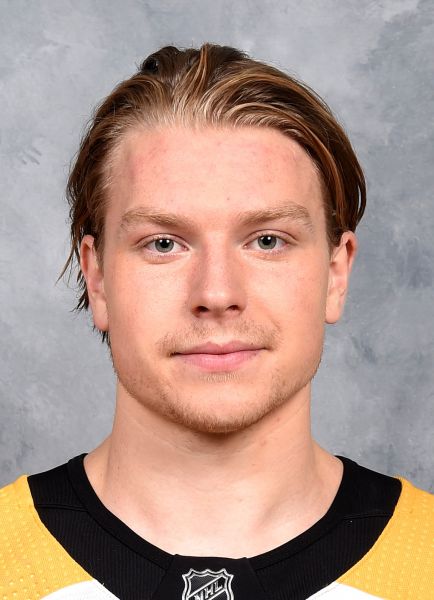
Off the top of the head: Roman Bychkov

The march through the Bruins prospects stable continues with Boston’s 5th-rounder last June, a flyer pick out of Russia who has the skills to translate to the modern NHL…if he ever comes over.- KL

Roman Bychkov, D Loko Yaroslavl (MHL)

Boston’s 3rd choice (5th round), 154th overall in 2019 NHL Entry Draft

Strengths: Left-shot D is an excellent skater who moves with fluid agility and has some real jump in his first couple of steps. Closes on pucks quickly in retrievals and effortlessly manages his gaps as he backs up against speed. Able to escape an aggressive forecheck with a nifty wiggle/shift and crisp edging to maintain balance and momentum. Superb puckhandler and passer- makes outlets and breakouts look easy. Intelligent and poised with the puck. Activates smartly and brings a confident, playmaking mindset in the offensive zone to step and pinch to boost the possession game. Plays with some jam and F-U…borderline dirty at times, but you have to like the competitiveness- he’s not going to be intimidated.

Weaknesses: Average size- (as is case with most his age) lacking in functional strength. Needs to improve his defensive reads and show more assertiveness when defending the rush. Stick is just OK- will get caught in passivity at times, allowing puck carriers to get around him and generate shots on net.

Overall analysis: When you’re picking second-to-last in every round and didn’t have 2nd and 4th selections, a player like Bychkov is an interesting swing of the draft bat. Playing in Russia’s top junior league, he’s a productive 2-way defenseman and power play weapon who is a breakout machine and uses his superb mobility and skills to get pucks north and in transition. If he were a little bigger and more effective in his own end, you would’ve heard a lot more about him in pre-draft circles, but he was solid at the 2018 World Jr. A Challenge and while not a star player on a loaded Russian team that lost the gold medal game to Team USA in Bonnyville, we like Boston’s thinking here.

Projection: Bychkov is a project player who has an intriguing ceiling if he can mature and better develop his defensive play, because he’s aces in terms of having the wheels and with the puck on his stick is a difference-maker at this level. He’s going to need time to play pro hockey in Russia and then likely break in slowly with Providence in a couple of years. When you’re talking about a pick that happened closer to the 6th round than the 5th, this is a player you can get behind to track going forward.

While we’re not seeing top-3 D potential at the NHL level right now, the tools are there for him to evolve into something closer if he addresses the shortcomings in his raw, but projectable game. Think of him as a similar kind of player to a poor man’s Vince Dunn– offensively capable, but the defense is a work in progress and not going to play a lot of minutes early on. Let’s face it- if teams felt he had that kind of potential (Dunn was a second-round pick), he would not have been on the board at 154, but he’s not one of those safe/high-floor players either- we get the sense that Bychkov will play his way into the mix with Boston, or we won’t ever even see him get close. But that payoff could be worth the wait.

***

Not much video out there on Bychkov that I am allowed to post, but here’s a YouTube clip from his 16-YO season- he’s No. 8 and on PP watch his lateral mobility and quick release to get the puck to the net from the point for the tip-goal. Smooth. (At about 2:25 of the video)

Again- on first Russian goal vs Finland (second assist), you can see how poised he is in the offensive zone- aggressively pinches down and works the puck to the net; after a rebound, the play is finished off. Easy to talk about, harder to execute.

Cameron Hughes: Then & Now

Cameron Hughes, C Providence (AHL)/Boston Bruins (NHL)

Hughes then:

March 25, 2016

He stands only about 6-foot and has an extremely light frame that won’t fill out all that much as he matures, but Hughes is gritty and willing to stick his nose in. He’s not ultra speedy, but moves well laterally and brings shifty elusiveness, especially in traffic. Hughes only tallied five goals, and has been more of a passer/playmaker at every level, but his vision and creativity are impressive attributes.

May 5, 2016

Entering the 2014-15 season, Hughes was thought of as top-three round prospect after starring with Spruce Grove of the AJHL, but he was underdeveloped physically and playing for a poor team in the Wisconsin Badgers. Things improved for Hughes this past year (5 goals, 25 points in 32 games), though Wisconsin was still below .500, costing head coach Mike Eaves his position. The Edmonton native is an above average playmaker who sees the ice beautifully and sets the table well. Watch for him to take the offense up a notch as a junior, but he needs to keep adding weight to his skinny frame, and will likely be asked to shoot the puck more.

June 11, 2016

A highly creative and skilled playmaking pivot, Hughes impressed RLR staffers going back to the 2013-14 season when he was a standout in the AJHL with the Spruce Grove Saints. Unfortunately, Hughes had the double whammy in his draft year of playing on a poor Wisconsin Badgers team, coupled with being physically under-developed in going up against the bigger, stronger, older NCAA competition. Hughes had a better offensive season as a sophomore and showed some flashes of NHL-caliber ability (he could work his way up to second-line center one day, as crazy as that might sound today), but the consistent production wasn’t there for him. Under a new coach and perhaps being a year older and a better surrounding cast, watch Hughes to open up some eyes this coming year.

May 16, 2017

Hughes has always been more of a set-up man than finisher, but with his offensive potential, it makes sense to hold onto him, put him in Providence and see what happens next. Of course- with so many prospects in the pipeline and a 50-contract limit for Sweeney and cap/roster management-centric assistant GM John Ferguson Jr. to work against, it’s also possible that Hughes might not make the final cut.

The key thing here is that Hughes has taken positive steps every season since being drafted, and as long as he continues to produce and play well as one of Wisconsin’s veteran leaders, there’s the chance that even if the B’s have to make a tough decision regarding his future in Boston, they can still leverage him for a future asset(s) they can kick down the road. Or- Hughes will play so well this season that the team keeps him and moves another player(s) out to give the team enough of a buffer to sign him and keep him in the system.

It’s one of those things you file under: “a good problem to have.”

Cameron Hughes now:

The Wisconsin Badgers former captain signed his ELC with the Bruins at the conclusion of his senior season in 2018, and he’s had modest offensive success at the AHL level. His rookie season (28 points in 52 games) was better than this past year when his production fell off (16 in 44), but that was impacted by a concussion he suffered taking a big hit (from former Providence and Bruins D Tommy Cross)  that forced him out of the Providence lineup for a time. He made his NHL debut on Nov. 4, playing in one scoreless game with the Bruins against the Pittsburgh Penguins.

A high-end playmaking/passing center, it’s hindsight now, but Wisconsin didn’t do him any favors by bringing him into the B1G 10 as a 17-year-old true freshman. He was physically underdeveloped, and it took him some time to get going- a year in the USHL would have likely served him much better, but it’s water under the bridge. Had Hughes gone to the ‘U’ there’s a good chance he would not have fallen into the sixth round, where the Bruins got a pretty good value pick after he was projected to be a top-3-round pick entering the 2014-15 season.

He still has the wheels, pure skill and brains to create offense. He’s a shade under 6-feet in height, and is still pretty light on the scales at about 170 pounds. His shifty, crafty style of play is noticeable on the ice, as he sees the ice well and is often able to elude checkers to find seams in defenses. Unfortunately, he’s also susceptible to taking big hits and this past season, it caught up to him.

Outlook: 

Hughes has the talent and IQ to be a solid depth forward at the NHL level, but isn’t likely ever going to develop into a top-2 line guy. Our biggest question with him has always been: is he a ‘tweener?

Hughes was not a prolific goal scorer even at the lower levels; not once in four years at Wisconsin did he ever produce double digit tallies (nor did he have a point-per-game season in Madison). Nevertheless, he’s always tallied some strikes that are jaw-dropping in nature, and so he has it in him to score a bit at the highest level, even if it’s not going to be a regular occurrence.

He moves his feet, skates with his head up and has some impressive net-drive moves to get to pucks and put them away. His best attributes are his vision, hands and work ethic. He was captain at Wisconsin and is a respected member of the teams he’s on.

At this stage of his development, he’s got an opportunity to make more of an impact at the AHL level as he continues to gain pro hockey experience. If he can use his positive attributes to play an effective three-zone game, he could make a push to establish himself on the lower lines in Boston at some point.

Realistically, it’s a pretty crowded field, and the impression we’re left with is that he might be more of a journeyman player who will need a change of scenery to set himself up best to be an every day NHLer. For a sixth-round pick, he’s done well, but we’d be surprised if he beats out other centers in Boston’s system (including his Wisconsin and current Providence teammate Trent Frederic) to carve out a niche in the Black and Gold.


Here’s a replay of his greatest NCAA goal, scored against Boston College in the fall of 2016. Warning- Filth factor is an 11 on the 10-scale:

Here’s a fun video from Wisconsin days with Frederic…

Reed Duthie: Off the top of the head- Oskar Steen

Reed Duthie is back with another deep-dive on a European Bruins prospect- this time, Oskar Steen, who just completed his first North American pro season. The Off the top of the head and Then & Now prospect series are exclusive to The Scouting Post and we hope you are enjoying the analysis of B’s futures. -KL

oskar-steen-2020-32

In the 6th round of the 2016 NHL Entry Draft the Boston Bruins used the 165th overall selection on an exciting talent from Karlstad, Sweden who had seen a breakout year jumping from Farjestad BK U20 in the SuperElit to Farjestad BK senior side in the SHL.

Immediately upon his selection Oskar Steen became one of the most intriguing prospects in the Bruins system.

As a 17-year old in the 2015-16 season, Steen was outstanding in the U20 circuit, collecting 8 goals & 24 assists for 32 points in 33 games finishing 2nd on his team, behind only August Gunnarsson who was playing his 19-year old season. Steen earned a callup to Farjestad BK in the SHL for a 17-game run where the diminutive but offensively gifted 17-year old would register 6 assists and even appear in five SHL playoff games.

Beginning the 2016-17 season, Steen clearly showed the brass for Farjestad BK and the Bruins that they had something special, recording 11 points in just 8 games at the U20 level before spending the rest of the season in the senior ranks, skating in 47 games for Farjestad BK and another 4 for legendary Swedish side MoDo in Allsvenskan (where he played with future Bruins draft pick Victor Berglund) and appeared in all 7 playoff games for Farjestad BK. Steen would spend he 2017-18 devleoping in the SHL recording 4 goals and 2 assists for 6 points in 45 games for Farjestad BK and appeared in another 5 playoff games for the club but was able to strut his stuff at the 2018 World Junior Hockey Championships recording 4 points across 7 games playing a key role as a #2 center in Sweden’s silver medal performance.

It was the 2018-19 season that would see Steen kick his game into another gear, leading Farjestad BK in points by a forward with 37 and finishing 2nd on the team to Joakim Nygard in goals with 17 across 46 games following it up with 7 points in 14 playoff games. That run was enough for the Bruins to transition the centerman to North America for the shortened 19-20 season but Steen would show signs of the type of player he can be, finishing his AHL rookie campaign with Providence scoring 7 goals and 16 assists for 23 point, good for 8th on a fairly loaded Providence roster, while showing his durability playing in 60 games (only Ryan Fitzgerald & Josiah Didier played in more, 61 each).

Assets:

Hockey IQ – An incredibly intelligent player, Steen has the ability to read the play well ahead of the pace and react quickly because of it. His advanced mind for the game has allowed him to successfully transition from the junior level to the senior level in his home country of Sweden and then transition again to the AHL all while still being an effective contributor in multiple facets.

Versatility – From using his tremendous intelligence for the game and from his developmental time with Farjestad BK, Steen has developed a very well-rounded game. A contributor for all 200-feet of the ice, Steen is a danger with and without the puck and can play in both power-play and short-handed situations and excel in any situation on the ice.

Speed – Excellent skater with quick acceleration, though his stride will begin somewhat short Steen quickly accelerates and lengthens his stride relying on his low center of gravity and powerful legs to drive him to full speed (think Sami Kapanen).

Vision/Distribution – Though not afraid to shoot the puck, as evidenced by his 17-goal outburst in his final SHL season, Steen is at his best with the puck on his stick locating his teammates with pinpoint passes to free them into open ice and scoring opportunities. Many of Steen’s scoring opportunities have come from defenders overplaying the pass and allowing him to use an ever-improving shot and release to find the back of the net.

Weaknesses:

Size – Not as big of a hindrance as it once was but standing 5’9’’ & 187 lbs, Steen is certainly not the biggest bear in the forest. Steen is able to use his bowling ball-like frame effectively, though he won’t go out of his way for contact he won’t avoid it either, relying on his strong balance, low center of gravity and smarts to win battles. Against larger defenders Steen can be simply outsized but is crafty enough to be able to beat them one-on-one.

Organizational Depth – If Steen were a natural winger his path to the Boston Bruins would be much clearer, however as a center he finds himself in a logjam behind the likes of Patrice Bergeron, David Krejci, Charlie Coyle & Sean Kuraly at the NHL level with fellow Providence teammates Jack Studnicka & Trent Frederic knocking on the door and 2019 1st Round Pick John Beecher a little further away.

Future:

A steal of a 6th round pick, Don Sweeney and the Bruins staff (*cough* P.J. Axelsson *cough*) must be commended for finding such a talent late in the draft and for having a hand in quickly developing him into a player who could knock at the door of an NHL spot as early as the 2020-21 season. Steen profiles as a player who could contribute in the middle-6, and brings the type of versatility the Bruins like with a serious offensive flair. With the depth at center in the organization, it would likely benefit both Steen and the Bruins to transition to the wing. A natural right-hand shot, Steen has the intelligence and versatility to excel on either wing and would very quickly cut down his time to an opportunity with the Bruins.

He is a player to keep an eye on, a versatile and skilled  forward with jam who could be another late-round, homegrown talent that could contribute in multiple faces of the game moving forward as the Bruins look to develop their next core of talent.

Oskar Steen with a nice shorty in his final Swedish season before signing with the B’s


Urho Vaakanainen: Then & Now

The prospect series returns on Tuesday with a then and now look at Boston’s top selection in the 2017 NHL Entry Draft.- KL

Urho Vaakanainen: Then

June 24, 2017:

A smooth-skating defender who describes his own playing style of one similar to NHL All-Star Roman Josi, Vaakanainen has spent the last two seasons playing pro hockey in the Finnish SM-Liiga. Tall, with a thin build, the 18-year-old was a member of Finland’s gold medal and silver medal-winning U18 teams in 2016-17, and also played on the 2017 WJC (U20) squad that woefully underperformed in Canada last winter.

Described by one NHL scout as a player whose “skating is first-rate; he can pivot and cut decisively in tight spaces and change direction on a dime,” the same talent evaluator also said that Vaakanainen “may not possess the high-level hands and offensive hockey IQ to be a top scoring presence on an NHL blue line.”

In going with Vaakanainen, the B’s bolstered the left side of their blue line while passing on some popular names up front who were projected to be good fits in pre-draft analysis, namely the big and talented Vesalainen (whose slide ended with Winnipeg at 24), Ryan Poehling (Montreal) and Robert Thomas (St. Louis).

“I’m a great skater, I can move the puck, I have a great first pass,” Vaakanainen said after his selection. “I’m a complete package- a two-way defenseman and steady guy.”

August 9, 2018:

Talent Analysis

Although not overly tall and having a relatively lean build, Vaakanainen plays with a long stick and uses his reach effectively. He’s got fluid feet: very good initial burst, an effortless stride and is crisp and balanced on his edges. This is a player who can move well in all directions- what is known as a “compass skater” in scouting parlance- and has the explosive first couple of steps and quick, smooth direction change that translates well in the short area game, something becoming more and more critical for NHL defenders going forward. Forwards who try to drive wide on him with speed will almost always run out of room to the far wall before they can make that sharp net drive- his feet are simply too good for that.

Intelligent and poised, UV sees the ice and is capable of defending the rush and keeping opponents away from the front of his net with an active stick. An economy of motion player, he is patient and will often allow skaters to take themselves out of lanes because he moves so well and keeps his stick in passing lanes.

Vaakanainen is not an exceptional player with the puck on his stick. When we scouted him at the U-18s two years ago, he moved pucks efficiently, but kept it pretty simple with higher percentage breakouts, a style in stark contrast to Charlie McAvoy, who is dynamic when in possession of the puck and can carry it out on his own when he has ice in front of him. This is not to say UV doesn’t have any skill, but he tends bring a simplified approach- he gets back quickly on retrievals and can then move the puck to the right areas. Where we have seen him get into trouble is when an aggressive forecheck either with an explosive F1 or 2-skater attack gets in on him quickly and forces UV to make faster decisions. In order to maximize his impressive skating, he’s going to have to be more decisive and avoid the temptation to hold onto the puck too long or just try the blind rim, which can lead to d-zone turnovers. He doesn’t have a heavy or overpowering shot- he tends to score by using a quick-release snap shot that he gets off his stick quickly versus an exaggerated windup and clapper. We’d like to see him try and get more pucks to the net, however.

Not a physical defender, UV manages his gaps well, using his lateral agility and long reach to angle effectively and close off skating lanes in the middle of the ice, where attacking forwards are at their most dangerous. The lack of physicality and bulk means that he’ll likely need support from his forwards when the puck gets down low and along the walls.

Overall, the offensive projection is still a work in progress- the B’s don’t need him to shoot the lights out or rack up assists as long as he can help speed the transition game to break pucks out while also keeping the opposition to the outside. His pro experience gives him a refined game, maturity and poise beyond where  many of his peers are- he doesn’t turn 20 until January and many of the guys picked in the same draft are going back to junior for one more year.

Urho Vaakanainen now:

Two years into his North American pro career, Vaakanainen has been a mixed bag so far.

His rookie pro season, split between Providence of the AHL and Boston was derailed with concussion issues, but he showed promise, putting up nearly a half a point per game in the AHL with the Baby B’s- solid production for a player in his first campaign. That was likely a reflection of his several years in the Finnish SM-Liiga, which compares favorably to the level of play seen in the AHL, so unlike junior players who face a transition to pro hockey, Vaakanainen’s transition was more in line with the smaller ice surfaces here versus what he competed on at home.

He made his NHL debut, playing sparingly in Boston before getting hurt (thanks to a dirty Mark Borowiecki elbow when Vaakanainen went to the net looking for a rebound), and missing a bulk of the 18-19 hockey season, with just 32 total appearances split between the show and minor league.

He played more games in 19-20 with Providence, getting into 54 before the AHL season was postponed in March due to COVID-19 (it was officially canceled yesterday). His production. however, was down significantly from where it was the year before, with the same amount of points, but with 24 more games played. He got into five NHL games with the B’s, again playing sparingly as a depth piece during his call up.

When drafted, Vaakanainen was talked about by the team as a 2-way defenseman and other hockey sources touted his offensive upside, but to be frank- we never really saw it. He’s more of a smooth, efficient defender who can chip in offensively and is mobile in retrievals and breakouts, but isn’t the prototype 2-way defender who joins the rush, quarterbacks the power play and is a consistent impact performer at both ends of the ice.

That is not a knock on him, but at the same time, he was not a significant offensive presence in 84 pro league games with JYP and SaiPa in his native Finland, and we’re doubtful that his point production is going to be all that significant at the NHL level. That is not to say that he won’t be a successful defenseman, but expectations should be tempered.

He can skate and move pucks, and has a good stick- those attributes will all help him establish himself as an everyday D at the highest level. We would like to see more of a competitive side and edge to his play- at times, the pace looks pretty average and he’s not all that tough a player to go up against. There are some intriguing positives, and his superb skating is a top carry tool. But we’d be lying if we said we didn’t expect more from him in year two. Granted, the injuries have set him back, but at some point, potential needs to translate into tangible results.

Outlook:

At this stage, he looks to project as more of a middle-of-the-roster depth player than a true blue 1/2 NHL D. You can certainly take that, but given where he was drafted and what some of the other options were at the time, if we redid the 2017 draft’s 1st round, he’s a bubble guy in our view.

The 20-21 is going to be a critical one for Vaakanainen. Smooth and efficient is fine- but on a relatively crowded Boston blue line, you’d like to see some more assertiveness and pop to be comfortable projecting that he’ll develop into an NHL regular. He’s still plenty young and there’s a lot to like, but he’s got his work cut out for him.

***

Sportsnet Clip then: When B’s selected Vaakanainen (note the comments after the pick- not much about offensive upside- all about his defense/stay-at-home acumen as Miro Heiskanen’s D partner in international competition)

NESN video on his 2018 development camp

Here’s the Borowiecki elbow- no call. Bravo to Billy Jaffe for calling out the officials’ incompetence on this one. Ladies and gentlemen- your moern NHL referees- where they can stand mere feet away and watch a flagrant foul but since it happens to some unknown Finnish rookie? No call. But boy- hook some 1st class NHL citizen away from the play with no impact, and you’d better believe the whistle is coming out…gross.


Zach Senyshyn: Then & Now

We continue updating Boston Bruins prospects in two different series with Zach Senyshyn. We’re taking the longer, more detailed approach with the 15th overall selection from 2015, with some superb past content from Dominic Tiano who has been following him longer than most of us.-KL

Zach Senyshyn Then on Scouting Post:

July 18, 2015 (One of the very first posts of the blog)

Zachary Senyshyn, RW Sault Ste. Marie (OHL) 6-2, 195

Acquired: 1st round, 2015 NHL Entry Draft

The 2015 NHL draft’s first true off-the-board pick has the natural skills to eventually justify the selection, even if the Bruins took an acknowledged risk with other more established players on the board. The good news: the Ottawa-area product is a fine skater who can beat defenders wide with his speed, takes pucks to the net and has the hands to find the back of the net with regularity. On the downside- scouts question his natural creativity and there is significant risk associated with him if he does not take the next anticipated step in the OHL with the departure of several key veterans he was playing behind. Although he isn’t an intimidating presence on the ice, Senyshyn is saying and doing all the right things and demonstrated his raw, but promising talent at development camp.

August 16, 2015

Zach Senyshyn scouting report:
Senyshyn plays a north/south game with very good size and still room to fill out. He has a very powerful skating stride with quick acceleration in his first few strides and top end speed. He has the ability to beat defenders with that speed one-on- one and the tenacity to drive to the net with the puck.

Senyshyn can throw a big hit but it’s not something he goes out looking for. He will battle along the boards for pucks and wins more of those battles than he loses. He possesses that same work ethic in his own zone. He plays the game in high gear from the drop of the puck to the final buzzer.

At times, Senyshyn has shown to make an excellent pass. His playmaking abilities weren’t really noticeable in his first year, but as he enters year two in the OHL, and playing with more talented players, it’ll be his time to shine.– Dominic Tiano

July 18, 2016: Bruins development camp roundup

Zach Senyshyn, RW

Plus: A year after tallying 26 goals on the bottom line and without much special teams time, the 15th selection in 2015 scored 45 goals to lead the Soo Greyhounds; he’s a big, explosive and skilled scoring presence on the right side. Minus: The goals are great, but the 19-year-old has work to do in his 200-foot game; he has a tendency to wait for the next scoring chance or let others go and get him the puck.

May 12, 2017- Another profile of Senyshyn from OHL analyst Dominic Tiano:

We all know Senyshyn is an elite-level skater who can beat defenders wide. He also possesses an NHL shot already. He’s willing to stand in front of the goal and take his licks and knock in rebounds. He plays smart with his stick seemingly always on the ice waiting for the pass. He has subtle little moves that allow for that extra 6-12 inches to get into a lane. Only time will tell how it translates to the NHL.

But for now, a year in the AHL is probably the best thing for him and the Bruins.

Zach Senyshyn now:

Three years into his pro career and after the above post was written, the time has mostly been spent in the AHL with the exception of 6 NHL games (1 empty-net goal, 3 points).  The projection on Senyshyn is just about in focus: He’s probably more of a third-line/middle-of-the-roster forward at the NHL level at best, which, in the context of his draft position, validates the concerns around the choice when it was made.

Mat Barzal (Islanders), Kyle Connor (Jets), Brock Boeser (Canucks), Travis Konecny (Flyers) and Anthony Beauvilier (Islanders)- all forwards drafted after the 15th selection, have established themselves as impact players, each with at least 121 NHL points (Barzal leads the pack with 207, while Connor is close behind with 201). There is no denying five years after the draft that the Bruins did not get the best value out of that pick. Like fellow 1st-rounder Jakub Zboril, Senyshyn has been a victim of others’ success more than the has been a subpar performer. And there is no denying the fact that a lot of people have taken great pains to point that out from day one.

Even with the potential surrounding the Senyshyn pick at the time, it was a given that he would be a project who would take time to justify the selection. However, the slower, more deliberate NHL timeline we predicted on this blog at the time of the selection ended up being optimistic.

Although he popped offensively in junior with 45 and 42 goals, his staple tool-  offense at the pro level has been slow in materializing. He’s had to learn how to be a more complete player to succeed in the Providence system, which adopts many of the same set plays and player responsibilities as the parent Bruins club. While we can say that his game has improved and he’s taken positive strides in terms of his pro habits that the AHL experiences have taught him, it’s not a stretch to say that more was and is expected.

Senyshyn is 23, and in a four-game NHL recall in late October/early November, he started to show why the B’s were high enough on him to invest ahead of the others. He showed some jump and was impacting shifts with his speed and an energetic style that despite limited even strength minutes, was making a difference and starting to move the needle. Then, he suffered an injury that ended the promising stretch just as things were getting started.

Steve Conroy of the Boston Herald reported on the lower body injury in a detailed piece back in December, when Senyshyn was returned to Providence five weeks after leaving the NHL lineup.

Here is Bruce Cassidy, quoted from the Conroy Herald piece with key analysis on the player’s Boston stint bolded for emphasis: “He did his job. He’s one of those guys who hasn’t earned his way yet so we haven’t used him on the power play or penalty kill, it’s all even-strength minutes, so you can get lost some nights in that role. We’ve seen that with Brett (Ritchie) a little bit, getting that motor turned on when you’ve got to sit for extended periods. And that’s where I thought (Senyshyn) did a decent job for us when he didn’t play. As a young guy, sometimes the mind wanders. I thought he went out and stayed true to his game and got on pucks, protected them in the O-zone. I thought he influenced the play well for us. It’s too bad when he got hurt. He was starting to gain a little bit of confidence and we were starting to see what we had. So he has to start over a little bit. Hopefully he picks up where he left off, whether it’s here or Providence and gains a little bit of confidence knowing that there is a role for him in this league.”

Cassidy, like most successful coaches at any level, focuses on the details- the little things. And going back to his junior years, we had scouts tell us that while Senyshyn had the tools to thrive in the NHL, his overall game and commitment to those habits and attributes that most successful NHLers have weren’t quite there. When it doesn’t come naturally to a player, then there is a window of time extended to figure it out. Not everyone can be Patrice Bergeron and play like a seasoned veteran at age 18, but any organization only has so much patience with the process before others pass you on the depth chart, and potential is either reached or left unfulfilled.

There’s no guarantee that had Senyshyn not gotten hurt that he would have been able to keep a spot on the Boston roster, but in missing the time he did, he needed to get back down to the AHL to get his conditioning and timing back on track, and there would be no other NHL opportunities after that.

Outlook:

At TSP, we can only guess that the positive, albeit baby steps towards earning a regular NHL shift might have done enough to convince management to hold on and give him more time. When you read between the lines of Cassidy’s comments back in December, he’s essentially saying that Senyshyn is young, but figuring it out and is trending in the right direction. That’s a good sign, and it likely means that with a qualifying offer in hand and another year under NHL contract, the third of three first-round picks will get another opportunity to prove he can play here.

That doesn’t change the fact that the projections here were overly rosy about him in the early going, but we won’t apologize for being high on a player who scored 114 goals in 195 junior games. Even though he was projected to go in the second round that year, we won’t fault the scouts who pushed for him in Sunrise, because sometimes you make gut calls based on passion for a player that pans out in a big way- like Bergeron and more recently, David Pastrnak. And sometimes, the player you believe in doesn’t deliver like you hoped. No one scout, no one team- no matter who they are- ever has a perfect track record. Every team can continue to learn as an organization in developing a sustained productive process from the decisions that don’t work out, just as much as the validation received from successful picks. Learning organizations might stumble, but they rarely fall.

Finally, the silver lining to the slow development, modest production and injury setbacks is that Senyshyn is still in the mix to establish himself as a player and could yet develop into a capable middle-of-the-roster forward. That’s not going to erase the criticism surrounding his selection, but even if the selection ends up being a bloop single to shallow right field, it is preferable to striking out swinging. With his growing confidence and a willingness to work, he has a chance to get on base.

Although it is cliche to say, the jury is still out on Senyshyn, but fire up some Europe if you can- it’s the final countdown.

For more on Senyshyn with analysis from Anthony Kwetkowski/Bruins Network,check out this recent podcast. He starts talking about him at the 1:18:50 mark of the audio.

Zach Senyshyn’s 1st NHL goal vs Minnesota to close out the 2019 regular season

Senyshyn- 2 goals in a 2018 preseason game vs Washington (plus a nice breakaway goal at 1:50 by Jakub Lauko– speed!) 1st at 2:03 vs Ilya Samsonov and the second (a fluky bounce) at 2:40, but he threw the puck at the net off the rush- good things happen.

Jeremy Lauzon: Then & Now

The Bruins prospects series rolls on with a player who might’ve been on the verge of graduating to NHL regular status when the 2019-20 season was put on pause. He’s an interesting profile to write because he’s finally paying some real dividends at the highest level.- KL

Jeremy Lauzon Then on Scouting Post:

Watch this Guy: Jeremy Lauzon July 24, 2015

So, why might Lauzon be the best between Jakub Zboril (13th overall) and Brandon Carlo (37th overall)? Like Zboril, Lauzon brings similar size and a mix of offense and defense. He’s more of a consistent competitor in my view, despite some reports of Boston’s top choice Zboril being “ultra-competitive” (I wouldn’t go that far based on what I saw in film study). Carlo is a massive rearguard who excels in a shutdown role, but I don’t know that he has the offensive skill/sense to be much of a consistent points producer. That leaves Lauzon as the best combination of the three- not as talented as Zboril or as big/defensively savvy as Carlo, but solid across the board and a gritty, hard-to-play against -d-man.

Prospect deep dive: Jeremy Lauzon March 7, 2016

Though not a truly exceptional player in any key area or specific hockey skill, Lauzon nevertheless is above average and more than capable at just about everything. He’s got good (Lauzon is about 6-1, 195 pounds) if not great (6-4, 220+ pounds or more is what is considered ideal in the modern NHL for D) size, and skates well though doesn’t provide dynamic speed and quickness. He’s a deft passer and effective goal scorer from the blue line, and has the ruggedness and smarts to neutralize opposition rushes and prevent players from getting to the front of his net.

Lauzon is putting up the best offensive numbers of his major junior career with the Rouyn-Noranda Huskies in his third season with them. He’s off his goals pace from a year ago (eight vs the 15 he netted in 2015) but with 44 points in 41 contests, Lauzon has already exceeded his 36 points set last season. He’s had to deal with some nagging lower body injuries that have limited his effectiveness in the new year after injuring himself after returning from Team Canada’s World Jr. Championship training camp in December. As one of the final cuts, Lauzon opened a lot of eyes around the CHL this year after being the 52nd overall selection by Boston last June.

Lauzon is a smart player who often does the little things in terms of maintaining his gaps, keeping the proper stick positioning and forcing opponents into committing early. He likes to go for hits in the open ice and will take every opportunity to finish his checks along the boards and remind guys in the other sweaters that he’s there. Though not a feared fighter, he’s willing to drop the gloves to defend teammates and plays a naturally rugged and aggressive defensive style that will translate well in Boston.

What’s Next For the Bruins- The Young D May 24, 2017

Jeremy Lauzon, LD, Rouyn-Noranda (QMJHL)- Injuries impacted Lauzon’s season and he didn’t put up the kind of regular season numbers in his fourth major junior campaign as he did a year ago. However, when it comes to Lauzon, it’s not so much about the stats as it is the consistency and balance. Besides, he had an outstanding playoffs (albeit an earlier-than-expected exit at the hands of the Chicoutimi Sagueneens in the second round of the Quebec League run), posting 5 goals and 14 points in 13 games with the Huskies.

With Lauzon, less is more- he made Team Canada’s World Jr. Championship squad but wasn’t given as much ice time as some of the other defenders. Still- he scored a big goal in the gold medal game against USA, and seemed to make the most of the opportunities he had. He’s got enough skill to score, but he’s also a tenacious, even nasty competitor on the back end who makes forwards pay for the real estate they try to occupy. He’s not huge, but big enough- he’s got a great stick and impressive vision. We said it back after the 2015 draft, but as a shutdown guy, he’s not as effective as Carlo and as an offensive presence, he’s not quite as talented as Jakub Zboril, but if your idea of success is a player who can thrive over all 200 feet of the ice surface, then Lauzon is your man. He’s been with Providence since his playoffs ended, learning and benefiting from being around the team, but he wasn’t ready to go health-wise after playing hurt against Chicoutimi and the way things have gone for the Baby B’s has meant that he’s on the outside looking in for now. His time will come, though.

Jeremy Lauzon Now-

The now 6-2, 205-pound left-shot defenseman made his NHL debut in 2018-19, playing 16 games as an injury replacement and scoring his first NHL goal against Las Vegas. In 2019-20, he came up in the middle of the season and was just rounding into form, having played his way into the nightly lineup consistently when the season was put on pause.

The numbers- 2 goals and 1 helper in 35 games split between last season and the current one- aren’t anything to write home about, but there is room in his growth and development to be more of a point producer than he has thus far shown at age 22 (he turns 23 on Tuesday). Of course, he’s not been a point-getter in the AHL to date, and isn’t likely going to blossom into a 40-50-point guy in the NHL in his prime. But, like many young players who are in the process of breaking into the NHL while seeing limited minutes in a more specific role to place a priority on playing defense, Lauzon has been fine.

He competes hard, plays with good intelligence and vision, making the right decisions with and without the puck; Lauzon does his job with his mobility, a smart stick and has enjoyed the trust of head coach Bruce Cassidy and assistant coach Kevin Dean for his willingness to keep things simple.

Style analysis: 

Why does one defenseman who seems to have all the major league tools and who was a first-round draft pick have trouble establishing himself as an NHL regular, while another who was drafted later the same year and carries a significantly more modest skill set has leapfrogged the first on an organizational depth chart?

With Lauzon, we think it simply has to do with the fact that he’s a better defender and brings a high hockey IQ to the table, along with a certain poise and ability to do the little things to make plays in his own end.  He’s willing to lay out to block shots and he’ll drop the gloves. He’s not a heavyweight fighter, but he’s tough enough, and in Boston, that matters.

NHL defensemen who can both produce points and effectively defend their own zone are coveted commodities and franchise cornerstones- that’s why there are so few of them available across the NHL. That leaves the rest of the population at the position: players who might bring more offensive abilities to the table, while others are better at taking care of their own end. Gone are the pure specialists: the “offenseman”- a player who lines up behind the forwards to take faceoffs, but is essentially a fourth forward on the ice- taking the puck and rushing it up the ice, but lacking the instincts or wherewithal or both to provide capable defense, or the “shutdown” D- a euphemism for a big, powerful player who lacked the skills to skate and carry pucks out of danger, but could grapple and pin and obstruct players in the defensive zone effectively enough to justify their spot on an NHL roster.

Now, if you expect to play defense in the NHL and stay there, you had best be a hybrid 2-way defender or at least be an exceptional enough player in your own end with the mobility to angle, retrieve and win foot races to loose pucks. The modern NHL defenseman has to be able to skate, think, pass and understand how to play within his team’s structure and systems, or he won’t be long on the roster.

Lauzon isn’t fancy, but he’s just tough- able to get up and down the ice, make the first pass and brings a tenacity and competitiveness that endears him to the coaches and teammates he plays with. His best junior season was a 50-point campaign, so his offensive numbers at the highest level will be modest at best, but Lauzon’s value transcends pure point production. He’s going to eventually develop into a player who can play a good chunk of minutes as a steadying influence on the back end.

In hindsight, it looks like we were overly optimistic in thinking he could be the best of the three D Boston took in 2015, and to Brandon Carlo’s credit, he’s taken the bull by the horns to establish himself as an anchor on the B’s blueline, while coming off his best offensive season to date with 19 points in 67 games. But Carlo is also a physical specimen at 6-5 whose mobility opened the door for him earlier in Boston than most, and he took full advantage. Lauzon, on the other hand, has been on a longer (and expected) developmental path. He can’t match Carlo’s physical gifts in terms of pure size, strength and reach, but he’s not far off at being able to contain opponents and neutralize scoring chances.

Outlook:

Lauzon’s persistence has paid off, not only in the form of an increased role with the big club, but with a two-year contract extension at a bargain rate of $850k per that will take him through the 21-22 season. He might even be in danger of being the one Bruin that new NHL franchise Seattle could walk away with in next June’s expansion draft. That might be putting the cart before the horse, but with his experience, cap hit and potential, Lauzon just might be the kind of player who makes perfect sense for GM Ron Francis and Co. if he plays at least 40 games for the B’s in 20-21.

If not, then he’s on the up and up as a player who should be able to slot into Boston’s top-6 going forward. He’s got just enough skill, a good amount of smarts and plenty of ruggedness to make it as a solid role player and maybe something more. It’s not overly complicated when it comes to figuring out if players will earn more NHL ice time or not- if the coaches trust them, then they’ll play.

It might not always make sense to media and fans who will look at other shiny, flashier objects in the system and say, “Why not him?”  Well, because if the flashy guy turns pucks over and can’t establish a solid level of the t-word with the team’s coaches, he’s not going into the game.

Lauzon won’t win a lot of style contests, but in the end, style doesn’t always win hockey games. As the season abruptly ended in March, the coaches trusted him because he proved that he is trustworthy.

Sometimes, that’s really all you need.

***

First NHL goal on former B’s 1st-rounder & prospect Malcolm Subban from late 2018

Squares off vs Matthew Tkachuk- noogie time:


A preseason fight vs the NJ Devils’ Nathan Bastian


Off the top of the head: Jakub Zboril

Jakub Zboril, D

6’/201

Boston’s 1st choice, 13th overall in 2015 NHL Entry Draft

Current Team: Providence Bruins (AHL)

Previous Team: Saint John Sea Dogs (QMJHL)

Strengths: Outstanding, NHL-caliber skater with speed, balance, agility; can get off the mark quickly, has a powerful glide and exhibits nifty foot work to change direction efficiently. Good puckhandler who can make the first pass and uses his feet and stick to break pucks out of his own end consistently. Hard shot- a missile that he can drive from the point through traffic on net. Enjoys the physical aspect of his position: engages with opposing puck carriers and will put his body through their hands to disrupt the rush. A willing hitter who opened eyes in his draft season for his embrace of physicality, and as he gains experience, is getting smarter and more effective in his ability to end plays along the walls.

Weaknesses: Vision/hockey instincts are pretty average; doesn’t always make the right reads/decisions and not an overly creative puck distributor. Play away from puck is a continued work in progress; still developing 360-degree awareness and d-zone coverages to prevent opponents from finding soft seams and exploiting time/space.

Overall analysis: Boston’s top pick five years ago has been slow to develop and might not ever get there (at least with the organization that drafted him), which makes him one of the more polarizing prospects in the system. Like others who have come before him and those who will surely follow, he is a victim more of expectations than out of a failure to perform. While his development has not been as rapid as other 2015 peers who were chosen after he was, Zboril has taken positive steps, even if he’s been unable to do more than play sparingly in just two NHL games with the B’s.

As part of a very strong draft class, Zboril was solidly in the second tier of defensemen available after Noah Hanifin, Ivan Provorov and Zach Werenski, all of whom were drafted in the first eight selections and have gone on to become established NHL players. Zboril’s junior teammate, Thomas Chabot, was drafted five spots later at 18th overall, and has emerged as a top tier player, which has added to the disappointment of a slow development process in Providence.

Luckily for the Bruins, Brandon Carlo is the defender from the 2015 draft who has been able to become a staple supporting cast member, and while Zboril doesn’t have Carlo’s size, he’s more of a 2-way threat and hybrid style player that it is hard to account for why things have not come together for him. The irony in the criticism Zboril gets on Internet message boards and Twitter is that at the time he was drafted, he was the one player of Boston’s three first-round selections at 13-15 who was the accepted commodity at his draft slot, while Jake DeBrusk and Zach Senyshyn were the players who raised the most controversy given where they were projected.

Five years later, it is obvious that Boston should have gotten more production out of those three selections, with only DeBrusk currently a full-time roster player, while others selected after 15 have gone on to become stars. Having said that, Zboril just turned 23 in February- he has time to establish himself as an NHL player with the B’s, even if time is running out. He just played out the third year of his entry-level contract, and should receive a qualifying offer. He’s been consistent in Providence- posting 19 points in each of his three AHL seasons. The offensive production that looked to translate from junior play probably isn’t going to be there, but he’s shown improvement as a defender since turning pro, and he can leverage that into a decent NHL role in the right situation.

Projection: The days of projecting the left-shot Zboril as a top-3 NHL D are long over, but barring some kind of miracle, he has the tools to be a solid 5/6/7 and role player at the top level. Granted, that’s not going to make many celebrate him given who Boston could’ve had at 13, but he still has it in him to establish himself in the NHL as a solid complementary/depth player who could enhance any defense with his mobility and skills.

His playing style and game reminds us of another heralded junior defenseman who put up points and was expected to be a 2-way NHL star. After being a top-10 pick in his first draft, Nick Boynton had to reinvent himself as more of a defense-first, supporting D, going on to play more than 600 NHL games and raising the Stanley Cup at the end of his career with the Chicago Blackhawks. We’re not saying Zboril is the next Boynton, but there are some similarities here, and at age 23, he’s far from washed up- Boynton was 22 when he finally cracked Boston’s lineup to stay. For a more modern example, Matt Grzelcyk was 23 when he became an NHL regular, but he did it after playing just one full season of pro in the AHL before making the jump to Boston to stay.

Right now- Zboril is at a personal and professional crossroads: can he finally make the cut in his fourth season, or will he go back down to the AHL, and essentially see the window close on a possible Bruins career? When you look at his physical gifts and playing style, there isn’t any clear explanation for why Zboril has failed to develop into an every day NHL player by now, but nevertheless, this is where we are.

At the very least, he’s shown improvement in each of his three seasons, so he’s got a chance to make it in year four- he can absolutely skate, pass and shoot- if he can put it all together, the ability is there to be a player in the NHL.


SportsNet pre-draft clip of Zboril- “expected to go in the middle of the first round”- yes, that was the projection, and that’s where he went.


TSP friend Anthony Kwetkowski/Bruins Network is a believer in Zboril, and talked about him at length in arecent podcast at around the 1:07:45 mark. Here’s a video interview he did with him last season:


Off the top of the head: Trent Frederic

The Bruins prospect series continues with an updated look at Trent Frederic. For a more detailed take, be sure to listen to the podcast with Anthony Kwetkowski of Bruins Network. The players in this series are not done in any kind of pecking order- we’re just selecting ones who we feel are going to appeal to the interests of the readership and fanbase.

Trent Frederic, C

6-2/205

Boston’s second selection, 29th overall in 2016 NHL Entry Draft

Current team: Providence Bruins (AHL), Boston Bruins (NHL)

Previous team: University of Wisconsin Badgers (B1G)

Strengths: Big-bodied, left-shot center is an outstanding athlete and has the major league tools to be an impact NHL forward. Very good skater with a fluid, powerful stride and the ability to pull away in open ice or put defenders on their heels when he gains speed through the neutral zone. Strong on his skates- will drive through contact and does his best work between the dots and just outside the paint. Good vision and solid instincts to be a capable 200-foot player. Strong in the faceoff circle. Very good hand/eye coordination- dangerous in front of the net for high-tips and deflections. Physically intimidating player- loves contact and relentless in the way he lines up opponents and finishes hits. Has developed into a good fighter who most would rather not tangle with; he uses his natural strength, balance and a long reach to devastate opponents with combination punches over and under, while wearing them down with the ability to absorb shots and keep throwing. Solid character- respected and liked on his teams, and willing to put in the work.

Weaknesses: Offensive creativity/IQ is not on par with other top centers in his peer group- not a pure passer or playmaker. Puck skills and shot may prevent him from being a true top-2 center at the NHL level, but they aren’t “weaknesses” in the traditional sense- he’s just not overly skilled and needs to commit to shooting the puck more often, as his eight goals this season (59 games) attest, a drop from 14 in his rookie pro year in 18-19. In 17 career NHL games, he’s gone scoreless.

Overall analysis: Frederic was not a popular pick in 2016, present company included, but he’s done a fine job of developing himself into a legitimate NHL prospect, even if his eventual offensive ceiling will be somewhat limited. He’s a top athlete who was an accomplished quarterback and baseball player until he focused exclusively on hockey when joining the U.S. National Team in 2014. Prior to that, he was on a powerhouse 16U St. Louis AAA Blues team, which included D1 NCAA standouts Luke Martin (U Mich.), Zach Solow (Northeastern), Josh Dunne (Clarkson), Ty Farmer (UMass), Joe Woll (Boston College) and Tommy Nappier (Ohio St). Keith Tkachuk coached several teams Frederic played on and Brady Tkachuk saw some time on that top Blues squad as an underager.

He was a highly sought-after NCAA recruit, and turned heads in his true freshman season in Madison, putting up more than a point per game and showing zero issue with the transition from junior to one of the top conferences in college hockey. While his sophomore year was a bit of a step back statistically, he turned pro at age 20, signing with the B’s before the 2018-19 season after finishing out the previous spring in Providence on an ATO. The production at the AHL level has been slower to develop, but with his big frame and rugged, hard-nosed play with a real mean streak, Frederic is proving to be a player who is right in Boston’s wheelhouse in terms of being a heavy, hard to play against center who is versatile enough to play on the wings or up the middle. He won’t be a point-per-game player, but his childhood hockey idol was David Backes, and he can certainly bring similar attributes. He’s a better skater than Backes, not as skilled, but should be a solid 2-way NHLer soon. Perhaps a more appropriate comparison to Frederic’s potential is current Bruin Charlie Coyle– will be hard-pressed to develop into a 30-goal scorer at the NHL level, but will be able to do a lot of things effectively.

Frederic has been unfairly maligned because of where he was expected to be taken versus where he went and seeing other players like Alex DeBrincat develop into top-6 NHL scoring forwards. At his best, he goes hard to the net with his stick on the ice and can redirect shots home or finish off plays in tight while giving out and taking hits. When it comes to pure north-south power forwards who play in straight lines and go to the net, there aren’t many in his class in the AHL right now at a career .51 points per game in 127 contests. And let’s be completely frank- if he had the skills in his draft year to be a clear top-6 at the NHL level, he would not have been taken at the end of the first round- he would’ve been gone in the first five picks.

Projection: Frederic can one day be a capable, consistent 3rd-line NHL center, but there’s still enough room in his development that he could play his way into a lower-end 2nd-line pivot in a pinch. Being able to play up and down the lineup is an asset for any team, and Frederic can also play wing if that’s where the Bruins need him. He fits the model of what the organization likes up front, and has enough grit and nasty to develop into a fan favorite once the rest of his game catches up to him. At worst, he’s going to be a very good 4th-liner who can do a little bit of everything, but with his physical ability and draft pedigree- more is expected. At age 22- there is still room to grow here, and he’s just too big, athletic and talented to be pigeonholed as a lower-end player right now.

Trent Frederic’s 1st NHL tilt: decisive vs. Brandon Tanev

https://www.youtube.com/watch?v=9GsRbKluIxg


Frederic demolishes Joseph LaBate (Belleville Senators) earlier this season

Frederic starts slowly vs. Anthony Angello but watch the finish and over/under combos:


An older, dated video on Frederic with interview and highlights from Wisconsin which showcases some offense

Closing time: Thoughts on Peter Cehlarik

One story that cropped up late in the weekend and got some mild traction in Boston and the Bruins beat Monday was word out of Slovakia where it appears that left wing Peter Cehlarik’s time with the team is up. The 2013 third-round selection was interviewed in local media outlet Ta3.com, expressing his frustration at not having carved out more of an NHL role for himself, and appearing to levy a sizeable share of the blame to coach Bruce Cassidy (admittedly, we’re going off of translation devices and the interpretations of other sources) for his inability to do so.

We’ve tried to be fair to Cehlarik here, observing in the past that given his hands/skills and potential to generate offense, he was worthy of opportunities in Boston. Having said that, it was never a secret that he was a surprising pick of the Bruins in Newark at the end of the third round because he did not have the kind of typical attributes that the B’s prize in their forwards: higher-end skating and/or ability to play with pace/urgency, willingness to consistently get to the front of the net and play hard between the dots, and a modicum of jam- basically-  being hard to play against. Even when putting up decent numbers in Sweden, Cehlarik could never be identified as a player who was a rugged competitor and a tough opponent. Although possessing a big frame, slick hands and the vision to create, he was a soft-skill, perimeter player.

Back in 2016, we had this to say about him after he signed his NHL contract with Boston:

The Slovak, who has spent the past three seasons playing in Sweden, is a top-six NHL forward dark horse kind of prospect, but he’s also one of those guys who is tough to peg because if he doesn’t make it as a scorer, it’s hard to envision him playing a heavy and responsible enough game to succeed on the third or fourth lines in Boston. His initial first steps are a bit clunky, though with a long, efficient stride, he can work well in open space with good straight line speed. Cehlarik improved his skating from when he was first drafted, but it will never be a strength. He has a quick release that allows him to score goals off the rush;  an-in-stride drive that sometimes handcuffs goalies. He’ll also take the puck in close and shows some pretty fine dangle in getting net minders to open up and commit.

So, now- we’re facing the reality that the 2013 draft class was a bust for the Bruins. They traded their 1st-rounder (Jason Dickinson) to Dallas for Jaromir Jagr, so the first choice was at the end of the 2nd round after reaching the Stanley Cup Final that spring. Linus Arnesson was Boston’s first selection, and the “2-way”, “puck-moving” defenseman has already come and gone from North America, returning to Sweden after the end of his ELC and 79 games, 1 goal for the Providence Bruins from 2015-17. Cehlarik joins him as the next highest-drafted player to not meet hopes and expectations.

The point of this post is not to highlight some of the organization’s missteps in the draft- it happens to every team and organization and while some seem to prefer to call attention to the draft failures by this club, that’s not the key takeaway here. What is important to note is that the B’s broke away from their normal draft model to take a swing at a player who did not fit with their organizational values and style. When it works, great- but when it doesn’t, should anyone be surprised?

The good news for the club is that they have done a better job than any other NHL franchise at identifying undrafted talent and getting production from that viable pipeline. It’s not  something you want to get into the habit of depending on, but if the 2013 Boston draft is shaping up as a dud (Ryan Fitzgerald is a group 6 free agent, Wiley Sherman may not be offered an extension given the recent NCAA signings) with only Cehlarik and Anton Blidh having played any NHL games, at least the lack of success in Newark hasn’t adversely impacted the team’s fortunes seven years later.

Final points on Cehlarik before we wrap up: He isn’t a terrible player. He probably could and should have gotten more playing time than he did, but at the same time, the idea we’ve seen put forth by some that he wasn’t given a “fair shake” rings hollow. What is a “fair shake,” exactly? We heard the same comments with Alexander Khokhlachev when it didn’t work out for him here, too- is a “fair shake” being gifted 15+ minutes a night on a top line regardless of production? Is a “fair shake” continuing to roll out a player who, for whatever reason, doesn’t enjoy the trust and confidence of the coaching staff and fellow teammates? Even if the player isn’t doing his part in practice and games to earn his way? Is a “fair shake” getting opportunities to play with David Krejci and Charlie Coyle? No one is entitled to a “fair shake”, whatever that means- you get what you earn.

The fact of the matter is- Cehlarik got 40 games in the NHL spread out over three seasons, and was unable to make it work. He says that Cassidy essentially blocked him from succeeding. That’s his view and he’s welcome to it. Cassidy said at various times when he was up that Cehlarik’s lack of details and at times urgency are what prevented him from sticking in Boston. Both can be true- it isn’t necessarily an either/or. The Bruins obviously wanted him to succeed- there is not a conspiracy to keep a good young player down, and it is not wrong to assert that he didn’t do enough to make it in world’s best league, despite some neat flashes of what could have been.

We could go on, but what is the point?

TSP friend Ty Anderson has done some solid work on the recent Cehlarik analysis. As a matter of fact, Ty’s insights and opinions over at 98.5 the Sports Hub are almost always on point. Whether you agree or disagree, he takes the time to put some meat on his opinions and loves a good debate. His coverage on the latest with Cehlarik here and here are worth checking out if you haven’t already.

In the end, we wish Cehlarik well in Sweden. He’s probably better suited to be a solid pro in Europe where his style of game will translate. We do not see him being an NHL player going forward- all teams had a chance to claim him on waivers and any one or more could have made a push to trade for him. It didn’t happen, so both parties are moving on.

As the old song goes, “Every new beginning comes from some other beginning’s end.”


Here’s video of Cehlarik’s best night- his only NHL multi-goal game. Credit to “Dafoomie”, who does a great job at archiving B’s clips for us all over on YouTube:


Bruins prospect interview: Kyle Keyser

Dominic Tiano did the bulk of the work here to do up the background post and track B’s undrafted free agent goaltender Kyle Keyser. We’re both glad to give you the most current update on a player who came from a non-traditional hockey market, but who played his junior hockey with one of the OHL’s most storied franchises- the Oshawa Generals. The Gennies, who most recently won the Memorial Cup in 2015, are responsible for producing some of the top Boston Bruins players in franchise history: Rick Middleton, Terry O’Reilly, Wayne Cashman, Marc Savard, Nathan Horton and…Bobby Orr. Without further ado, enjoy this post and interview about one of the more unheralded prospects in the B’s organization. With Tuukka Rask firmly entrenched as the No. 1, but getting a little long in the tooth, the Bruins must start looking to the future in net, and Keyser deserves greater attention despite not having been drafted.- KL

Goalie #38 Kyle Keyser of the Oshawa Generals

Photo: Brandon Taylor/OHL Images

A future NHL goaltender from Coral Springs Florida?

Hockey was gaining steam in Florida and more and more youngsters were getting into the game at the time Boston Bruins prospect Kyle Keyser was. But very few were willing to strap on the pads with visions of guarding the 4 X 6 cage at the National Hockey League level.

Keyser finds himself at the doorstep, but it has not been the traditional route you see goalkeepers take.

As a 14-year-old, Keyser made the move to Michigan to play Bantam AAA hockey for Belle Tire for the 2013-14 season. The following year, Keyser guarded the net for the Victory Honda Under-16 team. He even got into a game for the Under-18 squad and all he did was shut the door stopping every shot he faced.

Prior to the 2015 OHL Priority Selection, Oshawa Generals General Manager Roger Hunt had his sights set on drafting Keyser and made no secret about it. But the Flint Firebirds selected Keyser with the fourth round, 74th overall, four spots before the Generals would make their selection.

Keyser would appear in 17 games during his rookie season and was named the Ivan Tennant Memorial Award as the top academic high school player.

But prior to the 2016-17 season, Keyser asked for a trade and there was no doubt Hunt would get his netminder. Hunt would give Flint back their own second round pick at the 2017 Priority Selection to acquire Keyser.

Keyser’s NHL draft year was his first with the Generals where he posted a 3.41 goals-against-average and .891 save-percentage. And much like it has been throughout his career, his numbers are always better in the playoffs as he posted a 2.37 goals-against-average and .937 save-percentage- A true money goaltender.

Many independent scouting services had him ranked for the NHL Draft. NHL Central Scouting had him 11th among North American goaltenders. Yours Truly had him as the third ranked goaltender from the OHL behind Michael DiPietro (Round 3, 64th overall – Vancouver Canucks) and Matthew Villalta (Round 3, 72nd overall – Los Angeles Kings).

No one really knows why NHL GM’s didn’t call his name at the draft. However, the NHL CBA allows teams to sign undrafted prospects to an Entry Level Contract prior to the start of the NHL season and on October 3, 2017 Bruins General Manager Don Sweeney did just that, inking Keyser to a 3-year deal. The Bruins saw enough of Keyser to make the decision an easy one that season as they drafted Keyser’s Oshawa teammate Jack Studnicka in the second round, 53rd overall.

The 2018-19 season saw Keyser take his game to yet another level, having his best regular season to date. But as I said earlier, Keyser is a money goaltender and during the Generals playoff run stood on his head leading his team to playoff wins over the rival Peterborough Petes and the heavily favoured Niagara IceDogs. It was going to take a miracle to win the Conference Finals over the Ottawa 67’s and few, if any, gave the Generals any chance of winning the series. Keyser had the best playoff save-percentage in 25 years heading into the series. But Keyser gave his teammates just that – a chance. The best performance I had ever seen from Keyser was in game 4 of that series. Leading 1-0 going into the third period and his team being outshot 24 – 18, Keyser put on a performance to be remembered during the third period as the 67’s pelted the netminder with 19 shots while the Generals mustered just 4.

But with less then 3 minutes remaining in the third, things fell apart in front of Keyser. William Ennis took the dreaded delay of game penalty and just a minute later, Nico Gross took a checking to the head penalty leaving the Gennies two men down. With DiPietro on the bench for an extra attacker and skating 6 on 3, Keyser turned aside chance after chance and tracked the puck like a bat tracks an insect.

With just 34 seconds remaining, Tye Felhaber would tie the game and send it into overtime. Still on the powerplay, Felhaber would win it just 20 seconds into overtime.

With junior hockey in the rearview, Keyser completed his first season of hockey with limited action in Providence of the AHL and Atlanta of the ECHL, looking forward to the 2020-21 as a springboard to his continued development.

Kirk and I had the chance to talk to Keyser in a question and answer session:

The Scouting Post: With all that is going on in the world today, first off, I hope you and your family are staying safe and well, have you begun any offseason training or will that come later on in the summer?

Kyle Keyser: Fortunately, with all the craziness going on in todays society, my family and I have been fortunate to be staying healthy amongst the uncertainty and challenging times that we face in the world today. It has obviously been disappointing to all of us with the season being postponed and not being able to be at the rink every day with the boys. I have started my off-season training with as many resources as I have available with keeping a conscious mind of prioritizing staying smart and healthy with workouts at my home. We have an excellent strength coach in Providence with Timmy Lebossiere, which he has been providing us at home workouts to stay heathy and in shape during these trying times. I’ve been working out 6 days a week trying to maintain good levels of strength and conditioning through his programs but the actual hard training aspect of summer won’t begin until things have resolved or slowed down with COVID-19.

TSP: Your path so far is not what you’d call a typical one, especially for a goaltender. What, as a kid from Coral Springs Florida, got you into the game and what possessed you to become a goaltender? Which goaltender did you admire growing up and do you try and model your game after him?

KK: Growing up in south Florida is not a traditional path for most people but has really allowed me to evolve into the person and goaltender that I am today. I grew up around the rinks as my older brother, Spencer, got into the game at a young age so it was natural for me to be around hockey all the time as I grew up and I fell in love with it around 3 years old and never stopped looking forward. I grew up idolizing Martin Brodeur as my favorite goalie and he was the person I constantly watched as I was growing up. As I’ve gotten older, I’ve really started to watch Tuukka (Rask) and Sergei Bobrovsky as people I enjoy watching and molding my game after. This season unfortunately I wasn’t playing as much as I wanted to, so I took the down time to really study a lot of their film and watch every one of their games when I was able to. I bought the NHL subscription pass to be able to watch all the Boston and Florida games whenever I could to see how they play different situations and break down their game film.

TSP: I’ve been following the OHL since the early 1970’s and I can honestly say one of the best single game performances from a goaltender I’ve seen was your game 4 performance versus Ottawa in the Conference Finals in 2019. I’m not sure you are aware of this, but heading into that series, you had the best playoff save-percentage in 25 years. Despite losing 2-1 in overtime, it was a performance to remember. What do you remember most about that game?

KK: Game 4 vs Ottawa was one of the most fun times I’ve had playing hockey. The entire playoffs, I was on an extreme adrenaline rush of playing the highest level of hockey and just trying too help our team make it as far as possible. In regards to that specific game, I felt that I was in a zone that only an athlete would be able to understand. I was doing my best to help our team’s season continue and move as far as we could. It was such an intense hockey game and series that I knew I had to play the best hockey of my life to give our team a chance to win that game. We fought extremely hard throughout the entire process and game and unfortunately, we came up a bit short. I wanted to win that series and game so bad that I knew that the only way to do that was being at my best. The hardest part of the game was knowing that if I didn’t perform my very best, that I was never going to be able to play another game in that uniform for my teammates and management, which puts a lot of things in perspective. I just wanted to go out and leave every ounce of energy and heart that I had to make sure I could give us a chance to win the game and crawl back into the series one game at a time.

TSP: In 2019, OHL coaches voted you as the best puck handling goaltender, after finishing second a year earlier. In today’s game, removing the trapezoid could have a huge impact. Do you have an opinion on whether it should remain or stay in the game?

KK: In regards to the trapezoid, I believe its an incredibly important part of the game and I wouldn’t want to remove it because it keeps the goalie in a safe environment where they know they won’t get run over or injured. Playing the puck sometimes puts you in vulnerable positions as a goalie and by removing it, I think you’d find a lot more injuries for goalies trying to help their team, which I’m all for keeping goalies more safe. I love playing the puck and being active to help our team escape sticky situations, but removing the trapezoid would increase unnecessary risk and I think its necessary to keep players and goalies protected without changing the integrity of the game.

TSP: Beyond the obvious speed/skill/age-experience factor of shooters, what have been some of the biggest challenges you have faced in your transition from major junior to pro hockey?

KK: I think the biggest difference is how smart the players are in pro hockey. You’re always trying to be one step ahead of your opponent at any level and its just that much harder when the players are that much more skilled. There’s not a big discrepancy in the first and fourth lines in pro hockey, so you have to be aware and alert at all times when they are coming at you regardless of who is on the ice. Another huge challenge is living on your own for the first time and being able to manage being an adult while focusing on hockey all the time. Making sure you’re eating the right foods and cooking good food to allow yourself to be at the highest level is definitely a challenge when you’re doing those things for the first time. Its a huge adjustment in learning how to balance everything in your life and making sure that you’re doing that at an elite level to be able to perform your best with a clear mind.

TSP: As the game continues to evolve with the ever-increasing speed and skill of the skaters and greater structure/systems and innovations teams are employing to improve scoring, what are some of the things you and your goalie coaches are doing to improve fundamentals like skating/footwork, hands, athleticism and even some of the tactical in-game strategies you can use as a goaltender to ensure you are on top of your game?

KK38: I think the biggest improvement and area of focus for me this year with our goalie coaches was working on the positioning aspect of the game. You find out quickly that some of the things you got away with in juniors, won’t work at the next level. I’ve always relied on my athleticism to make a lot of saves but I’ve tried to improve on using my size and positioning as the base for most of my saves in allowing myself to be square to the puck. I know that I can use my athleticism if I need to but I don’t want that to be my default in all situations. I want to have good strong positioning and patience to be able to make easy saves and then use my athletic and explosive abilities to make saves that would require those skills. Using my positioning has been a main emphasis point of focus to allow myself to be ahead of the play and then using my athletic abilities as a last resort to make saves instead of using that as my foundation.

TSP: Who are some of the best shooters you’ve faced in your career to date, and what about them made it so difficult to defend/prevent them from scoring?

KK: Just from my experiences in training camp, some of the hardest shooters to stop would be guys like (David) Pastrnak and (Brad) Marchand. The reason is that they’re so good at not giving away where they’re going to shoot the puck and they’re always keeping you guessing. As a goalie, you’re always looking to gain an advantage in reading shooters and their tendencies but when shooters of their caliber are as unpredictable as they are, it makes it very difficult to read what they’re going to do or where they’re going to shoot. You really have to challenge yourself to be patient on your feet and make sure you’re in the best possible position to give them the least amount of space and net to shoot at because most times, if there are holes in your positioning, they’re going to exploit those areas and make you pay. Those two guys have always been difficult to stop and read from my past three training camps in Boston.

TSP: What has your experience in the Bruins organization been like with regard to the coaching, player development and person-to-person interactions you have received since signing with the team? Who has been the most instrumental in your development as a player and person?

KK: My experience so far in Boston has been nothing short of incredible. From top to bottom, the organization is first class in their staff and how they treat each and every player. Whether you’re a perennial 50 goal scorer or on an entry level deal, they treat every player with the same amount of respect and honesty, which goes a long way. I have been extremely fortunate to know that they will always put me in good positions to succeed and give me all the resources I need to play at the highest level. Coach (Bob) Essensa and Coach (Mike) Dunham, the two goalie coaches in the organization have been instrumental in my success and ability to grow. They have helped me understand different aspects of the position that I wasn’t aware of the importance. They have allowed me to grow tremendously as an individual and as a goalie by always encouraging me to improve and try new things that I didn’t know I needed to.

As an athlete, you’re always working on things to get better and reach the highest levels and those two guys have always been right by my side to provide me with insightful information and new things to help me accomplish that, so I know without their guidance, I would not be in the position I am today. They’re so great at being genuinely great people and always dropping everything if I ever needed anything whether it be from a hockey or personal aspect of life. I’m very grateful for their support and guidance throughout this journey thus far and I’m excited to keep working with them every day and growing as a person and goalie.

We want to thank Kyle Keyser for taking the time to share his insights with us here, and to 3 Amigo Dom for setting it all up and providing the analysis in this post.