So, here we are…the long awaited podcast with two friends and experts on the Ontario Hockey League, Dominic Tiano of OHL Writers and Reed Duthie, play-by-play announcer (for home games) of the OHL’s Hamilton Bulldogs.
We did 2 hours of material, but breaking it into a pair of one-hour (pretty much) parts, and we’ll start this one with quick intros and then a brief discussion of the 2017 Stanley Cup final series between Pittsburgh and San Jose, recapping keys to success for the Pens and Sharks and then taking a closer look at what the Bruins might need to do to get things back on track.
After that, it’s a holistic focus on the OHL players eligible for the 2016 NHL Entry Draft, starting at the very top with Matthew Tkachuk and getting to Markus Niemelainen before technical difficulties forced a tactical pause.
We’ll be back with part 2 soon so Dom can finish his thoughts on Niemelainen, and then we have an amusing point-counterpoint going on Sean Day between Reed and Dom before we continue the march down the list of OHL prospects.
So regardless of what NHL team you happen to root for, if you want a comprehensive look at the guys coming out of the OHL for this year’s draft, both podcasts are for you!
Will let you listen to this and chew on it for a bit and then will post the second hour of the OHL-centric NHL draft podcast later this weekend.
Oh, and the video was just me being a rookie and not paying attention to what I was doing…part 2 will be audio only, but you’re all stuck looking at half of my face and my shiny bald head for most of this…apologies!
As we inch closer to the 2016 NHL Entry Draft, taking place in Buffalo on June 24-25, one name hockey fans (and draftniks in particular) are hearing a lot these days is that of Dante Fabbro.
The Vancouver-area native just wrapped up a stellar season in the BCHL with the Penticton Vees, where he was named that league’s top defender. The two-way threat posted 14 goals and 67 points in just 45 games, more than doubling his production from a season ago. Fabbro, who turns 18 in a few days, carried that success over to the 2016 World Under-18 Championship tournament in April, posting eight helpers in seven games and earning recognition as arguably the top defenseman in that high-level competition in Grand Forks, N.D.
“Obviously, the U-18 tournament wasn’t what we expected from the outcome,” the Boston University-bound Fabbro told the Scouting Post from his British Columbia home this week. “I think going into that tournament, I definitely wanted to prove myself from a player standpoint just to play against those CHL guys to see how they compared, so I thought the experience was pretty cool- playing against the top players there and then moving out- it’s the summer here, and I haven’t skated all that much- on the ice a couple of times, but I’ve been working out a lot and obviously, my focus was on the (NHL) combine to excel in that.”
Fabbro participated in the NHL’s formal “get to know you” event, held in Buffalo, where the higher-ranked draft prospects on Central Scouting’s rankings congregate to conduct interviews with teams over multiple days and then do fitness testing to measure just about every aspect of their athletic ability to include a medical evaluation.
“I talked to quite a few teams there,” he said. “It was pretty crazy but I think it was a unique experience in a sense that not a lot of kids get to enjoy that experience and see that kind of thing. It was good to go through that with and be around other guys I know and have played with and will be playing with or against next year made things a lot easier for sure.”
It was an eye-opening experience for him, meeting up with the various NHL staffs and seeing how the teams operate, his first taste of what could come for him. Ultimately, Fabbro doesn’t feel like there are all that many differences in the style and methods each club employ as part of the combine interview process, but was impressed at the level of professionalism and preparation he witnessed from the staffs he interacted with.
“The biggest thing I learned going through those interviews is that you just have to be yourself because they can see right through you and they know if you’re not being yourself,” he said. “You are who you are and they’re either going to like you or they’re not going to like you, so at the end of the day you gotta keep a cool head and be humble about the whole experience and learn from it. If they have advice, you should take it to heart and use it to get better, obviously continue from there.”
He continues to forge a close bond with Vees teammate and University of North Dakota recruit Tyson Jost, who like Fabbro, had an outstanding U-18 tourney and has likely parlayed that strong performance and a 100+-point season in the BCHL into top-10 draft billing.
“We had something to prove and that was our mindset going into the thing,” Fabbro said, hinting at his awareness of talk on the Internet mostly that because he and Jost are coming out of the BCHL, they somehow should be graded lower than other major junior or NCAA prospects in the draft. “Pretty much we were on a mission not only to prove ourselves but to show the BCHL isn’t just a league for players not to develop or who can’t play in the CHL, but they can develop anywhere because you have good coaches and players around you.”
That drive has caught the notice of observers around hockey and the NHL, regardless of where he’s played over the past several years.
“His compete is so impressive,” said a Western Conference team NHL scout recently when asked about Fabbro. “Set the talent and hockey sense aside for a second…some players talk about working hard and being consistent, he goes out and proves it every night.”
Fabbro is not exactly what you would call “big” by modern NHL standards- he’s hovering around 6-foot and perhaps a more generous 6-foot-1, but with an athletic build that has room to pack on more muscle as he physically matures. He’s not undersized, but that fact sometimes can get lost in the sauce a bit as the NHL is starting to trend up towards bigger, more mobile defenders along the likes of last year’s second-round B’s pick Brandon Carlo, or 2016 prospect Jakob Chychrun, both of whom stand about 6-5 but move extremely well.
“Fabbro’s not small by any stretch,” said one NHL scout who is based in B.C. and has followed the former eighth overall WHL bantam draft pick of the Seattle Thunderbirds closely for several years. “I would say he has more of a compact build, so while he’s not got that height and long reach and the natural physical strength that goes with, he compensates nicely because he’s such a phenomenally smart player. The way he processes the game is remarkable; he’s easily one of the most intelligent and decisive players I’ve seen at any level, and that poise and calm, especially in the face of a ferocious forecheck, is something you just can’t coach in a player. They either have that knack and the ability to see the ice and make the instinctive plays or they don’t. When it comes to escapability and just being able to transition the puck up the ice effortlessly, there aren’t many players who can do it better than he does it.”
For his part, Fabbro is pretty self-aware of what he does better than anything when it comes to hockey.
“The biggest thing for me is definitely my hockey IQ and the ability to see the ice, make passes under pressure. That’s how I’ve developed my game over the past couple of years, so I know there’s a lot of things I still need to learn and get better at but hockey IQ comes naturally to me and making the simple plays. I might make too simple a play sometimes and but it all goes back to the vision, IQ and being able to escape pressure.”
By the same token, there is room for improvement, and Fabbro has identified a couple of specific focus areas he’s going to address in the offseason.
“I’ve got to improve my speed,” he said in an answer that certainly surprised the Scouting Post because he shows off some pretty deft skating and footwork already. “I felt I lacked a little bit in my pivoting (and transitions). Obviously, my separation speed is good at skating up the ice, but hockey’s a game of time and space, so you have to put in the work to get better every day and be that much quicker and faster on the puck.
“So, I’ve been doing a lot of off-ice work this summer, and I’m about to get back into my on-ice training and try to get every last ounce of the workouts in and making them benefit before the draft and I head to Boston for summer school. I’m just making sure that I can prove myself not only as a player but as a human being as well. ”
Whether he ends up as a player who is even available to the Bruins when they pick at 14, and if he would be the player GM Don Sweeney and chief amateur scout Keith Gretzky call to the stage to put on the spoked-B and Boston draft cap, Fabbro will soon be known to area hockey fans as he prepares to join an impressive cast of characters on Commonwealth Avenue under head coach David Quinn.
“It was one of those things where it felt right, and in talking to Coach Quinn and (associate head coach) Albie (O’Connell) they seemed like genuine and trustworthy people who are building something special there,” Fabbro said. “I’m lucky to have a chance to play for and grow under guys like that for however long it takes me to make pro. I’m pretty appreciative of what they’ve done for me so far and I’m looking forward to the summer work and then obviously, the season ahead.
“Another thing in my decision was the recruits coming in- it’s a pretty high class of players coming in, plus the players already there. The big thing for me in deciding on BU was the knowledge that it would be a challenge to remain in any position in a lineup like that, and to be surrounded by such good players and coaches can only be positive for my own development. You’re always going to have that challenge no matter where you play, and there’s always going to be someone better than you, so you want to try and beat them at whatever you can.”
And, having grown up outside of one of Canada’s biggest and most beautiful cities, there was something about Boston that drew him in, even if it meant being thousands of miles away from friends and family.
“What’s not to love about Boston? It’s a college town, it’s a sports city- there’s Fenway Park right around the corner, there’s TD Garden…it’s a place that I just connected with right away on my visit and is definitely the whole package for sure.”
There’s an old adage that talks about players having tools (size, skating, shot- all the physical attributes you need to play in the NHL) but no toolbox (hockey sense, ability to think the game), so in Fabbro’s case, he’s blessed with both. There is little doubt that if he were a couple of inches taller and had perhaps opted to play in the WHL, he’d be in the discussion with Auston Matthews and Patrik Laine for top billing. Having said that, Fabbro isn’t concerned about the various opinions about his projections and where he might or might not go in the draft and what is long-term potential in the NHL is at present.
“I think the biggest thing for me is that I’m not someone to take any crap but I’m pretty subtle in how I go about things and I think before I act,” he said. “I’m not someone who is going to act out or put my team in a tough spot, and I try to approach most situations like that by making sure I control what I can. I’m a pretty relaxed guy but when the competition starts, I ramp it up and I am how you see me. When people get to know me, I speak a little bit but I’m there for my team and that competitiveness shows.”
It’s more proof at a player who is mature beyond his years and grounded. However, at the end of the day- what gets you to the NHL and keeps you there is ability. Fabbro has the building blocks, but he also appears to possess the drive and want to that could propel him to big league success one day.
“There’s still lots of work ahead of us,” he said of himself and Jost, but in reality, was speaking for every member of the 2016 NHL draft class. “The big thing with us is that we’re dedicated and obviously want to get results. We’re striving for more every day and we continue to get better.”
The Dante Fabbro file
Height/Wt (RLR): 6-0, 190; Shoots: Right
Born: June 20, 1998 in
2015-16 club: Penticton Vees (BCHL)
Minor hockey program: Burnaby Winter Hockey Club
Favorite NHL team growing up: Vancouver Canucks
NHL player he most tries to emulate: Duncan Keith
Scouting report: Elite hockey sense, some of the best of any player in the 2016 draft: panoramic vision allows him to survey entire ice surface, instantly process and activate at right times. Pushes the pace with quick feet and effortless skating. Quick hands and a knack for delivering on-target passes at any range. Driven and competitive…a leader…mature and poised. Not overly physical but smart defensively and knows how to angle opponents away from skating lanes. Has everything you want in a top NHL defender except for ideal size. Working to add mass to his frame and increase power on shot along with pivots and transitions.
Quotable: “Dante Fabbro is probably fifth on the list for many teams, but we love his off-the-charts hockey sense and character. For that reason, we think he’s the safest bet of the bunch to be an intelligent two-way contributor who plays 10-12 years and eats huge minutes while playing on both special teams. He almost never makes a mistake or a bad decision, has great positioning, and has tremendous vision and passing skills. He lacks a dangerous point shot, though.”- Kyle Woodlief, USA Today June 15, 2016
Every year, Red Line Report chief scout (my boss) Kyle Woodlief, puts out an article on USA Today that breaks down the top players at every position.
Here is this year’s offering of the 2016 NHL Entry Draft forwards and it shows a top-10 chock full of talent. This gets back to what I was talking about on the recent Days of Y’Orr podcast, when I was contrasting last year and how the top-3 defenders were a given to come off the board inside the top-10. This time, if Boston wants a top defenseman, they might get him by simply standing pat and waiting for their turn at 14 because there are so many intriguing forwards in an impressive group at the top.
Here’s the article and you’ll notice that Kyle mentions Tri-City Storm right wing (and Western Michigan University recruit) Wade Allison as the sleeper. He’s bang on- Allison is surging up draft lists after a dominant second half and big time USHL playoffs en route to the league championship and playoff MVP honors. Allison has size, skating, a very nice shot and the spirit/character to be a future leader. I don’t like to make comparisons- but he reminds me of Joe Pavelski in that he comes off like one of those guys who ratchets up his play in big moments. Who doesn’t want someone like that? And, a team could very well grab Allison in the 1st round when all is said and done.
It says a lot about the quality at the top of this draft class when guys like Clayton Keller, Kieffer Bellows, Julien Gauthier and Alex DeBrincat don’t even make it in the top-10 up front.
Greg Ezell and Bree Mellen hosted the Days of Y’Orr “Optional Skate” show- that award-winning Boston Bruins blog’s flagship podcast.
We were on for about an hour and focused on myriad topics- a recap of Boston’s 1st 4 picks last June: Jakub Zboril, Jake DeBrusk, Zach Senyshyn and Brandon Carlo. Against my better judgment, we also went down the road of Alex Khokhlachev…I just call it like I see it with Koko, and try to be as fair in my assessment as possible. We also talked goalies- Zane McIntyre, Malcolm Subban and Daniel Vladar.
When we transitioned to the 2016 draft- talked Dante Fabbro and Charlie McAvoy, plus Kieffer Bellows and a few others like Markus Niemelainen. Erie Otters 50-goal man and mighty mite Alex DeBrincat also gets some love because he’s just a pure shooter with killer instinct despite being only 5-7, and I close out with some capology talk and why the Winnipeg Jets are going to be making some real noise in the next few years.
Besides, any time I can make a Warrant “Cherry Pie” reference, it’s a good day on radio- give us that No. 1 single, Bruins!
For those who aren’t that keen on the Boston Bruins, this podcast is for you!
In it, I break down some of the top talents in this year’s class- where they’re probably going and also discuss some risers (Luke Kunin, Dennis Cholowski are just two).
We’re about 2 weeks out and the combine is in the books, so more and more info will start to leak out. Is it legit? Is it deception operations from teams looking to distract away from the guys they want?
This post will attempt to look at what the Boston Bruins might aim to do come June 24-25 in Buffalo, as they currently have three picks in the top-50, with four more in rounds 5-7. This analysis is based on my knowledge of the draft picks combined with 16 years of covering the Bruins and their draft efforts/prospects for the New England Hockey Journal.
I. The Bruins’ draft philosophy
The Big Bad Bruins.
That’s been embedded in the team’s DNA for decades and you can see it in many of their picks and trades going well back into the 1970s. In 1986, GM Harry Sinden succeeded in bringing a talented but underachieving young former top-10 pick three years earlier in Cam Neely to Boston, and created a franchise icon.
Now, Neely is the embattled team president, receiving far more criticism and the questioning of his abilities as an executive than he ever did when he was patrolling the right wing, firing home 395 goals and 500+ points in a Hall of Fame career and endearing him to the Boston faithful with his throwback, blue collar style. His career ended far sooner than it should have, and the team spent much of the next decade looking for the NHL’s next big power forward (and they pretty much found him in 2006).
Those Big Bad Bruins days are long gone, and although the 2011 Stanley Cup champion was the closest thing the city had to those beloved teams from a bygone era. But through the decades, the organization has sought to identify and draft bigger, rugged skill players who can not only impact the game physically, but provide an offensive boost. Some of those picks were successful:
Al Secord, Gord Kluzak, Glen Murray, Kyle McLaren and Milan Lucic come to mind, but far more players didn’t meet with the hoped for success: Brian Curran, Nevin Markwart, Shayne Stevenson, Matt Alvey, Joel Prpic, Johnathan Aitken, Kyle Wanvig, Darren McLachlan, Tommy Cross, Anthony Camara and Cody Payne are just some names. Others rumored to be in Boston’s wheelhouse but who weren’t available to be drafted such as Zack Kassian will go down as blessings in disguise that the team couldn’t waste an early first-rounder on.
Boston has tended to spend more time looking for the power forward or two-way D with an edge than the smaller, faster, skill forward or pure offensive defenseman who can excel at moving pucks up the ice and getting back to retrieve them. The B’s also prioritize smart, character types who can thrive in coach Claude Julien’s demanding system. This at times draws jeers for the tendency to see pure offensive or skill players overlooked, but that doesn’t account for the selections of David Pastrnak or Ryan Donato in 2014 with the team’s first two selections. Both are not only offensively-gifted skill guys but also have the head and heart for the game.
In fact, up until last year, the Bruins seemed to be a best player available or “BPA” team, but when they drafted Jakub Zboril, Jake DeBrusk and Zach Senyshyn with three consecutive first-round selections in the middle of the order, at least two of those players looked more like needs-based picks as opposed to taking the players whom many felt represented the top values on the board.
With two consecutive non-playoff finishes in the books, the B’s are under intense scrutiny this time around, and one cannot say with any degree of certainty that they will adopt a BPA mantra in a few weeks. However, BPA can appear to be a luxury when a team has as many holes and needs as the Bruins appear to entering the 2016-17 season.
It’s no secret that Boston’s team defense cost them a playoff spot this season and possibly more, as the case can be made that with a better than average core on the back end, the B’s might have been good enough to make a run at the conference championship.
The reality is- we’ll never know, because the D was so overmatched, especially down the stretch, that the implosion that saw the team miss the postseason in such spectacularly poor fashion, was, looking back on it, entirely predictable.
GM Don Sweeney played more than 1,000 NHL games at the position for Boston and Dallas, so he knows his defense needs a lot of work. We’ll toss out the whole Kevan Miller extension in this article because frankly- I refuse to believe he’s going to keep both Miller and Adam McQuaid on their current deals. The Miller extension had to be an opening move to trade McQuaid (plus Dennis Seidenberg and/or Joe Morrow, perhaps?) and begin more of a rebuilding of the back end than a re-tool as sold last summer when Colin Miller and Matt Irwin were brought in. In order to do it, Sweeney not only needs at least 1-2 capable veterans (and not the 5/6/7 variety either) and at least 1 youngster, maybe 2 from within the organization to come in and nail down a regular spot at a lower cap hit. Of course- to do that, he’s got to move some older, less productive guys out of the organization to free up the space. Easier said than done, and if the defense of June 2016 looks largely unchanged in September 2016, then the front office will have earned the sharp criticism. I’m pretty confident there will be changes, though- what remains to be seen is what those are.
When it comes to defenders, right-shooting D are more of a pressing need than guys who pass and fire from the left. Who’s to say that RHD will be a need in a couple of years from now in Boston, but as of today- watch for the B’s to look at spending some early draft capital on shoring that side of the ice up.
In addition to defense, Neely said the team needs to get heavier on the right side of the forward lineup. As a former RW and the preeminent power forward of his time, that makes sense. There are a few intriguing options in the draft, but nobody who can come in and contribute right away. Heck, even after his 45-goal season, I’d say that Senyshyn is still a few years and a more rounded effort in three zones from being ready to play for the Big B’s. That’s not a knock on the kid, but not everyone can be a Pastrnak and precociously show up as a rookie ready to go as he did after being the 25th overall pick in 2014.
The team could also stand to keep looking for skilled centers– there isn’t much room at the inn now, and Jakob Forsbacka-Karlsson, Donato, Ryan Fitzgerald even Cameron Hughes who was a nice under-the-radar pick in the sixth round last year, look promising at the position. However, landing a big and talented pivot on a longer-term timeline makes sense for Boston at this point, given that Patrice Bergeron and David Krejci are both on the wrong side of 30.
With the selection of Daniel Vladar a year ago, goaltending isn’t a need, but watch for the B’s to seek value in the latter rounds. Zane McIntyre had a disappointing rookie pro year after so much promise, but this will be a bounce back year for him. Vladar is already under contract, so there’s another spot for a longer-term project in net the way McIntyre was six years ago.
With plenty of needs to go around, don’t expect Boston to get too picky, either. Of course, depending on who is available at 14, BPA and need could meet at the nexus, but for now- it looks like the B’s will try to grab the top-rated player on their board when their turn comes, regardless of position. And at least given the current projections at 14, it looks like either one of a pair of right-shooting defenders with Boston connections could end up pulling on the spoked-B in primetime.
III. Wither Dante or Charlie?
Dante Fabbro or Charlie McAvoy? McAvoy or Fabbro?
We don’t know for certain, but it seems that one if not both could be available to them. While I won’t go out on a limb to say definitively that it will be one or the other, this section will explain to you precisely why Fabbro and McAvoy make sense as value picks where Boston is currently sitting.
We’ll start with McAvoy- he’s more familiar to Boston hockey fans, having just completed his freshman season at Boston University, where he started out as a 17-year-old frosh. His start was a slow one, aided in part by his needed to shed a little unwanted weight, but by the time the calendar flipped to 2016, the Long Island (Long Beach, N.Y.) native was looking every bit the hot prospect he was expected to be entering the season. (Highlights posted by the Draft Analyst)
The first thing about McAvoy is that he pushes the pace. He’s got an explosive first few steps and he loves to grab the puck and just go. For any fan that has seen the Bruins hemmed into their own zone, going with the D-to-D passes in the face of ferocious forechecking pressure, this is welcome news. If you’ve seen Torey Krug skate the puck out of trouble on the left side, McAvoy represents someone who can do the same thing on the right.
The best thing about McAvoy can get him into trouble at times, as he likes to pinch and gamble. I’ve seen him skate the puck all the way to the back of the net, fail to pick up the back side pressure and turn the puck over before his forward can rotate back to cover, leading to an odd-man rush the other way. A lot of that is just coaching and experience, but his decision-making will need to improve at the next level.
McAvoy only had three goals last season, but he’s got a good shot- he can get it off in stride or generate power from a stationary position and by the end of the year he was shooting with more authority. Watch for him to jump to double digits next season with the added role and confidence as a sophomore.
Here are more highlights thanks to NHL prospects posting on YouTube:
Now- as for Fabbro, he’s headed to BU in the fall, where he and McAvoy will form a pretty dangerous 1-2 punch from the right side for coach David Quinn and Co., and will likely be deployed on separate PP units to spread the wealth.
Fabbro isn’t as flashy offensively as McAvoy is but he’s more cerebral. His hockey IQ is among the highest of any player I saw this past season, and he has the kind of panoramic vision to rapidly survey the ice, read the play and move the puck to the right spot. When you look at how much Boston’s transition game has foundered of late, Fabbro’s skill at getting the play up the ice quickly would be like manna from heaven.
Impressive highlights of Fabbro from the U18s last April (bigwhite06):
He’s taller than McAvoy is but not as thick through the core. He’s not as dangerous with the big shot, but he’s got a sneaky-quick wrist shot that he uses to good effect and it comes off the blade of his stick in a blur.
What I really like about Fabbro is his personality- there’s a healthy swagger there of a born leader who knows he’s good, but will put in the work and gut out an injury to help his team win. Here’s another highlight package on Fabbro by NHL Prospects:
These two are very close and you pretty much have to flip a coin between them. Having live scouted both, it is hard to imagine that teams seriously considering one or the other see a wide gulf between them- they’re extremely close in terms of what they bring to the table and that all-important “upside” when it comes to defenders in this day and age of the NHL. In the end, their combine interviews, coupled with whether both are on the board when Boston picks, may be the deciding factor if one or the other gets the call.
The good news for Boston fans is that if both are off the board at 14 (and that’s entirely possible), then that means a couple of pretty good players who weren’t projected to be available at 14 going into the draft will be sitting there for the B’s. Assuming, of course, that they want them.
IV. What about Jakob?
So, the Jakob Chychrun question and the desire for the Bruins to move up to get him has reared its head again.
Let me be clear: I like him as a player. I’m not sure I like him anywhere near as much as I did after watching him on film as an OHL rookie and earlier in the season.
After watching Chychrun at the U18s in April, I was left wanting more and wondering about his hockey IQ. I see a player with major league tools (size, skating, passing, shot), but to borrow an old cliche here- not sure about the toolbox (vision, instincts, read-react, judgment and decision-making under pressure).
The problem I see see with Chychrun right now on Twitter and other places is that he’s still living off of an older reputation and I don’t see that public perception has caught up to the fact that a shaky 2nd half and OHL playoffs followed by a mediocre U18 tourney has him trending downwards. Now, that’s all relative…it’s hard to imagine that he’ll fall far in the draft past a team like Buffalo at eight, for example, but if he does- you’ll immediately see the various fanbases clamoring for their teams to move up decisively to nab Chychrun.
He’s a good player and you can’t teach his size, skating or natural ability. But, is he the potential franchise cornerstone he was being hyped up to be back in October or November? I’m not sure about that.
If you want a classic case of a player who will instantly represent a “win” for the team that drafts him, especially if he goes anywhere after pick 5 or 6, then Chychrun is the guy. But, if I had to bank on JC being the player in the NHL at his peak that we thought he was even six months ago, I’m not betting the farm. If I’m wrong, so be it- but then he will have realized his immense potential and that’s good news. However, Chychrun might end up being just another serviceable NHL D- if you need a major hit on the blue line, that doesn’t get it done.
Fabbro was his D partner on Team Canada and outplayed him by a wide margin. McAvoy thrived in a tough competition level as a 17-18-YO freshman, and some scouts look at him and believe he would have put up some big points in the OHL this year. We can’t prove it, but the gap between Chychrun and those two isn’t as big as fans might think.
V. Okay, enough about pick 14…how about the others?
The B’s watched their second first-rounder (acquired last summer from San Jose for SCF goalie Martin Jones) go from 18 to 29 or 30. That’s a game-changer for Boston.
They could certainly hold onto the pick and make it near the end of the draft’s primetime event on Friday night, but that would leave them with just one selection between 30 and 135 on Day 2.
Assuming Sweeney doesn’t try and move that SJS 1st for NHL help on D, there’s a possibility he could also trade back into the early 2nd, to give him a pick somewhere around 31-35 and 49, while picking up an extra 4th-rounder in the process to narrow the gap.
I know what you’re thinking right now…you’re thinking- why, oh why did he trade the 3rd- and 4th-round picks in 2016 for John-Michael Liles and Lee Stempniak (to say nothing of Brett Connolly– acquired by Sweeney’s predecessor for 2nds in ’15 in ’16)? I don’t have a good answer- it didn’t work the way he wanted to, so the criticism here is valid and warranted if the B’s do end up moving the 29 or 30 for an extra 2nd and 4th. Rant away. But when you’re finished, stop a moment to consider the B’s history with second-round picks and maybe it’s not so bad after all?
If the B’s hold onto the late 1st, I like the potential for another big, swift-skating D there in Finland’s Markus Niemelainen. He was the nails at the U18s, even if he didn’t put up big offensive numbers and I find him criminally underrated by Central and other lists that have him in the 50’s and 60’s. He played for a gong show of a club in Saginaw this year, but he’s so nimble and quick for such a big man, and you can see that there might be some real untapped offensive potential with him. Of course- if Boston likes him and thinks they can get him in the early 2nd, they might move that 1st for more assets.
Another skilled 2-way D worth following is WHL guy Lucas Johansen, younger brother of Nashville C Ryan Johansen. The Kelowna Rockets rearguard can really skate and pass- he’s more of a finesse, positional defender versus a classic player who brings a physical edge in going both ways, but when it comes to wheels and head, he’s got 1st-round tools.
Another rising player, but one to consider up front is Tri-City Storm RW and Clark Cup playoff MVP Wade Allison.
If Chychrun is still enjoying the positive wave of goodwill and hype based on last season and the early part of 2015-16, then Allison is the opposite- he got virtually no buzz until he went off in the season’s second half and vaulted up the various lists and rankings. The earliest you’ll probably find him in public is in the 40s-low 50’s, but I could see him breaking into the late 1st or at least off the boards in the first few picks of the second round. Look at this guy go…video compliments of Storm Hockey:
Allison is a powerful skater who drives the net, excels in puck possession, has the kind of heavy shot that terrorizes goalies and brings a solid, workman-like mentality to the rink every day. Oh, and remember what I said earlier about Neely’s comment about getting heavier on the right wing. Just sayin’… MVP! MVP! MVP! (Great interview, too)
Alex DeBrincat won’t get picked by Boston late, but if they’re serious about liking Johnny Gaudreau back in 2011 as was reported last season, then there’s no reason for them not to take this dangerous scorer even with the very small size. DeBrincat is simply deadly and worth a first-round pick, even though he might slip to the second.
At 49, the B’s could see some value with U.S. NTDP captain Ryan Lindgren, who is a personal favorite as a jack-of-all-trades who might just be a master of some- like winning. He’s not exceptional, but is so polished, smart, competitive and underrated…he deserves more attention than he gets. If someone like a Filip Hronek or Taylor Raddysh falls to the bottom third of the second round, Boston might see the value there. Hronek impressed against men in the Czech Extraliga this year and is PP ace with skill and brains- he’s just real light and reedy in his build- a lot of maturing and off-ice work ahead. Raddysh is one of those on-again, off-again big wingers who is a bit of an enigma, but if he can pick up a step and add some consistency, could be a horse (remember- mission: get heavier on RW!)
After that, unless the B’s acquire an extra pick, they have a loooongg wait.
In the 5th round, you’re looking at dark horses and sleepers- you could see a few overagers- 1996 and 1997-born guys. I wrote about a few of them in the June issue of the New England Hockey Journal- you should check it out. http://www.hockeyjournal.com
VI. Can we just wrap it up? Please?
So, there it is. My first real comprehensive take on the Boston draft and its potential for this blog.
It sets the foundation for what I hope is some quality discussion and research.
One thing I will leave you with (if you’re even still reading and there’s a quiz on Twitter btw) is this: avoid groupthink. Just because I’m high on Fabbro or McAvoy doesn’t mean I’m right. Research the players- seek different angles and opinions and don’t be so quick to form the foundation of your views based on what others are telling you.
I realize that resources are often scarce and viewings of these players few and far between, but if you want to be prepared for what lies ahead when Boston makes that first critical pick in Buffalo, you owe it to yourself to arm yourself with the knowledge to be a critical thinker in the debates that are sure to follow, especially if the B’s pass on a “higher” profile player to grab their guy. Following the other lemmings who are convinced that player a or player b should be drafted at that spot over whomever the Bruins choose is not critical thinking. At least, not if you haven’t done some honest work yourself to form that opinion instead of just hopping on the bandwagon.
Ultimately- whether the B’s grab a popular choice or not- whether perceived as good or not so good- we’re still not going to know if they were successful. Resist the urge to claim victory or defeat and adopt the kind of patience that will be required as the Bruins attempt to build a winning jigsaw puzzle for more sustained success beyond 2017.
June is finally here and in addition to the Pittsburgh Penguins being up 3 games to 1 in the Stanley Cup Final series against the San Jose Sharks, it means that the NHL Entry Draft is about 2 weeks away.
TSP founder’s note- Truth in lending- going to plug a product here, and for those who might not be aware, I am a member of the staff that produced it, so this is not an objective product review. As long as you’re okay with that, read on…
The 2016 draft previews and guides are out. Red Line Report’s 22nd annual draft issue arrived in mail boxes yesterday (or today if you’re further away from Lake Placid) and you can also order it on pdf at a $50 fee.
Why so expensive?
Well, for one- Red Line Report is an independent hockey scouting service founded by professionals and designed for professionals. There are no bells and whistles- no photos, statistics or any of the eye candy that you want in a classic magazine format publication. What you are paying for is hard information and scouting reports, insider notes and analysis on players that RLR scouts (all of whom have proven hockey backgrounds either as players or analysts) have all seen *live* in multiple viewings.
Back in the mid-1990s, several smart hockey men (one of whom is a D1 NCAA hockey head coach) realized that there was no existing professional journal for hockey insiders, and thus Red Line was born- with an idea of providing hard news and notes on players and prospects that might be of interest to various team executives, staffers and coaches. The original RLR did not exist in the format that it does today, but by 1997, it was becoming increasingly more of a deeper dive into NHL draft prospects than what the public typically saw from the annual Hockey News draft preview issues published every spring since 1984.
When Nashville Predators scout Kyle Woodlief left his position in 1998, he had previously done work for Red Line before his NHL scouting job and saw an opportunity to bring his vision to life. Woodlief purchased the publication and immediately set about shaping RLR into the NHL’s unofficial 31st team- running his staff like an NHL team does and building an annual amateur player ranking very similarly to the way the 30 pro hockey clubs do.
As such, RLR never, ever uses our inside knowledge to put players on our list where we think they *might* get drafted- we rank the players from top to bottom based on how we see it, and that’s why a player like Boston University defenseman Charlie McAvoy, who very well could be a top-10 selection in Buffalo and should fall no lower than 15-18 in a few weeks, is currently ranked just outside our first round. This is nothing against McAvoy, who has the makings of a good player, we’re just not convinced he’s better than the 30-odd players we have ranked ahead of him. Sometimes we’re spot on, and other times- not so much. But you can say that about 100% of the NHL teams out there and every individual who has claimed to be a draft analyst- no one has a perfect track record…that’s just not how the world works.
In the near two decades that Woodlief has owned RLR, he’s helped more than 10 of his staffers land scouting jobs with NHL teams. All 30 NHL clubs currently subscribe to Red Line’s professional season-long service along with myriad junior, NCAA and other pro clubs. When it comes to independent scouting, RLR is the recognized standard. That is not to say the other draft publications aren’t, but I’ll let them make their own cases to the marketplace. I know the people involved, and there is mutual respect there.
So, what are you getting for your $50?
For starters- the Red Line business model is simple: less is more.
Our draft guide is just 32 pages because we know that there is such a thing as paralysis by analysis. If you want more product, then there are other options out there worth exploring, but we won’t expand our guide to compete, because we believe in our approach- largely unaltered since 1999.
Inside, you get our draft list of players from 1 (Auston Matthews) to 312 (Julien Tessier). Yes, we know there are only 211 draft spots (2014 1st-rounder Conner Bleakley’s re-entry means that Phoenix gets a 2nd-round comp pick for him after acquiring his rights but not signing him by June 1), but we see a lot of players, so there is no harm in building a more robust base list, which helps teams with a perspective as they finalize their own lists.
Of those 312 listed players in RLR, we do in-depth scouting reports on the top-116. These scouting reports are typically around 120 words a pop, so you’re not going to get a lot of repetitive language to describe how crisply a player’s edging contributes to his game. We know your time is precious, so we get to the point and cover the gamut of what a player does and what we think he can be at the pro level one day. Every profile comes with an NHL projection of what kind of contribution we think he’ll make (if he makes it) and an NHL player comparison.
Also in the guide-
— 2 mock drafts in which Kyle and yours truly attempt to determine what the 2016 first round will look like. These mocks are very different from our own list because in it, we *are* using our inside info in certain spots to predict what teams will draft whom where. For example- McAvoy is a top-20 pick in both.
— A comprehensive team needs analysis to assist you with what we think each NHL club is lacking and how some of those needs might factor into their draft strategy.
— A European free agent roundup. Some players on our list have already been signed to NHL deals and we list them out. Other European vets are available, so it gives you the reader a head start should your favorite NHL team snap one up between now and the September start of training camp.
— The 2017 NHL draft top-67. This is how we see things some 400 days before next year’s draft and a lot can change. In our 2015 draft guide, here’s what our top-5 looked like:
1- Auston Matthews
2- Jakob Chychrun
3- Jesse Puljujarvi
4- Logan Brown
5- Jake Bean
One year later, all five of those guys are in the running for top-10 selections, with Matthews a cinch to be No. 1 overall and Puljujarvi very likely going 3rd. Truth in lending- we whiffed on Patrik Laine, who was 48 in June 2015- that had much more to do with a lack of work ethic and maturity last year, but he proved us all wrong and is a firm No. 2 on our 2016 draft guide list. Oh, and B’s fans- we had Dante Fabbro at 7th overall a year ago (and he’s pretty close to that ranking in June 2016), so don’t let anyone tell you he wasn’t highly regarded coming into the season- that’s bunk.
— Finally, our draft guide has its annual “special categories and awards” section, where we rank the most underrated, overrated, best and worst skaters, scorers…best character guys, toughest, and then those who we find lacking for one reason or another. When you hear people (agents?) complain about RLR, this is usually at the crux of the matter, but this is something that is as much a part of the draft guide as jelly is with peanut butter on a sandwich.
So…that’s the pitch.
$50 is a lot to spend on any publication and our product is not for everyone. But again- if you are a hard core hockey and draft enthusiast, and you want what the pros use (true story- sat next to Blues scout and HHOFer Al MacInnis on a flight to Pittsburgh and when I introduced myself as a RLR staffer, he pulled out our draft guide), then it’s a good investment. (Yes, tooting the own horn here, but it’s an honest statement- NHL guys read RLR)
You can order the guide (sans subscription) a la carte at the aforementioned price by going to http://www.redlinereport.com or by simply calling Kyle at 518-523-4289 and placing your order. If the year-long subscription interests you, there are several options you can choose from. And when you get Mr. Woodlief on the phone, tell him Kirk sent you. I won’t get anything more than a boot in the backside when the staff meets up in Buffalo for the draft, but at least he’ll know I’m working for a living.
***
Up next on the blog- will do a Boston Bruins draft strategy analysis for you, whereby I will attempt to break down the team’s philosophy and what I believe they need and how that all dovetails into what they will do in Buffalo.
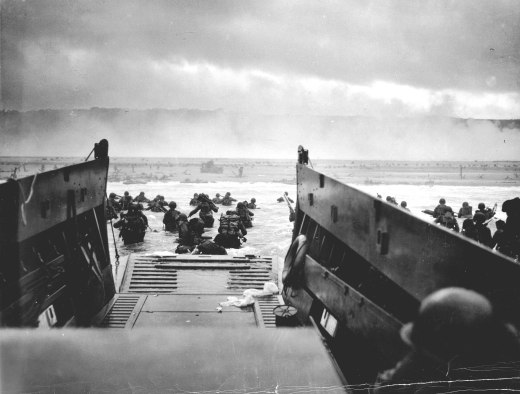
The Allies launched the invasion of Western Europe with Operation Overlord, better known as D-Day- June 6, 1944.
As a veteran of the 1st Infantry Division’s 18th Infantry Regiment, there is much history of the attack on Omaha Beach, so I will take some time in solemn remembrance today. (Photo: Iconic image of the 1st Infantry’s 16th Infantry Regiment wading ashore from Higgins Boat landing craft- troop (LCT)under fire at Omaha Beach, June 6, 1944)
I’ve been off the blog, because as you might have heard, 9 of our 1st Cavalry Division soldiers drowned on Thursday during a flash flood that knocked their truck over while they were making a water crossing. It was a tragedy of unspeakable consequences for their families, who lost their loved ones in a horrific accident. One of the dead was a West Point cadet.
With the NHL Combine in the books, I’ll be back to cover some of that ground in the coming days, and I’m setting up a draft podcast with Dominic Tiano and Reed Duthie, where we expect to hit the OHL, which has a pretty strong representation in the 2016 NHL Draft.
Well, it isn’t exactly how we drew it up after the San Jose Sharks failed to make the playoffs a year ago, but here they are- for the first time in the careers of Joe Thornton and Patrick Marleau– the players taken 1st and 2nd overall in 1997- the West Coast apex predators have a chance at winning the franchise’s first Stanley Cup.
For some Bruins fans, it’s shades of Ray Bourque in 2001 all over again. Former Bruins star and captain leaves town and has a chance at winning their only championship, with the Boston NHL club mired in mediocrity. Of course- there’s no real comparison between the sentiment fans had for Bourque and what folks are expressing for Thornton- but it’s kinda similar.
Thornton was a good guy, a heck of a player, but a lousy captain. He wasn’t ready for the responsibility when he was given the ‘C’ in 2002 at age 23. I think he liked the idea of being the team captain, but when it came time to handle the essence of leadership and the sacrifices that come with being a team’s identified leader and the one who has to face the music in good times and bad, Thornton wasn’t mature enough to handle it.
In hindsight, being traded out of Boston was the best thing for him. Playing in California suits Thornton perfectly and it’s interesting to note that he eventually lost the captaincy in San Jose as well. California cool only gets you so far, apparently. GM Doug Wilson obviously made the right choice, as Joe Pavelski has been everything you want from a captain and more. He’s scored the big goals and if the Sharks are going to overcome their 0-1 series deficit, Pavelski will be the guy who leads the charge. He’s a winner. And Thornton is on the verge of earning that moniker for the first real time in his career- it won’t be easy but now is the time for Jumbo Joe to demonstrate the best kind of leadership- setting the example and stepping up.
Being a great captain is different from how someone is measured as a player. That he’s not a top leader is not an indictment of Thornton, because his NHL body of work is Hall of Fame-worthy. However, when it came to anointing him with the mantle of leadership in Boston, it was too much, too soon. And his tenure in San Jose proved that some guys are simply better followers than leaders.
On the flip side, the Pittsburgh Penguins are vying for a fourth Stanley Cup in franchise history, and what would be a second for Sidney Crosby (2009), tying him with franchise icons Mario Lemieux and Jaromir Jagr (1991 and 1992).
After underachieving for much of the year, the Pens pulled an impressive Lazarus act, surging at the most important time possible, and riding the wave of outstanding play from Crosby, Kris Letang, Phil Kessel...(wait, did you say PHIL Kessel?) and rookie goalie Matt Murray.
Big things were expected of the Penguins this year going into the season, so if you had pulled a Rip Van Winkle on the eve of opening night and woke up today, you wouldn’t be all that surprised that Pittsburgh is in the SCF for the first time since they won it all seven years ago. It’s how the Penguins got here that has been so interesting, and it took them a while and a coaching change (hello, Mike Sullivan) to get going, but with a relative unknown in net who’s posting quite a Cinderella story in Murray, they’ve knocked off some good teams to get here.
Flip a coin. A lot of Boston fans are cheering for Thornton, and that’s all fine. Remember- if his team wins it, he will have earned it. He doesn’t deserve to win…no one does.
And as for the pick…draftniks sigh…it’s 29 or 30. What does it matter at this point- where once people thought it might be a lottery selection, Martin Jones dashed those dreams but even choosing at 18 might have netted the team a nice power forward in Max Jones (no relation) or perhaps a later flyer on Julien Gauthier or developmental D in Logan Stanley. No matter…the Sharks have busted those dreams and so you have to figure the pick acquired from San Jose for Jones will be in play come draft weekend. I would be surprised if the Bruins hold onto it if they can flip it for an extra 2nd and perhaps a 3rd (Don Sweeney would likely have to package a pick or prospect) or 4th rounder (typical value for moving out of the end of the 1st). Or, the team might use it as a part of a trade deal to bring back the much-needed NHL help on D. Either way, the Sharks have continued to rub a little salt in the wounds of a lost Boston season.
The 2015-16 hockey season and rollercoaster is just days from being over, but the endless offseason is only getting started.
***
Here’s a guy to keep an eye on, btw: Tri-City Storm forward and USHL Clark Cup champion and playoff MVP Wade Allison. He’s a big, heavy-on-the-puck right wing with size and skill.
He’s shot up the various draft boards and rankings after an outstanding second half of the season, and the Western Michigan University recruit’s stock is surging at the right time.
I’d say his first couple of steps are a little clunky, but he’s a powerful skater in the straight line who does effective work in the high danger areas and along the walls. His tremendous playoff scoring run keyed the Storm all the way to a sweep of Dubuque in the Clark Cup final.
Don’t sleep on this kid (and forget about getting him in the 3rd round if you’re thinking he’s going to fall), who seems to have it all including an impressive personality to boot.
TSN 1260 radio (Edmonton) host and friend Allan Mitchell aka “Lowetide” had yours truly on today to talk about the Memorial Cup.
We covered 2016 draft eligibles from the London Knights powerhouse Matt Tkachuk, Jesse Puljujarvi and Olli Juolevi, then segued over to B’s prospects Jake DeBrusk and Jeremy Lauzon, before going back to the draft. Covered the bases on: USA NTDP d-men Adam Fox and Ryan Lindgren, plus a little on Trent Frederic, Will Lockwood and then closed out on UConn freshman Tage Thompson. Also was asked about Oilers prospect and Bay Stater (North Easton, Mass.) D John Marino (who just won a Clark Cup with the USHL’s Tri-City Storm and is Harvard-bound), and answered. Boom.
Here’s the audio…I come on at about the 8:15 mark. Thanks as always to Al and his producer Lieutenant Eric for having me on.
 scoutingpost