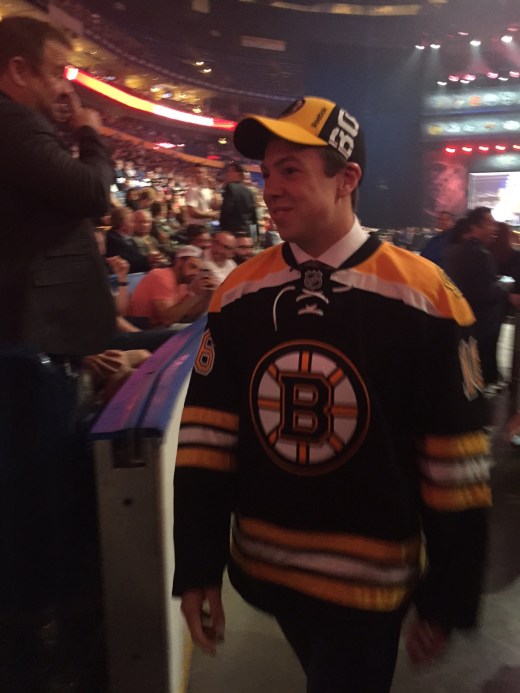
Getting to know Charlie McAvoy

McAvoy1

By the time the Boston Bruins and owner Charles Jacobs stepped up to the podium at First Niagara Center in Buffalo to announce the team’s first draft choice with the 14th overall selection last Friday, it was all but fait accompli that one of Boston University defenseman Charlie McAvoy or Boston University recruit defender Dante Fabbro out of Penticton was going to be the name called.

Both were available, both were right-shot defensemen, both represented not only what many would consider the top talent available at that spot, but were also filled a clear organizational need for the B’s.

He stumbled over the words, but the younger Jacobs, who was born in Buffalo as the son of Bruins owner Jeremy Jacobs- CEO of the Western N.Y. Delaware North Corporation- called McAvoy’s name and after a season of frustration and an epic meltdown over the last 30 days of a year in which the B’s had largely overachieved before crashing to earth in March and early April, Boston had their man.

“Charlie’s one of those players who can do a little bit of everything,” one NHL scout for an Eastern Conference team told the Scouting Post in Buffalo before the draft. “Some are talking top-10 for him, and I could see that. He has the talent for it. More realistically, I see him going around 15-20, but that’s not a knock on him. He’s got that wide body and a natural knack for getting up in the play. With his skating he can push it at both ends, and that’s so important in the NHL these days. He’s also a bit of a character, too. He totally rocked our interview…we’re not in a position to get him, but we all kind of looked at each other when he left and thought, that’s a good kid right there.”

McAvoy is a nice fit in Boston with his blue collar roots. He grew up on Long Island the son of a plumber and fireman who was a natural at hockey but came from a large family, and finances did not permit him to continue playing the sport at the higher levels. A staunch NY Rangers fan, hockey remained his favorite after moving onto other sports like football and baseball, but he vowed to do what it took to allow his son to stay in hockey if that’s what Charlie desired.

That desire took McAvoy through the Long Island Gulls and New Jersey Rockets minor hockey programs before he landed a spot with the U.S. National Team Development Program in Ann Arbor, Michigan (Team USA moved to Plymouth, Mich. before the start of the 2015-16 hockey season). While there, he emerged as a legitimate first-round NHL option, and carried that potential forward to fruition in his very own Empire State on June 24, 2016.

Born on December 21, 1997, the younger McAvoy missed the Rangers’ first and only Stanley Cup victory since 1940 by three-plus years. He was a Broadway Blueshirts fanatic whose first favorite player was Hockey Hall of Famer Brian Leetch. To this day, Leetch remains the player he most tries to emulate in his playing style. At the rate he’s going, it’s not outside the realm of possibility that McAvoy could develop into a successful NHL star with similar attributes.

“I’m at a loss for words; it’s an unbelievable feeling and I’m so happy to be a part of this,” McAvoy said after the selection and he made his way into the bowels of the arena to meet the press for the first time as a member of the Boston Bruins. “I’ve gotten close with (the Bruins) this year and I’m sure my friends at home are happy, but I’m kind of cutting the ties with New York sports. Boston’s an unbelievable city and it’s a great place with great people and I’m happy to be staying there.”

Although not tall, McAvoy has a thick, strong build. His BU coach, David Quinn, spoke to the Scouting Post (TSP) after the selection briefly and credited the newest Boston first-rounder with putting in a lot of weight room work to get himself into better game shape after arriving, and said that the 18-year-old made significant progress as a player in all facets from the beginning of the 2015-16 season until the end. He also talked of Charlie’s “magnetic personality” and that players want to spend time with him.

“That was something that I worked on a lot- the defensive side of the puck,” McAvoy said. “It was something I needed to grow in and get better in and I feel like I made great strides throughout the year.”

McAvoy is a natural offensive talent. In his own words, he sees himself as a threat to be effective at both ends.

“I’m a two-way defenseman,” said McAvoy. “I can play the offensive side of the puck and that’s something I like to do, but I’ve grown a lot on the defensive side of the game.”

During a pre-draft podcast, TSP likened McAvoy to one of the pirates of old who liked to set his hair on fire before plundering a hapless vessel. He’s a classic push-the-pace, aggressive defender who likes to lead the rush and has the skating and puck skills to carry the puck out of his end on his own and can make all of the key outlet passing and long leads. There are times where his riverboat gambler mentality will get him out of position, but McAvoy has the natural hockey sense to learn from that and with continued strong coaching at BU by Quinn, Albie O’Connell and Scott Young– he’s sure to get better with his reads and decisions.

His defense partner, former BU captain and future Bruin Matt Grzelcyk, had left-seat ride with McAvoy all year, watching the 17-year-old arrive on campus last summer to complete his academic requirements so he could play in the NCAA while other peers remained in high school. That maturity and self-discipline to see it through impressed Grzelcyk enough, but it was McAvoy’s poise and ability that elevated him as the season went on.

EDIT- I managed to exchange texts with Grzelcyk and this is what he has to say about his former teammate and fellow Bruins prospect:

“Playing with Charlie was an awesome experience,” Grzelcyk, who just concluded an outstanding four-year career at BU (two years as captain) after being a third-round pick by his hometown B’s in 2012, said. “Even though he was the youngest player in college hockey last year he was mature both on and off the ice as soon as he stepped foot on campus.

“He’s a great skater who’s tough to knock of the puck and was able to add a bit of an edge to his game; in my opinion, it made his impact on the game even greater. Over the course of the year, I believe he was best when he was able to simplify his game and allow his skill to take over. He was an unbelievable D partner to have, and an even better teammate. I could not be happier to see him picked by the Bruins.”

Now, with his first collegiate season under his belt (he scored three goals, but added an impressive 22 assists in 37 games, which was more than Noah Hanifin had a year ago), he’s looking to kick things up a notch on Commonwealth Ave, after the Terriers took a disappointing step back last year.

“I was joking with (Don) Sweeney, I said- Grizzy and JFK- they can’t get rid of me now,” he said. “They’re unbelievable players and great people. It’s going to be exciting to go through all this stuff with them.”

McAvoy’s national team coach, Don Granato, who left the NTDP to join his brother Tony as an assistant with the University of Wisconsin, talked to TSP about his former defenseman and said that McAvoy has one of those even-keeled yet outgoing personalities- teammates just gravitate to him because of who he is and how he conducts himself. He’s a 1st-round talent and a 1st-round person, he said, citing that McAvoy is one of the most loyal players of any he has coached in his career. “Anything we told him, he soaked up like a sponge,” said Granato. “He wanted to get better, and that kind of loyalty and dedication in a player is something that helps you go the extra mile as a coach.”

That loyalty might have been part of a small theater of the absurd that cropped up Friday night when someone got ahold of a tweet that McAvoy sent in May, 2013 at age 15. For those who might have been under a rock at that time, the Bruins were in the second round of the playoffs against McAvoy’s Rangers and had just taken a 3-0 series lead (they would win it in five games on their way to the Stanley Cup final against Chicago). The die-hard Broadway Blueshirts-supporting teen sent out a tweet expressing his hatred for all things Bruins. It’s a sad commentary when people are so thin-skinned and petty that more than three years later, some were actually holding that against him. If you’re one of those people- do yourself a favor- look in the mirror and give your head a shake. You need some perspective in life, and shame on TSN and any other media outlets who picked up on a teenager’s tweet and made it a circus sideshow on the biggest night of his young life.

“Not necessarily,” was McAvoy’s attempt at diplomacy when a reporter asked him point blank if he “hated” all Boston sports teams growing up (he even chuckled before responding). “You grow up- kinda- I guess you’re taught not to like them (Boston sports) because of the rivalry but I’ve got a Red Sox hat now, so that’s the first step and I’ve got this Bruins jersey, so that’s pretty cool. I’ll just keep growing.”

He then demonstrated what his coaches and teammates talk about when they say what a good, fun guy he is to have in the room, showing one last bastion of loyalty to his New York Giants:

“I don’t know if I can be a Pats fan,” he quipped with perfect comedic timing, drawing an instant reaction from the Boston media (pro tip- we thought it was funny). “But we’ll see. Give it a little a time.”

The Bruins, for their part, could have opted for the more defensively-polished and serious Fabbro. TSP was not shy in saying that Fabbro was the higher-rated option, but at the same time- the margin between the two was razor thin. The British Columbia-bred Fabbro went 17th overall to the Nashville Predators, and will join McAvoy at BU next season. We said it all along- if the Bruins had a choice between the two, it was win-win either way. McAvoy has a higher offensive upside, but Fabbro was a little better defensively. Both are winners, so if you felt like you were sold on Fabbro over McAvoy, just consider that perhaps playing in Boston’s back yard tipped the scales.

With four first-round picks either at BU or headed there next year (Clayton Keller, McAvoy, Fabbro and Kieffer Bellows), McAvoy said that they all got together for lunch on Friday before the draft and that he can’t wait to get going again. Assuming everyone arrives on schedule (there is talk of Keller perhaps playing in the OHL, as the Windsor Spitfires own his major junior rights), the Terriers are poised to be the beasts of the Hockey East.

“I’m excited to be Charlie’s teammate and excited about joining that BU tradition,” Fabbro told TSP before the draft. “Coach Quinn and Albie and everyone has built something special and I’m just looking forward to being a part of it and doing what I can to help the Terriers win.”

As for the Bruins, they admitted to having a tough choice between the two players, and in hindsight- it might have been easier had one or the other come off the board before 14. In the end, they simply liked McAvoy a little more, and Bruins chief scout Keith Gretzky made mention that playing well against guys as much as six years older than McAvoy was one of many factors that tilted the B’s towards him.

“We’re excited with the skill set and the upside he has as as player with and without the puck,” Sweeney told assembled reporters Friday night. “He’s a multi-tool player; we feel like he has offensive upside that will continue to get better. You know, he steps into the college game and you can track where he was in the first half of the season, second half and understand that he got acclimated.

“People had spoken about him maybe to try to do a little too much at times, and he’s playing against guys that are four or five years older in some cases and really handled himself very well. He’s a very physical player at times- we’d actually need to back him off, but it’s another very good quality he has. He can puck-separate; he finds the middle of the ice and as a matter of fact, ‘JFK’ spoke highly of that in terms of a centerman wants the puck, and he wants it in motion when he’s going up ice and I think today, it’s paramount for defensemen to be able to establish more than one option; be able to recognize it, be able to execute it and I think Charlie does it well.”

In the end, McAvoy’s selection infused some excitement at a time the team needed it. He’s headed back to BU for at least one more season, but with his advanced strength and physical maturity, don’t be surprised to see the Bruins bring him out as early as next spring when his season ends. It wouldn’t constitute the impossible to see him turn pro sooner than that depending on how he looks at the B’s development camp the week of July 11, but having him return to school for one more NCAA campaign looks more realistic at this stage. If he takes the anticipated step forward, Boston won’t wait long to get him into their system and see if he can contribute to the NHL roster sooner rather than later.

Even with the optimistic outlook, however, McAvoy knows that the work is only beginning and that he can’t afford to take anything for granted. He’s got some work to do conditioning-wise and one can only imagine that noted Boston strength coach John Whitesides is eagerly awaiting the chance to sink his teeth into McAvoy and tease even more performance out of the youngster’s impressive natural physical package.

“You can’t get caught up in it because this is one day,” he said of the excitement of being a first-round NHL draft pick. “I’m going to enjoy this with my family and my friends but I’ll be at school Monday and I’ll be working out in the morning and I’ll be back in class and that’s really where it all starts: growing and continuing to grow, and getting ready to play in the NHL every single day.”
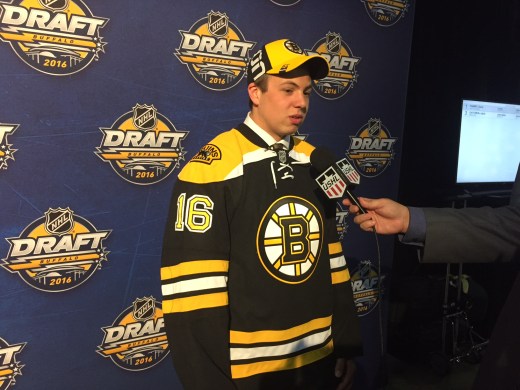
McAvoy2

Bruins prospects in their draft years 2010-2012

As a companion post to what I put up yesterday in going back to look at the Boston Bruins’ roster players and how they were projected in the annual Red Line Report June draft guide issues going back to 1999 (Chris Kelly) through 2014 (David Pastrnak), I thought we could also take a quick peek at the team’s prospects…the good, the bad & the ugly and see what is perhaps in store.

My conclusions from yesterday’s exercise- not enough production from the Bruins with their draft picks. Their best players (not including Zdeno Chara-I didn’t have a RLR 1996 draft year ranking for him, or guys like Tuukka Rask who were drafted by other teams) were all beyond the top-50 as ranked by Red Line, which goes to show you that hitting on first-rounders isn’t the be-all, end-all of developing players. However, there is clearly a dearth of high-end talent: All three of Phil Kessel (2), Tyler Seguin (2) and Dougie Hamilton (5) are gone. Boston had a chance to move up to grab Noah Hanifin (3- 2015) but it didn’t pan out, so they went with three picks in the middle of the round instead.

This gets to the heart of some of the concerns and criticisms fans and observers have voiced in recent years. It’s legitimate, but the B’s have also netted some value selections along the way as well.

So, let’s get onto the prospects, shall we? This post will cover most prospects/players still in the system (and in at least one case- on the way out) from 2010-12.

2010

Zane McIntyre (formerly Gothberg), G Drafted: 165 (6th round- Boston)

Red Line ranking: 154    Key comment: “Has all the technique of a gerbil on roller-skates.”

Observations: RLR nailed the pre-draft projection, and it is true- McIntyre (who changed his last name in 2014) had some technique issues coming out of Minnesota HS. He had a setback last season, as he struggled to adjust to the tempo and skill level in the AHL, but here’s betting that the soon-to-be 24-year-old will bounce back. The 2015 Mike Richter Award winner as the NCAA’s best goaltender has plus character and hockey smarts, but probably needs to settle down and simplify his approach. The shine is off his star a bit compared to where it was a year ago (and it had to hurt watching North Dakota win the 2016 collegiate title without him), but don’t count him out. McIntyre has shown a penchant for mental toughness, and he’s motivated to prove his worth. Watch for something from him this offseason here on the blog.

2011

Alexander Khokhlachev, C Drafted: 40 (2nd round- Boston)

Red Line ranking: 13        Key comment: “Little Russian offensive whiz is vastly underrated.”

Observations: ‘Koko’ slipped to the second round amidst concerns about his average size and relative skating for his diminutive stature, though for several years, he looked to be near the top of Boston’s prospects depth chart. On the plus side, he’s got high-end creativity and to his credit, evolved his game in Providence, going from a bumpy start in 2013 to becoming (now Boston assistant) Bruce Cassidy’s go-to guy up front with two consecutive productive AHL years. Unfortunately, in albeit limited chances in Boston, Koko could never get it going to stick. The debates are endless over whether he was given a real opportunity, but at some point- you have to look past the coaches and focus on the player. For whatever reason, he made barely ripple despite ample preseason ice time and team sources told TSP that Koko did not respond very well to what the coaches wanted him to do. His goose is essentially cooked in Boston, as he has reportedly signed with St. Petersburg SKA of the KHL and will return home to Russia unless the B’s can figure out a way to deal him elsewhere for anything they can get. It’s an unfortunate story for Boston, but the reality is- there is plenty of blame to go around for his inability to make it work here.

Brian Ferlin, RW Drafted: 121 (4th round- Boston)

Red Line ranking: 245

Observations: As a previously passed-up player in 2010, RLR wasn’t keen on Ferlin despite his highly productive 2010-11 campaign with the Indiana Ice. Despite an awkward-looking skating stride, the Jacksonville native did some impressive work at Cornell in three seasons before turning pro in 2014. He made gradual but steady progress in the AHL as a rookie in 2014-15, earning a late-season recall to Boston, where he played a solid, grinding game on the B’s fourth line. Unfortunately for Ferlin, he suffered a concussion in the 2014 AHL playoffs, and one game into this past season, took another high hit that aggravated that injury, costing him much of his second pro campaign. His challenge is to work himself back into the mix with so many other similar bottom-six forwards in the system.


Sean Kuraly, C Drafted: 133 (5th round- San Jose)

Red Line ranking: 263

Observations: Acquired from San Jose as part of the return for Martin Jones, the Ohio native joins Austin Czarnik as consecutive Miami Redhawks captains in the B’s system. Red Line was not all that keen on Kuraly in his draft year, ranking him significantly lower than where he ended up going. With a big frame and decent skating in a straight line, he isn’t naturally skilled or all that creative offensively. He looks and acts the part of a solid grinder who will likely transition to the wing at the pro level. A solid middle tier player, don’t expect any kind of extraordinary return on investment, and he’ll likely spend at least one full season in Providence, maybe two before he’s ready to seriously challenge for a full-time NHL position.


Rob O’Gara, D Drafted: 151 (5th round- Boston)

Red Line ranking: 73

Observations: This Red Line favorite went way beyond where that service projected him, but so far- the Yale grad has lived up to the promise he showed as a Milton Academy junior. A big and mobile shutdown defender, his offensive numbers dropped off in his senior season after a surprising junior year. He’s always been a fine skater with agility and fluid footwork even when a gangly teen, so now that he’s filled out to a solid 6-4, 225 pounds- he has the physical attributes to make a run at the pro level. The Long Island native looked real good in late-season work with Providence in the spring, scoring his first pro goal and demonstrating that he belongs. Watch for him to begin the year in the AHL, but it’s not outside the realm of possibility that he could make the big club with a strong camp and preseason or earn a call up at some point during the season. There isn’t a high offensive ceiling, but with his smarts and skating, O’Gara could stabilize the middle pairing one day.


Austin Czarnik, C Drafted: Undrafted (Free agent- Boston 2015

Red Line ranking: 142      Key comment:  “Yet another skilled, entertaining, feisty little dwarf.”

Observations: RLR was ahead of the curve on Czarnik in 2011, when he was ranked in the top-150, but despite being a talented scorer out of Green Bay of the USHL and later Miami University, no one took a flyer on him. Boston surprisingly won the free agent sweeps after he completed his senior season a year ago, and he immediately formed chemistry with fellow free agent Frank Vatrano in Providence and again in their first pro training camp together last September. Although just 5-7, Czarnik has blazing wheels, superior vision and a gritty, energetic game. All he needs is an NHL chance, and he doesn’t appear to be too far away from getting one.


Noel Acciari, C Drafted: Undrafted (Free agent- Boston 2015)

Red Line ranking: NR

Observations: Though not ranked by RLR in the 2011 draft guide, the service was onto him, listing him in the January issue as a player who played a very heavy and physical, but clean game. Four years later, Acciari parlayed that into the captaincy at Providence College and a national championship before signing with his childhood favorite Bruins. Undaunted by the prospect of being an undrafted free agent in a sea of like players, Acciari played hard for Providence and if not for taking a slap shot to the face that broke his jaw, would have made his NHL debut even sooner than he did. Acciari played 19 big league games (1 assist) but impressed with his adept faceoff skills, ability to hit hard but clean (ask Brooks Orpik about that) and ruggedness and mature character as a rookie. He did a fine job as Boston’s fourth line center, and he’ll never be one to put up much in the way of points at the NHL level, but more production would be welcome.

2012

Seth Griffith, RW Drafted: 131 (5th round- Boston)

Red Line ranking: 52       Key comment: “Average size, skating…all he does is light the lamp.”

Observations: Ranked later in the 2011 draft guide, Griffith was even more impressive  the following year, and like Jimmy Vesey, parlayed a superb 18-19-year-old season into a draft ticket in Pittsburgh after being snubbed. Griffith has a smallish frame and is not a dynamic skater, but boy- can he ever score! He finished near the top of the AHL in scoring last season and has an uncanny creativity and knack for generating offense. The biggest issue holding him back is the fact that he might be a classic ‘tweener: a highly effective AHL performer, but simply not fast or strong enough to be a top-six winger in the NHL, while lacking the ideal tools to be an effective bottom-six forward. He’s a heck of a talent, but might not be the right kind of fit to thrive in Boston. The key question is if that is in fact the case- can Don Sweeney leverage him into a helpful return, or will he be lost to another club for little to nothing?


Malcolm Subban, G Drafted: 24 (1st round- Boston)

Red Line ranking: 69                Key comment: “Catches pucks as though they are live grenades.”

Observations: The RLR staff were not fans, as evidenced by Subban’s third-round projection. Boston surprised by grabbing him in the top-25, which was an eyebrow-raiser at the time, mainly because the Bruins didn’t need a goalie and you could make a convincing case that he wasn’t the best player on the board. In fairness to Boston, the talent level in 2012 dropped off a steep cliff in the first around 20, so Subban wasn’t a terrible gamble to make, but he’s struggled to establish himself as the team’s future option in net. Last season, he suffered a lower body injury and then was pretty rotten in his first month of play as he worked through some movement issues. However, in early December through the end of January, it was  as if someone flipped a switch- he played the best hockey of his pro career to date. Then, during warmups against Portland, he took a shot to the throat, fractured his larynx, and was lost for the rest of the season. That’s simply how things have gone for Subban, but he might just get the opportunity to be Rask’s backup this season. The talent is there- even if the luck and playing experience hasn’t been. RLR’s low draft ranking reflected questions about his technique and overall long-term potential…he has yet to prove them wrong for the skepticism.


Matt Grzelcyk, D  Drafted: 85  (3rd round- Boston)

Red Line ranking: 237

Observations: This Charlestown native is another lower-ranked player that the B’s took much earlier, though in the Boston University captain’s case, he looks a lot better than where he was projected. A standout at Belmont Hill Academy before leaving Massachusetts for the National Team Development Program in 2010, the small but speedy and smart offensive blue liner was not a big riser at the draft, and Grzelcyk originally didn’t even plan to go to Pittsburgh to attend in person until he caught wind that it would be well worth his time. After the Bruins selected Subban in the opening round, they didn’t have a pick again until the late third round, and that’s where they grabbed him. He’s had his injury challenges- losing significant time to shoulder and knee surgeries, but with his wheels and natural offensive instincts, he could contribute at the NHL level one day after an AHL apprenticeship first.


Matthew Benning, D Drafted: 175 (6th round- Boston)

Red Line ranking: Not ranked

Observations: At the time, there were whispers of nepotism when the B’s drafted assistant GM Jim Benning’s nephew out of Spruce Grove of the AJHL, but to his credit, the younger Benning is legit and has worked his way into becoming one of Boston’s most underrated prospects. Although he has just average height, Benning is a punishing hitter who moves around the ice initiating contact.  He’s got the vision and a soft touch on the puck to be effective in the transition game, and he also showed some improved power on his point shot this season for the Huskies. He’s not a flashy or dynamic offensive presence, but he chips in with key production, as he did in helping the Dubuque Fighting Saints to the USHL’s 2013 league championship. Banning is positionally savvy with a willingness to do the dirty work and like his dad, Brian, might be one of those players who goes on to fashion a solid if unspectacular NHL career because of his versatility and smarts.


Colton Hargrove, LW  Drafted: 205 (7th round- Boston)

Red Line ranking: Not ranked

Observations: The rugged, older Texas power forward was picked up late and had very low expectations headed to Western Michigan University, but he has improved his offense in each season since the B’s grabbed him in the final round. With his big frame and natural strength, Hargrove showed some unexpected offense this season, doing some grunt work out in front of the opposition net and getting rewarded for it. Sweeney said that Hargrove put in diligent work last summer to improve his conditioning for the AHL and it paid off for him. He’s still a work in progress and will likely top out as a grinding third-line wing (at best) if he makes it to the NHL, but has the makings of a capable power forward and depth player for Boston. He needs to take the next step in 2016-17 and not regress after the pleasant surprise that was his rookie pro campaign.


Justin Hickman, C Drafted: Undrafted (Free Agent- Boston 2015)

Red Line ranking: 153               Key comment: “Strong centre with big shot is not the sum of his parts.”

Observations: The Seattle T-Birds standout was on the radar back then, but wasn’t picked up. The B’s ended up winning a bidding war for his services as a free agent 18 months ago, when he had to shut down his final WHL season for shoulder surgery. His rookie pro year was a disappointment in Providence, but reflects being eased back in more than anything. He didn’t play all that much and the production was certainly nothing to write home about, but Hickman has a natural edge and perhaps an untapped scoring skill set that could manifest itself as early as next year. Having said that- he was an undrafted free agent, so temper the expectations. (Of course- the next guy on the list didn’t have much in the way of expectations and look how that turned out…)


Frank Vatrano, LW Drafted: Undrafted (Free Agent- Boston 2015)

Red Line ranking: Not ranked

Observations: What a story- from the outhouse to the penthouse! Very few were on Vatrano in 2012 not because he didn’t have talent, but because he was overweight and didn’t show the requisite work ethic to give teams confidence in taking a draft flyer on him. Those clubs are all regretting that now, as he not only was a goal-per-game guy as a rookie AHLer (36) but even impressed in stints with the big club. Vatrano rededicated himself in the offseason and came to rookie camp in September about 20 pounds lighter, looking like a completely different player. He always had that laser wrister that struck fear into opposing goalies, but he didn’t always move his feet and without the right conditioning, took longer to recover in between shifts. Now, he plays with manic energy and uses his quickness to dart into skating lanes and get himself into scoring position. He was like a mini-Midas last season- practically everything the East Longmeadow native- we like to call him the Springfield Rifle- touched…turned to gold. He’ll have a lot of scrutiny on him in the new season- he won’t sneak up on people like he did this year, but some guys just have “it” when the puck is on their stick, and Vatrano is one. When you hit on an undrafted free agent like the Bruins did with him after just one full year at UMass, then it takes the pressure off of the lack of success the team has had at the draft.

Coming soon: Bruins prospects in their draft years, 2013-15.


Bruins prospect updates- the Pros

Most of the Boston Bruins’ are in offseason mode. Note, I said most- not all.

Jake DeBrusk’s Red Deer Rebels were eliminated from WHL championship play by the Brandon Wheat Kings, but by virtue of being the Memorial Cup host city, they’ll be playing May hockey once the three CHL champions are decided.

Jeremy Lauzon, who dodged a major scare after taking a skate blade to the neck a few weeks back missed Rouyn-Noranda’s third-round playoff series win over the Moncton Wildcats. He may or may not be back for the President’s Cup series against the Shawinigan Cataractes. The deeper the Huskies go, the better the chance that the B’s may see one of their three second-round picks back in action, but that will depend on medical clearance and the player’s long-term health takes precedence over the desire to have him in the lineup today.

For everyone else, it’s about preparing for the 2016-17 season. I’m breaking up the prospects list into pro and amateur sections, and sliding all of the recent NCAA signings and players who are projected to be playing in the AHL season next year onto the pro side.

B’s pro prospects

Noel Acciari, C (undrafted free agent- 2015): The former Providence College captain finished the season with the big club, playing 19 NHL games down the stretch and impressing with his skating, smarts and effort. The single assist with the B’s is  an indicator that offense will not be Acciai’s strong suit, but given more time to center the bottom line as he gains experience, more production will come. He’s an overachiever who is strong on draws, hits everything forcefully but cleanly, and immediately earned the respect and trust of coaches. He broke his jaw when he took a Chris Casto shot to the face earlier to the season or else, as reported by Providence Journal veteran reporter Mark Divver, Acciari would have made his Boston debut even earlier. He’s signed through next season (pending RFA) at a $792.5k cap hit.

Linus Arnesson, D (2013 draft, 2nd round): The Swedish defender had tougher first full North American season than projected, dealing with nagging injuries for most of the year. Never a player who was thought of as having a high offensive ceiling, he’s mobile and savvy, but more was expected of him. With a year under his belt, Arnesson is a player who could see a Boston opportunity via recall at some point next season if there are injury issues on the B’s blue line, but if he can stay healthy, the focus will be on continued development. Arnesson is under contract through 2017 (pending RFA) at a $817.5k hit.

Anton Blidh, LW (2013 draft, 6th round): Gritty, abrasive forward doesn’t bring much in the way of points potential, but if you’re looking for a grinding energy winger who forces turnovers and plays a heavy game, Blidh’s your guy. Having said that, the B’s have no shortage of forwards who fit in this category, so there’s not a big buzz factor here. He’s got two more years on his ELC (2018) with about a $784k cap hit.

Brandon Carlo, D (2015 draft, 2nd round): One of Boston’s more eagerly anticipated prospects after being the 37th selection in June 2015, the late ’96-born Colorado native is eligible to spend the 2016-17 season in the AHL if he doesn’t make the Boston roster out of camp. At 6-foot-5, he’s highly mobile and a premium shutdown type defender. The jury is still out on his offensive instincts/vision to develop into a higher-end two-way threat at the NHL level, but make no mistake- this guy will play. Last fall, Carlo signed a three-year ELC that will keep him under contract through the 2019 season (RFA) at a rate of $820k per.

Chris Casto, D (undrafted free agent- 2013): Casto posted his best pro season to date, but has the look of a journeyman pro at the AHL level and it’s hard to see him beating out those higher on the depth chart to make a go of it His ELC is up and there’s a good chance that the B’s will allow the former University of Minnesota-Duluth star to hook on with another team.

Colby Cave, C (undrafted free agent- 2015): After signing with the Bruins a year ago, Cave showed some promise in Providence as an effective two-way forward with speed. He’s not a top-six project, but could in time establish himself on the lower lines. With two more seasons left (2018) on his ELC before Cave becomes a RFA ($655k), the former WHL captain is in the fold at a nice rate.

Austin Czarnik, C (undrafted free agent- 2015): The AHL’s leading rookie scorer with 61 points had opened eyes this season. Despite his small stature, he’s a plus-skater with superb puck skills and the hockey IQ to provide offense. He nearly willed Providence to a victory in Game 3 of their sweep at the hands of Wilkes-Barre/Scranton, and is a solid bet to see NHL time with the Bruins next season. He’s signed through 2017 at a rate of $817,500 (RFA).

Brian Ferlin, RW (2011 draft, 4th round): He was greatly impacted with concussion woes this season, his second pro campaign after a promising 2014-15 year that saw him earn a late stint in Boston. A bottom-six winger who can skate and excel in puck possession, Ferlin needs a bounce-back campaign in 2016-17. His ELC ($875k) is up and he is a restricted free agent.

Seth Griffith, RW (2012 draft, 5th round): Providence’s top scorer (23 goals, 77 points in 57 games) saw some very limited time in Boston this season and is still on the bubble in terms of proving whether he can break into a top-six forward role or might be a ‘tweener as someone who puts up points in the AHL, but has trouble establishing himself in the NHL. He’s got the hands and head to score, but the lack of size and speed make it a challenge for him. Griffith’s ELC ($759k) is finished and he’ll likely be tendered a qualifying offer, but whether the B’s dangle him as part of a trade package at some point remains to be seen.

Matt Grzelcyk, D (2012 draft, 3rd round): The Boston University captain signed a two-year (thru 2018) NHL contract worth a reported $858,750 per season (RFA) at the conclusion of his NCAA season. It was a tougher year for the Townie, as he dealt with starting the season late after knee surgery, only to injure his other knee shortly after coming back. His excellent speed and puck-moving ability will make him one of Providence’s top threats in all situations if he doesn’t win an NHL job out of camp next fall.

Colton Hargrove, LW (2012 draft, 7th round): A pleasant surprise, finishing sixth on the team in scoring with 14 goals and 30 points in 66 games. A big, rugged forward- Hargrove’s improved conditioning helped him to have success, but after a productive and impressive middle stretch of the season, he cooled off at the end. There is one more season left on his ELC, which pays him a $737,500 rate (RFA)

Danton Heinen, RW/LW (2014 draft, 4th round): After a tough start offensively, the British Columbia native erupted in the second half of the year for Denver University, finishing as the team’s top scorer and helping DU reach the Frozen Four. He’s a slick, playmaking wing who posted a pair of assists in his pro hockey debut with Providence and is a darkhorse to break camp with the NHL Bruins on the opening night roster come October. He’s signed through 2019 at a $872.5k cap hit.

Justin Hickman, LW (undrafted free agent- 2015): The Seattle Thunderbirds captain did not have the anticipated impact after missing the rest of 2015 to shoulder surgery and signing with Boston. He’s a hard-nosed winger with underrated scoring ability, but took a while to adjust and adapt to the demands of the AHL. Heavy on the puck and willing to play a physical, grinding game- watch for him to take on more of a consistent role next season, with about 15-20 goals at the AHL level a reasonable target to aim for. Hickman is on an ELC that keeps him a Bruin through 2018 at an (unconfirmed per General Fanager) $700k hit.

Alexander Khokhlachev, C (2011 draft, 2nd round): Despite making a difference in the AHL for much of the season, the 40th overall selection was not able to do much with the limited ice time he was given in Boston. There’s not much else can be said that hasn’t been already at TSP- he’s talented enough to be an NHL forward but hasn’t translated being an impact performer on the farm to the big show. Koko’s ELC has expired and he is expected to either be traded to another organization or pursue his Europe options with St. Petersburg, which owns his KHL rights.

Sean Kuraly, C (trade with SJS- 2015): The Miami University RedHawks captain signed for two years (thru 2018 at a $809k cap rate) after finishing a disappointing senior year. Acquired from the San Jose Sharks last June as part of the return for goaltender Martin Jones, Kuraly has good size and skating ability to be more of a two-way center or wing who is heavy on the puck and does the grinding work on the bottom-six.

Zane McIntyre, G (2010 draft, 6th round): A TSP favorite since before he was drafted in 2010, it was a season of ups and downs for the rookie pro. The former star at University of North Dakota has some work to do on technique and mechanics after being exposed at times during the regular season. His performance in Game 3 was a particular disappointment, but he has the drive to roll up the sleeves and get to work, so it will be interesting to see how he responds to the adversity next year. He’s signed through 2017 at a $975k cap hit (RFA).

Colin Miller, D (trade with LAK- 2015): The NHL tools are clearly there for the one-time Kings prospect picked up last draft day as part of the Milan Lucic trade. Although not tall, Miller has a thick build and has the skating and puck skills to be a solid NHL defender, but he also has to show he can think the game enough to log bigger minutes and take care of his own end. Miller’s ELC ($602,500) expired and he is RFA. Expect the B’s to extend him a qualifying offer and we’ll see what happens next.

Rob O’Gara, D (2011 draft, 5th round): Four-year starter and NCAA champion at Yale University finished up his eligibility this past March and signed a two-year ELC worth $925,00 per through 2018.A big (6-4), mobile defender who is sound positionally and can move the puck effectively, O’Gara may need developmental time in the AHL, but could one day join Boston’s blue line to form a pretty good shutdown presence with Carlo.

Malcolm Subban, G (2012 draft, 1st round): After a rough beginning due to a lower body injury, Subban was playing the best hockey of his pro career over a two-month stretch in the AHL when he took a shot to the throat in warmups. A fractured larynx cost Subban the rest of his season and means he has to hit the reset button, so to speak. He’s talented enough to win the Boston backup job this fall, but experience and an extended run as an AHL starter have continued to elude the 24th overall pick. His ELC runs  for one more season at about $863k before he becomes RFA.

Frank Vatrano, LW (undrafted free agent- 2015): The crown jewel of undrafted free agents last year tore apart the AHL (36 goals, 55 points) in 36 games with Providence, and still found time to make an impressive showing in Boston, where he finished the NHL season. The Springfield Rifle (no, I’m not calling him the “East Longmeadow Rifle”- that doesn’t have anywhere near the ring) added eight more goals in 39 games while exhibiting the speed and gusto that is sure to produce more offense at the highest level. Vatrano’s transformation and sheer impact this season earned him AHL co-Rookie of the Year honors (with Colorado prospect Mikko Rantanen) and set him up as a potential key contributor in Boston going forward.

Daniel Vladar, G (2015 draft, 3rd round): After finishing a solid USHL season with the Chicago Steel, the 75th selection last June is a giant (6-foot-6) project with impressive athletic ability. On the flip side, Vladar needs work with his technique and is still pretty raw- it remains to be seen whether he will be in the AHL, ECHL or possibly Europe next season. While not impossible, NHL is about as long a shot as it gets for Vladar at this stage of his development. Signed a three-year contract in late April worth $742,500 annually.

(Source for contract updates: http://www.generalfanager.com/teams/boston-bruins)

Update:

Maxim Chudinov, D (2010 draft, 7th round): After reports that the small, speedy and feisty defender wanted to sign and come over to North America, his St. Petersburg SKA team in the KHL just announced that he agreed to another two-year contract extension. Though it does have several reported provisions to give him an out if he gets an NHL offer or if his salary isn’t paid on time, the Bruins lose his exclusive negotiating rights on July 1. It looks like Chudinov won’t justify Boston’s decision to draft him six years ago, though the door isn’t completely closed. His agent is former NHL defenseman Petr Svoboda. If you can read Russian, here’s the extension announcement: http://www.ska.ru/news/view/ska-prodlil-kontrakt-s-maksimom-chudinovym

(h/t to Dominic Tiano for the update)


Danton Heinen leaves Denver U, signs 3-year ELC

Heinen

As reported here about a month ago, forward Danton Heinen has given up his remaining two years of NCAA eligibility to sign a three-year entry-level contract with the Boston Bruins after they drafted him in the fourth round in 2014.

Several sources told the Scouting Post that Heinen would not be going back school for his junior season back on March 12, citing an eagerness for him to get started on a pro career. He had reportedly told several of his teammates that he would not be back, and so it was just a matter of Boston waiting for his season to end. With the recent news of 2016 Hobey Baker Award winner Jimmy Vesey declining to sign with the Nashville Predators, it’s a reasonable assumption that if Boston was entertaining the thoughts of talking Heinen into remaining an amateur for one more season, they were all about bringing Heinen into their organization immediately.

The ability for college players to choose their own destinations after four years and choices by Kevin Hayes and now Vesey to not sign with the teams that drafted them means that NHL clubs will not hesitate to bring players out of the NCAA sooner now, and if a kid is not altogether thrilled to be a part of that organization, don’t be surprised to see their advisors (read: player agents) leverage tools like burning a year off the ELC in order to get them to come out on the NHL team’s timeline. The Winnipeg Jets also signed Kyle Connor yesterday after just one year at Michigan and taking the hockey world by storm. Connor is the lightning rod that Bruins fans are using to criticize Boston’s first round choices in 2015. It looks like we’ll soon find out how much the team missed out on by passing on the USHL and NCAA’s top scorer in consecutive seasons. Connor’s signing is one more reminder that the old days of guys spending four years in school is getting increasingly rare (though the B’s duo of college defenders- Rob O’Gara and Matt Grzelcyk– did just that)

Getting back to Heinen- the 20-year-old British Columbia native had a slow offensive start to the season, but erupted over the second half, tallying about two points per game to lead the Pioneers to the Frozen Four before ultimately coming up short against the eventual 2016 champion University of North Dakota Fighting Hawks (PC or not they’ll always be the Fighting Sioux to me).

In two NCAA seasons in the Rocky Mountains, Heinen tallied 36 goals and 93 points in just 81 games. Playing on the Pacific Rim line or “Pac Rim” this season from January on, Heinen simply caught fire. After being at well under a point-per-game just as the calendar switched to 2016, he teamed up with fellow left coasters Dylan Gambrell (eligible for 2016 draft) and Trevor Moore (could leave school as a free agent or return- reportedly weighing his options right now) to finish atop the Pioneers with 20 goals and 48 points, adding to his 16 goals and 45 points from a season ago.

PacRimLine


Heinen is about 6-foot-1 and a solid 185 pounds. As a 1995-born player he was passed over in 2013 because he was small and extremely light, but he’s hit an impressive growth spurt since and dedicated himself in the weight room, adding strength and mass to his frame.

A good skater, what makes Heinen arguably Boston’s top prospect along with Zach Senyshyn for the offensive potential both possess, is that he has exceptional vision and hockey sense, to go with one sick set of mitts. He was a center in junior but has been developed as a winger in college under head coach Jim Montgomery, first playing on the left side as a freshman before shifting over to the right (his off-wing) and settling in with the Pac Rim unit. He uses his high IQ to anticipate/read/react and after hitting a lot of posts and not getting much in the way of puck luck in the early going, his talent took over as he racked up the points down the stretch. He’s heavy on the puck and has the intelligence to take on the various responsibilities required of him in Boston’s system.

Heinen is not a flashy or dynamic player who is going to wow you by exploding to top speed in a few strides and putting defenses into near-constant back pedal mode, but what he will do is slow down the play or speed it up depending on the situation. When he gets down below the circles and in between the hashmarks, he’s deadly- either hounding the puck and hitting linemates with accurate passes to set up quality chances or burying goals with a quick release and little hesitation to shoot the puck when the lane is open for him to do so.

Like many young players these days- I caution fans not to jump squarely on the hype train just yet. Heinen is good enough of a player to challenge for NHL duty right away next fall, but that doesn’t mean that the right answer is that he will play in Boston. Frank Vatrano showed that a rookie pro with the right blend of skill and want to can make it with the big club, but we have an extended offseason ahead of us. Before we start projecting what line he’ll be on, how many goals/points he’ll score and whether he should be paired with Vesey (who as of right now until Aug. 15 or unless his rights are traded between now and then is still property of the Predators), let’s take a moment to see how he looks in Providence first. He’s there this week on at ATO (amateur tryout) and his 3-year contract won’t kick in until 2016-17. Let’s see how he looks in his first taste of pro hockey, and then keep in mind that there will be some personnel changes between now and when training camp opens up in mid-September.

I know, I know- what fun is being patient when we can entertain ourselves with endless speculation and line permutations?

For now, Heinen being in the fold is an intriguing step. He’s unproven, but the potential is higher than average and he was a super find by the Boston scouts. For more on him, check out my blog post from before the season began titled “The Curious Case of Danton Heinen” and I walk you down the path of how, as a little known commodity in the BCHL that more than a few teams were quietly tracking, the Bruins appear to have struck gold.

Time will tell…and we won’t know how successful the find was for a little while yet.

Bruins roundup: Czarnik, Griffith up; Tanev to Jets

I’ve been focused on the Jimmy Vesey situation but some key events happened yesterday directly and indirectly related to the Bruins.

The news broke Wednesday morning that Providence College senior forward Brandon Tanev came to terms with the Winnipeg Jets on an entry-level contract that would pay him max money, and take him through the end of the season. Say what?  Great news for the player- he plays fewer than 10 NHL games for a non-playoff club and immediately becomes a restricted free agent (RFA) up for a second contract that will bump him up but put him that much closer to unrestricted status. Good for Tanev, who took the long road but scored the NCAA championship-winning goal a year ago and brings pure speed, grit and a mature two-way game to Winnipeg.

The Bruins wanted Tanev and were reportedly talking to him as late as Tuesday night, but with their playoff race so tight, they couldn’t afford to give him what Winnipeg could. Consider it turnabout from a year ago, when the Bruins successfully wooed Seattle Thunderbirds captain Justin Hickman away from Winnipeg. Like Tanev, Hickman was an undrafted player who had been to Jets development camp and because he was a major junior player, even went to their main camp in 2014. However, in January 2015, when he had to shut it down for season-ending shoulder surgery, the Bruins came calling and he turned down Winnipeg’s offer to sign with Boston. In Tanev, the Jets returned the favor- not that this was a driving force behind the decision, he was a prime target for them and a lot of credit goes to Winnipeg’s Mark White, former Brown University coach and now employed by them as a scout and someone to help that team develop more of a foothold in New England.

Tanev is a good player and would have been a nice add for Boston, but for that kind of a deal, I can understand why the B’s weren’t the ones he went with. The team is right to focus on the players whose rights it already controls- Matt Grzelcyk and Danton Heinen– and they can also turn their eyes to a much bigger prize in Vesey later this summer. DU winger (and Heinen’s Pacific Rim linemate) Trevor Moore could be a target, but I’ve heard major interest in him on the part of the Toronto Maple Leafs and they have more contract room to sign him plus the opportunity to slot in sooner to boot. Regardless of where Moore ends up, he’d be a good get for Boston, but he’s not in Vesey’s class, and it’s likely a situation similar to that of Tanev where they try but won’t be able to win what could be a bidding war for the small but skilled Californian’s services. We’ll see.

The Bruins made emergency recalls yesterday to Seth Griffith and Austin Czarnik.

As mentioned previously on TSP, David Krejci is obviously banged up, but Ryan Spooner did not make the trip to New Jersey. Spooner’s injury is not major, but the team is being cautious with him, so Czarnik appears to be the center fill-in and may become the third NCAA undrafted free agent to play for the Bruins this season (Frank Vatrano and Noel Acciari being the others). Talk about getting bang for your buck! Czarnik was Miami’s captain (interestingly enough- his RedHawks successor Sean Kuraly just signed his ELC with the Bruins this week- let’s hear it for the Brotherhood)

UPDATE: Czarnik returned to Providence as of Thursday afternoon, so it looks like his NHL debut is turned off. For now.

You really have to hand it to the Bruins scouting staff- namely Scott Fitzgerald and Ryan Nadeau– for being so instrumental in finding these gems a year ago. Vatrano (did you know that he’s another player the Jets had interest in- they invited him to a development camp in summer 2014 but he was injured and did not attend) has had a jaw-dropping rookie pro season to say the least. Acciari came in at the beginning of the month and stabilized the bottom line with his speed, savvy and ability to play a clean physical game even if there’s not much in the way of offense. Czarnik, who showed off tremendous chemistry with Vatrano in the rookie tournament and NHL exhibition before continuing the magic in Providence, is a small but ultra-skilled and fast center with high-end hockey sense. He’s a forward version of Torey Krug in terms of his character and dedication to the sport, so it will be interesting to see how he looks with the big club- if not for his size, he would have been drafted and a known commodity coming out of the NCAA.

More to the point- he’s earned this chance to come up and see his first taste of the NHL by traveling and practicing with the big club. We’ll have to see if he makes it into the lineup against St. Louis on Friday, but it’s no doubt an exciting time for Czarnik and his family, and validates his decision to sign with the B’s last year when other teams like the Toronto Maple Leafs were reportedly wooing him as well. It is also telling that Boston did not bring Alex Khokhlachev up in lieu of Czarnik. That should pretty much signal the end of Koko’s tenure with the Bruins- right, wrong or indifferent- he just never quite did enough to stick. We’ve gone over it and whether you feel like he wasn’t given enough of a chance is really moot at this point. One can only hope that the organization can get some kind of asset back in return, but if he bolts for Russia that might prove problematic. In the meantime, Czarnik deserves the audition and he’ll infuse speed, skill and energy into the Boston lineup assuming he plays.

You can question Boston’s draft record in spots, but when the team can plumb the undrafted free agent ranks for players like this trio, it elevates the organization and underscores that it is a team effort and the foundational building blocks and resources are being spent wisely. We’ll see what lies ahead for these youngsters, but the early returns are encouraging.

Griffith is back for the second time this season and it would be good for the former London Knight to give the flagging Boston offense a jolt.

The 2012 fifth-rounder is still looking to carve a niche for himself and there’s no doubting his natural knack for scoring and impressive stick. If ever there was a time for a player vying for a role in the NHL and opportunity was there for the taking, it is now for Griffith.

The Blues are on a major roll and Boston’s chances on paper aren’t good. However, with some new blood and a great game from Tuukka Rask, anything is possible.

TSP Podcast: “Don’t Cry For Me Music City”- the Vesey Report

Jimmy Vesey’s decision to not sign with Nashville this week has created some legitimate hockey buzz.

Rather than write a big post about my own connection and background with Jimmy, one that goes back to his high school years when he was being seriously scouted for the USHL, and address some of the key issues around this situation, I figured I’d do a podcast on it.

It’s 50 minutes, but if you make it through- you’ll know a lot about Vesey’s past and some of the factors that might have played into his decision to part ways with the Predators. I address that team’s reaction and how they essentially burned the bridge with him…assuming he didn’t Alec Guiness the thing over the last week or so (Bridge on the River Kwai reference- check it out if you’ve never seen it). I also talk about the current NCAA loophole that allowed Blake Wheeler to choose his destination in 2008 after being Phoenix’s fifth overall pick four years earlier. Others have followed suit- Vesey certainly wasn’t the first, and if the NHL doesn’t close the avenue available to certain NCAA players that qualify, he won’t be the last.

I take a look at how the Bruins’ players under similar circumstances have fared- Zane McIntyre, Rob O’Gara and Matt Grzelcyk– Vesey’s close friend and minor hockey teammate. He’s on track to sign with the Bruins as well, so this gets to the heart of the premium the organization has placed on developing relationships and the success the team has had in signing its draft picks. Danton Heinen is next. But, if the NHL doesn’t act to provide some kind of compensation, eventually, the B’s could find themselves in a similar spot. So long as we understand that this is the way of life that the current collective bargaining agreement allows for. Don’t blame Vesey- it’s not about compensation with him, it’s about choice and the ability to decide his own NHL destination.

If you can’t get enough of Vesey analysis and news- I covered similar ground today on TSN1260 in Edmonton with Allan Mitchell. You can listen to that much shorter segment here.

Enjoy the audio commentary.

For a bonus, here’s the capsule I wrote on Vesey in the June 2012 New England Hockey Journal NHL draft preview article for the region:

1. Jimmy Vesey, LW South Shore (EJHL) 6-1, 195 Shoots: L (North Reading, Mass.)GP- 45   G- 48   A- 43 PTS- 91 PIM- 43            Central Scouting Final Rank: 77 NA

The skinny: Vesey used the draft snub as powerful motivation to shatter EJHL scoring records with the Kings under Scott Harlow (Bridgewater, Mass.). His skating continues to get better, but his high-end instincts and soft hands mean he won’t get skipped this time. The 2012 John Carlton Memorial Trophy winner as the top area scholar-athlete in hockey has also added about 15 pounds of muscle to his frame thanks to hard work with noted trainer Brian McDonough (Easton, Mass.).

Quotable: “He’s such a strong skater and was a lot more aggressive with the puck this year, taking advantage of his good hands and hockey sense. With his added strength and conditioning, he’s been so much more effective in all areas of his game.”- Gary Eggleston, regional scout, Central Scouting Service

Update: final stats JFK, Grzelcyk, O’Gara

UPDATE 1 3/29/4:15 pm EST: TSP has confirmed that Rob O’Gara is signed and in the fold with Boston. Later this week, he will ink the ATO to join the Providence Bruins for the rest of the season. According to ESPN’s John Buccigross, Sean Kuraly is under contract as well. That would put the Bruins at 48  contracts (see update below), so it might be an indicator that Tanev is a bridge too far, so they’re getting Kuraly in the mix to start his pro career now. Also in play- the B’s could allocate their final contract spot on Matt Grzelcyk (more on him below).

Even more out of the box- Maxim Chudinov still technically belongs to the B’s but with the Russian Ice Hockey Federation holding the cards to a transfer of Chudinov to North America this late in the season, it’s a real long shot (h/t to friend Dominic Tiano for the connecting of the dots here). Just like Sweden did with Carl Soderberg back in 2013, the World Championship is coming up and Russia undoubtedly wants him for that event with Chudinov’s team out of the KHL playoffs. We’re not even sure Boston wants to sign Chudinov at this point (and I expressed my doubts about that in a previous post), but I guess we shall see. I wouldn’t close the book on Tanev just yet, but O’Gara is confirmed and with Kuraly appearing to be as well, that means there is one deal left- unless I got the math wrong, which is possible.


UPDATE 2 3/29/7:54 pm EST: Because of the ATOs, the confirmed contracts for O’Gara and Kuraly do NOT count against the 50-max limit for Boston. B’s currently at 48. Thanks to Dom for getting that information from someone in the know on CBA and contract-related stuff.


Original post:

Three more Boston Bruins prospects’ seasons ended in the NCAA over the weekend, with Boston University and Yale losing to Denver University and UMass-Lowell respectively.

Out of the NCAA tournament are BU Terriers Jakob Forsbacka-Karlsson and Matt Grzelcyk. As reported on TSP yesterday, Rob O’Gara’s Yale Bulldogs fell in OT to UMass-Lowell and he should sign a 2-year entry-level deal with the Bruins real soon. What we don’t know yet is if the B’s will have him report to Providence to finish out the AHL season on an ATO (he won’t be eligible for the playoffs but can remain with the team to practice and work out with the minor league affiliate) but those details will follow.

Grzelcyk is in a similar boat: as a senior, his NCAA eligibility is exhausted, so he needs to be signed. Like Jimmy Vesey, he could opt for free agency on August 15 or sign with his hometown Bruins. TSP reached out to several sources about Grzelcyk’s status, but nothing solid has come back. In similar fashion to Sean Kuraly, the B’s can opt to wait on signing the BU captain until other contracts come off the books at the end of the season, but before the 15 August deadline to retain exclusive negotiating rights. The team could theoretically offer him an ATO to play in Providence, but without an NHL ELC in place, that would entail some risk on Grzelcyk’s part.

There has also been some below-the-radar buzz that the B’s were so impressed with JFK’s poise as a freshman that they might try to sign him right now (by right now I mean this offseason- not necessarily this week or next) and put him in the organization right away. That would be a tough loss to David Quinn’s Terriers, but if events of recent days are any indication, NHL teams might be forced to move earlier on prospects they feel strongly about rather than risk losing them to the existing NCAA loophole. Regardless, a decision on JFK doesn’t need to happen right now, so we’ll see how things play out in what is shaping up to be a very interesting offseason.

Don Sweeney and his team are still focused on trying to make the NHL playoffs, and given how much the Bruins were mocked at the 2015 NHL draft for what they were doing, they’re in a pretty decent spot as of right now. First things first, but signing O’Gara now makes sense and the team can afford to take a wait-and-see approach, especially with undrafted free agent Brandon Tanev still unsigned and the Bruins very much in the mix (though facing stiff competition from other serious suitors).

If Tanev signs along with O’Gara, that puts the Bruins at 49 contracts, so they might have to wait for the 2015-16 deals to expire before moving forward on anything else.

Here’s the final stats on JFK, Grzelcyk and O’Gara in the meantime. Since I covered him in depth in yesterday’s post, O’Gara’s writeup is a little thinner than the Terrier duo.

Jakob Forsbacka-Karlsson, C Boston University (HEA)

2015-16 final statistics:

Games played: 39  Goals: 10  Assists: 20  Points: 30  Penalty Minutes: 28  +/-  4

2014-15 stats differential (USHL)

Games played: -11  Goals: -5  Assists: -18  Points: -23  Penalty Minutes: -10  +/-  -6

Season in review: After being the 45th overall selection in 2015 (incidentally the same exact draft position as that of Patrice Bergeron in 2003 and Ryan Spooner seven years later), JFK opened a lot of eyes around the Hockey East with his smooth, poised and refined game as a freshman, playing all 39 of his club’s games. At least two NHL scouts told TSP at various times during the season that JFK was the top player on the ice in games they witnessed, marveling at his smarts and ability to play such an effective and complete 200-foot game. The Stockholm native who spent the previous two years with Omaha of the USHL (a big reason for the disparity in statistics between his last junior season and first NCAA campaign) finished third on the team in scoring behind accomplished seniors Danny O’Regan (Sharks) and undrafted free agent Ahti Oksanen, a former defenseman who converted to forward as a junior. More impressive than the numbers, however, was JFK’s defensive presence on special teams and a polished, veteran-like ability in the faceoff dot.

Outlook: It would be interesting to see the B’s lure the 19-year-old out of school so soon, but not all that surprising. With the possible (probable?) departure of enigmatic center and restricted free agent Alexander Khokhlachev in the offseason, the Providence Bruins would have room to accommodate another young and talented pivot. One thing that could keep JFK at BU is that he’s on the lower spectrum of his physical development at present. Although he’s about 6-foot-1, he’s still pretty light at under 190 pounds and has one of those body types that will be hard to keep weight on his frame during the season. He’s not one of those players who pushes the pace throughout a game- he’s a good skater with a rangy stride, but at times will slow the play down and be more deliberate in the way he operates. We’ve seen him drive defenders back on their heels, so the capacity exists for JFK to be a dangerous offensive table-setter when he wants to be. Right now, he appears to be well on his way to eventually making the Bruins as a third-line center with top-two line upside who can do a little bit of everything for his team. Forsbacka-Karlsson draws a lot of comparisons to Bergeron in terms of his cerebral approach and versatility, but you couldn’t heap more pressure on a kid by likening him to No. 37, so we’ll have to see where it all leads. For now, the first of two second-round selections as part of the trio of picks acquired from Calgary last June for Dougie Hamilton, appears to be on track for bigger and better things in the not-too-distant future.

Matt Grzelcyk, D Boston University (HEA)

2015-16 final statistics:

Games played: 27  Goals: 10  Assists: 13  Points: 23  Penalty Minutes: 36  +/-  17

2014-15 stats differential (USHL)

Games played: -14  Goals: even  Assists: -15  Points: -15  Penalty Minutes: even  +/-  -15

Season in review: It was a tale of two hockey seasons for the second-year captain and Charlestown native who was picked in the third round of the 2012 NHL Entry Draft by his hometown team. He missed the beginning of the year recovering from knee surgery last May and wasted no time making his presence felt, only to injure the opposite knee just six games into his schedule, forcing him to miss 12 total contests on the year. He tied his previous season high of 10 goals, including netting his first career NCAA hat trick against UMass. His assist totals dipped, but considering the number of games lost to injury, put him on a comparable pace to his junior year totals of 28 helpers and 41 total points. Offense was more of a challenge for BU this season, and that shouldn’t come as a major surprise given the loss of 2015 MVP and Hobey Baker-winning center Jack Eichel to the NHL. Grzelcyk gutted it out by playing through the pain associated with an LBI, and when speed is your bread-and-butter, that’s a significant challenge to overcome. He did it without complaint and aplomb, which is typical of his character and why his teammates elected him captain in a landslide. Twice.

Outlook: Although undersized, Grzelcyk has the speed, vision and hockey IQ to be an impact NHLer one day. The easy comparison in playing style is Torey Krug, but outside of the size, the two are their own defender. The former Belmont Hill and U.S. National Team star who led the Americans to a fourth-consecutive gold medal at the U18 championship in 2012 is a faster skater and plays more of a finesse game than Krug’s natural scrappiness. Krug is an aggressive shooter and despite his woes this season at finding the back of the net is probably the better finisher at the NHL level than Grzelcyk will be if he makes it. Both players can carry the puck out of their own zone and when the defender known as “Grizzy” has the time and gets it cranked up in his own end, he can effortlessly go coast-to-coast with the speed and puckhandling ability to beat defenses that try and stand up at the blue line. As mentioned previously, he has no NCAA eligibility remaining, so the Bruins have until August 15 to sign him to an ELC. Because the team is up against the 50 contract limit, they may opt to kick the can down the road until they get some breathing room at the end of the NHL season. Such a decision doesn’t speak ill of Grzelcyk, and where he fits into the organization’s plans going forward, but might reflect a desire for him to have a chance to get healthy and be fully ready to go for the 2016-17 season. Signing him now and sending him to Providence opens the door to the possibility of further injury; not sure the cost-benefit is there just to play a few pro games to close out the year.

Rob O’Gara, D Yale University (ECAC)

2015-16 final statistics:

Games played: 30  Goals: 4  Assists: 8  Points: 12  Penalty Minutes: 41  +/-  5

2014-15 stats differential (USHL)

Games played: -3  Goals: -2   Assists: -7  Points: -9  Penalty Minutes: +10  +/-  -10

Season in review: The numbers were down from what was expected a year after O’Gara posted his best offensive season with six goals and 21 points, to lead the Yale blue line in scoring. Even so, the senior logged consistent minutes in all situations and played a lot with Ryan Obuchowski (undrafted) as coach Keith Allain’s most trusted pairing. In bigger context, Yale is not an offensive team, but limits goals against and scores just enough to come out on top more often than not. Fixating on the statistics does not tell the entire story, even if the scoring totals were a step back for O’Gara this year.

Outlook: The former prep star and graduate of the Long Island Royals minor hockey program has the size (6-4/220) and smarts plus a top-shelf attitude to develop into an anchor-type presence on the Boston blue line. He’s not a flashy, top-end kind of defenseman but is a player you win with. He’s continued to grow and progress since the B’s took a chance on him in the wake of their Stanley Cup victory, but more seasoning and refinement for him in the AHL before he’s ready for primetime wouldn’t be a bad thing. At the same time, O’Gara has the maturity and physical attributes/experience to be a pleasant surprise at Bruins camp next year and challenge for an NHL job as early as 2016-17. Given that we don’t know what kind of offseason changes lie ahead, especially to Boston’s defense as a whole, trying to project O’Gara in the short term is premature.

Sean Kuraly and Danton Heinen update plus NCAA playoffs & the underrated Matt Benning

As tweeted out over the weekend, several reliable sources told me that Denver University sophomore forward Danton Heinen will turn pro after he plays his last game for the Pioneers. What remains to be seen is how soon the Boston Bruins will sign their fourth-round selection from the 2014 NHL Entry Draft.

With the team at 47 contracts and allowed a max of 50, the B’s have some decisions to make on timing of signings, as in addition to Heinen, there are three other NCAA seniors that will need NHL deals before August 1: Matt Grzelcyk, Rob O’Gara and Sean Kuraly, who was acquired from San Jose last June along with the Sharks’ first-round selection for goaltender Martin Jones. With respect to Heinen, he has NCAA eligibility remaining, and the other guys don’t, so that’s a total of four contracts assuming the B’s sign all of them.

Last weekend, the RedHawks and captain Kuraly saw their NCAA tournament hopes dashed by the University of Minnesota-Duluth, who knocked them out of the NCHC playoffs. That makes Kuraly eligible to sign now and go to Providence on an ATO to finish out the season in the AHL if the Bruins so choose. Whether they will do so is going to come down to an internal organizational decision, as the 23-year-old center is less of a scoring/top-six type of forward and more of a bottom-six/grind-it-out checking player who plays a heavy game but doesn’t bring much in the way of a high offensive ceiling for the NHL.

Kuraly is coming off of a disappointing statistical season- one that saw him crash from a career-best 19 goals as a junior to just six tallies in 36 games with head coach Enrico Blasi’s Redhawks. He’s a good skater for his 6-foot-2, 210-pound frame and has a hard, heavy shot. The Ohio native is not all that creative nor does he bring much of a high-end skillset with the puck. He’s a good faceoff man and penalty killer, so there’s promise here- not everyone can progress on to the NHL and once there, then slot into a prime scoring role. In Kuraly’s case, he’s always been one of those players whose game and versatility translated more as a checking forward at the highest level and there’s nothing wrong with that. One member of the Bruins organization told me hours after the trade bringing Kuraly to Boston went public that they were hoping he would one day be a third-liner for them, so even at the most optimistic period- coming off a career year in Oxford- the B’s didn’t have many illusions about what type of player he was going to project as for them.

That brings us back to Heinen. To say his upside is considerably bigger than that of Kuraly is an understatement. After a tough team start offensively (DU was just 7-7-4 and 3-4-1 in the NCHC back in late December- the Pios finished with a 17-5-2 conference record, going 14-1-1 after the halfway point) Heinen and the Pacific Rim line went into overdrive when the calendar turned over to 2016 and he’s been absolute dynamite since February. The versatile winger who played LW for Jim Montgomery as a freshman after being a center in junior hockey, has been over on the right side this season with Trevor Moore on the left and Dylan Gambrell in the middle. Denver just knocked University of Nebraska-Omaha out of the postseason, with Heinen playing a prominent role and his 18 goals in 36 games leads the club (he’s third overall in scoring behind his linemates with 40 points). Even if the Pioneers don’t win the NCHC (they face stiff competition in the Frozen Faceoff to include No. 1-ranked North Dakota), they’re a lock for the NCAA tournament, which means he could be playing into April and won’t be available until late March or into the middle of April.

We’ll leave it to the Bruins to figure it out- timing is an issue for Heinen signing, but it’s a done deal that he will not stay another year in the NCAA, as he has reportedly told the Pioneers of his desire to move on. So, when the Bruins officially announce the signing (whenever that happens), you’ll know the decision was in the works for some time.

Meanwhile, the B’s will have to see what happens out East as well, with a pair of senior defensemen in Grzelcyk and O’Gara who are wrapping up their collegiate careers. Grzelcyk’s BU Terriers were unceremoniously bounced by the upstart UMass-Lowell Riverhawks, who got some outstanding goaltending from Kevin Boyle (a UMass castoff, btw- I bet the Minutemen could have used him, eh?) but are expected to make the NCAA tournament card, so we’ll have to see how that plays out first.

Also knocked out of the Hockey East tourney in surprising fashion- the Notre Dame Fighting Irish (and B’s prospect Anders Bjork) by Northeastern University, featuring B’s 2012 draft choice Matt Benning on defense. The 21-year-old junior and nephew of Vancouver Canucks GM (and former Boston AGM) Jim Benning is a defense-first guy who plays bigger and with an impressive physical edge for possessing pretty average size at 6-foot, 200+ pounds. He’s posted a career-best five goals this season after not finding the back of the net at all last year (his 24 assists/points still rate as his highest NCAA single season total to date). Benning isn’t going to wow you- he’s a consistent presence if nothing else. He’s not flashy or dynamic but is smart and rugged. He fills lanes quickly, gaps up well, and will pop you good if there are any thoughts of trying to cut to the middle- keep the head on a swivel when Benning is out there for the Huskies. His father, Brian, played more than 500 NHL games as a defenseman and tallied nearly 300 career points, so while his career wasn’t all that long (he retired at age 29), he was an impact two-way threat/effective puck-mover who was at his best in the late 1980s with the St. Louis Blues and Los Angeles Kings. Matt Benning is a chip off the old block- he’s got nice vision, the ability to make an effective first pass and a willingness to join the rush, not to mention the little bit of nasty he brings to bear during the trench battles along the walls and in front of the net.

Come to think of it, young Benning might be one of the most underrated prospects in Boston’s system. He’s rarely discussed or talked about and because he’s a sixth-round pick, he doesn’t get the benefit of the doubt when it comes to NHL draft pedigree. He’s been nothing but solid since the B’s drafted him- helping the USHL’s Dubuque Fighting Saints win the 2013 Clark Cup championship and being one of head coach Jim Madigan’s go-to guys (he was an alternate captain this season). With his active stick and watching him effortlessly slide across the ice to put a shoulder into an encroaching opponent and often times get the better of physical matchups against bigger players, there is a lot to like about Benning and his pro future, even if he isn’t on the tip of everyone’s tongue. Here’s an excellent Hockey East All Access feature on him (including the tidbits about his grandfather Elmer, longtime NHL scout and his efforts to have his son and grandson get involved with figure skating as youngsters to improve their balance, edging and overall mobility):

Everyone is excited to see how NU will do against Boston College (and Ryan Fitzgerald) this coming weekend’s semifinal match in their bid for Hockey East supremacy.

As for O’Gara, he and his Yale second-seed mates were bounced out of the ECAC tourney over the weekend in two close, hard-fought games by the seventh-seed Dartmouth Big Green. Dartmouth’s goaltender stopped nearly 96% of the shots he faced in overtime and regulation wins Friday and Saturday. Yale played well enough to win those games, but the offense failed them at a critical juncture. O’Gara and Yale will find out their NCAA tournament fate (along with BU) on March 20 when the entire field of 16 teams (which includes the automatic-bid six conference champions) is announced.

If neither BU nor Yale get a chance to see their seasons extended, then Boston’s hand could be forced sooner rather than later.

Things are heating up…not just a sign of the coming spring but on the ice for the NCAA playoffs as well.


B’s prospects deep dive 3: Grzelcyk, O’Gara, Lauzon & Arnesson

We’re back with four more B’s prospects- a defense-focused edition that looks at a pair of NCAA players, a major junior D and one unheralded Providence performer who is all but the forgotten man in Boston’s system.

Speaking of unheralded- the next post will take a look at BC junior Ryan Fitzgerald’s progress, plus Ryan Donato, Anders Bjork and Seth Griffith. This blog will continue to be forward thinking…(get it?)

Matt Grzelcyk, D

The Boston University senior has overcome injuries this season to post another fine offensive season from the blue line. He’s already matched his single season-best 10 goals from a year ago, but in 17 fewer games.

Grzelcyk had off-season knee surgery in May, which caused him to miss the beginning of the 2015-16 NCAA season with the Terriers. Unfortunately, after just a few contests back and an immediate contribution on the offensive ledger, he injured his other knee and was lost for several more weeks. However, he came back with a flourish early in the new calendar year and promptly scored his first career NCAA hat trick in the process.

Although he stands about 5-foot-10, Grzelcyk has huge heart and a high-end hockey IQ. He’s an outstanding 4-way compass skater with instant burst, rapid acceleration/top straight-line speed and the ability to move laterally and change direction quickly with smooth pivots and transitions. The 22-year-old Townie pushes the pace by using that pure speed and quickness to lead the rush and has improved his shot significantly from where he was when the B’s drafted him in the third round four years ago.

The two-year captain is more of a skater/puck-mover/distributor in the offensive end than he is a pure trigger man and finisher, but he has the vision and creativity to set the table and finish off plays as one who isn’t afraid to go into the high danger areas and expose himself to a big hit to get pucks to the net. After scoring six total goals in his first two years (57 games- lower minutes/60 than he played as a junior and senior) in the NCAA, Grzelcyk has potted a nifty 20 and counting in the last two seasons (65 games) with a little more to go before he closes out his college career.

Like Torey Krug, Grzelcyk will be forced to prove that he can develop into an NHL defenseman but he’s so dynamic in terms of his skating and ability to get back on pucks quickly in retrieval and then advance the play back up the ice. I avoid player comparisons in general, so I don’t want people to get the idea that Grzelcyk = Krug…they’re two pretty different players once you get past the physical similarities. Grzelcyk will probably beat the Boston veteran (sounds weird typing that, but Krug’s three full NHL seasons and 225 career games affords him that distinction) in a foot race, but Krug’s got a bigger shot and (this year aside) is more of a scoring threat when he uncorks his drives from the blue line and out near the circles. He’s snakebit, but Krug didn’t score 26 goals in his first two NHL campaigns by accident. Both D are good at carrying the puck out of their own end and getting it up the ice with the quick first pass to beat the forechecking pressure or rushing it themselves through the neutral zone and negate any attempt to trap them into surrendering possession. Those are key attributes for the modern NHL rearguard.

Unfortunately, because of Grzelcyk’s size, coaches have to use him in favorable matchups and as Claude Julien has often mentioned when discussing Krug over the past several seasons, the smaller defender has to outwit and play a savvy positional game. Mitigating physical 1-on-1 matchups is the key to not getting overpowered when covering down in your own end, so the more Grzelcyk can help the B’s move the puck out of their own end and maintain possession in the offensive zone, the lest actual defending he’ll have to do.

Factor in the natural leadership and character and he’s the right kind of person and player to bring along and one day put into the NHL lineup. But first things first- he’s trying to get his Terriers back to the national championship after falling short in 2015.

Current assessment: The Bruins are no doubt looking forward to getting this player into their pro system when his college season ends in the next month or so. They took him much earlier than he was projected to go in 2012 and he’s steadily progressed in his development in the Hockey East. He has had two major surgeries, however- his 2013-14 campaign ended early due to shoulder surgery and then he had the aforementioned knee procedure about a year ago. That’s something for the B’s to keep an eye on, but it should not stand in the way of them signing Grzelcyk. Given his dream of playing for Boston and his connection to the team with his father’s position on the TD Garden bull gang, it is difficult to envision a scenario where he would attempt to not sign and become a free agent on August 1. He’ll likely need time in the AHL first but could gradually work into a role in Boston within the next season or two.

Rob O’Gara, D

Brandon Carlo has gotten a lot of attention as a top prospect in the Bruins organization for his size, skating and shutdown potential, but O’Gara is a few years older and plays a more refined game with a similar style and physical package.

O’Gara, who like Grzelcyk, is finishing up his NCAA hockey career after four strong years. The Yale Bulldog was named the ECAC’s best defensive defenseman last season after also putting up career offensive numbers as a junior. The production is down this year, but the Long Island native who turns 23 in July is not the kind of player who should be judged by statistics and offensive output. His three goals and 11 points in 27 games this season are well off his six goal & 21-point effort from a year ago (33 games), but more par for the course in terms of how he’s performed at Yale since arriving for the 2012-13 campaign.

Size and skating are the two main pillars for O’Gara: at 6-foot-4 and about 220 pounds, he’s big and strong, yet mobile enough to thrive in the modern professional hockey circuit. Ever since the B’s drafted him out of Milton Academy at the end of the 2011 draft’s fifth round, O’Gara has impressed with his fluid footwork and smooth, powerful skating stride. Even at his first Bruins development camp (he turned 18 the day he reported to Wilmington), he stood out with his poise and ability to move well and defend his own net. He was an extremely raw young player when drafted, but in the nearly five years since, has developed into one of the more poised and dependable shutdown defenders in the entire NCAA.

O’Gara leads his peers with a quiet tenacity manifested in the near-universal respect he garners from teammates, coaches and scouts. He’s not a rah-rah, in-your-face, fiery leader, but sets the right example and inspires others to follow him through consistency and his natural humility. In his first year of prep school with the Milton Mustangs, he often times had to cover for his higher-risk D partner Pat McNally, but did so with the skill and poise of a polished and seasoned player at that level. Since leading the Mustangs to a prep championship in 2011 (Milton lost the 2016 NEPSIHA/Elite 8 title yesterday to the Gunnery), O’Gara was a member of Yale’s first (and only) NCAA title-winning squad in 2013, his freshman season. He has a proven track record of being part of a winning formula, which is one of the things that attracted the Bruins to him in the first place.

Even as a shutdown prospect, O’Gara is an underrated passer and puck mover. He moves confidently up the ice with his head up, looking to hit forwards in stride to force defenses back on their heels. When the play is coming at him, he keeps the puck in front of him and uses his smarts to angle the carrier away from his net and out to more oblique angles to cut down on quality scoring chances. He’s not an overly physical defender but will make contact and use his natural strength to win board battles. He uses his long reach to make effective poke checks in the open ice. Like any young ‘D’ he has to guard sometimes against running around and trying to do too much, but when O’Gara keeps things safe and simple, he’s difficult to beat 1-on-1.

Current assessment: Like Grzelcyk, O’Gara has been carefully cultivated and developed in the Bruins organization, so the expectation here is that he will sign once he plays his last game for Yale. Whether that means he makes the jump to pro hockey right away or finishes out his semester in New Haven as Cornell’s Brian Ferlin did in the spring of 2014 after signing his entry-level contract with the B’s remains to be seen, however. He’s been patient in terms of his development and a long but steadily upwards developmental curve, and the team has exhibited the same kind of patience as well. It’s probably too much to expect him to jump right to Boston straight out of college, but stranger things have happened. If he goes to Providence to finish out the regular season, he’ll likely benefit from the chance to get his feet wet and experience the faster pace and higher skill level of the AHL before he begins his first full pro season in 2016-17. Regardless, O’Gara appears on track for bigger and better things, and consistently is underrated and overlooked when in fact the organization is solidly and firmly in his corner as a solution player going forward.

Jeremy Lauzon, D

The third of three defensemen drafted out of ten selections in 2015 might provide the best payoff of the trio in pro hockey when all is said and done.

Though not a truly exceptional player in any key area or specific hockey skill, Lauzon nevertheless is above average and more than capable at just about everything. He’s got good (Lauzon is about 6-1, 195 pounds) if not great (6-4, 220+ pounds or more is what is considered ideal in the modern NHL for D) size, and skates well though doesn’t provide dynamic speed and quickness. He’s a deft passer and effective goal scorer from the blue line, and has the ruggedness and smarts to neutralize opposition rushes and prevent players from getting to the front of his net.

Lauzon is putting up the best offensive numbers of his major junior career with the Rouyn-Noranda Huskies in his third season with them. He’s off his goals pace from a year ago (eight vs the 15 he netted in 2015) but with 44 points in 41 contests, Lauzon has already exceeded his 36 points set last season. He’s had to deal with some nagging lower body injuries that have limited his effectiveness in the new year after injuring himself after returning from Team Canada’s World Jr. Championship training camp in December. As one of the final cuts, Lauzon opened a lot of eyes around the CHL this year after being the 52nd overall selection by Boston last June.

Lauzon is a smart player who often does the little things in terms of maintaining his gaps, keeping the proper stick positioning and forcing opponents into committing early. He likes to go for hits in the open ice and will take every opportunity to finish his checks along the boards and remind guys in the other sweaters that he’s there. Though not a feared fighter, he’s willing to drop the gloves to defend teammates and plays a naturally rugged and aggressive defensive style that will translate well in Boston.

Current assessment: Lauzon has work to do in terms of refinements and tweaks to his overall body of work, and unfortunately, as a 1997-born player, won’t be able to jump to the AHL next season. The good news for Lauzon is that after his camp showing in December, he’s just about a sure bet to skate for Team Canada at the 2017 WJC (along with fellow B’s prospects Zach Senyshyn and Jesse Gabrielle I would add) assuming he stays healthy and continues to progress. He’s currently tracking as a potential top-3 NHL defender one day, but will need time to develop in junior. Depending on how Boston’s blue line situation looks in 2017, we’ll have a good read on how much AHL time he might require before he’s ready to stake a serious claim to regular NHL work.

Linus Arnesson, D

Like O’Gara anyone looking at the 2013 second-round selection’s offensive numbers is likely going to think that the smart and poised Swedish defensive defenseman is headed for Bustville.

That’s not the case, though some of us were admittedly thinking that he might develop into more of a two-way threat when Boston drafted him.

The 60th overall pick that year is a lean 6-foot-1 who moves around the ice efficiently with a long, mechanically-sound stride and is known for his consistent and effective two-zone ability. The product of the Djurgardens club isn’t going to wow you on any particular night, as he tends to play a pretty vanilla style. He keeps his stick in passing lanes, makes quick decisions and essentially keeps it simple without taking needless risks. No one is going to mistake him as the next Erik Karlsson, but he’s a more impactful than his four assists in 43 games might attest.

Because Arnesson is a smart and engaged player, he’s picked up fairly quickly on Providence (and Boston’s) zone-oriented scheme after playing more of a man-to-man defense in Europe. It hasn’t been a perfectly smooth transition to date, but when you go back and watch the film, there aren’t many glaring mistakes or issues jumping out at you either. Think about it- how many times do you hear or read about Arnesson and his play in Providence this season? I would submit to you- not very often. And if ever the old adage that says you don’t notice a good defenseman if he’s doing his job properly holds true with anyone, it’s the case with Arnesson.

Current assessment: Because he’s not exciting, dynamic or carries a first-round draft pedigree, it’s easy to overlook or forget about Arnesson. Whether he can carve out a niche for himself in Boston as a solid, steady middle-pairing D who may get you about 10-15 points per season tops but who can likely be paired with a smaller, but more offensively-inclined (read: risk-taking) partner or just never does enough to stick in the Boston organization is something we’ll all have to find out. When Dennis Seidenberg was helping the Bruins win a Stanley Cup and get to the final series of second championship, a lot of people could see his utility. Arnesson is obviously not the same player that Seidenberg is, but he brings the kind of safe, but limited ceiling that every good club needs.


Bruins hammer Penguins in decisive home win

Are the Boston Bruins Dr. Jekyll or Mr. Hyde?

Are they a good team with clear shortcomings on the defensive side that sometimes make them look worse than they are, or a mediocre team that is able to pound opponents so decisively on occasion so as to fool the optimists out there who support them?

The answer just might represent a little of both.

On Wednesday night, the B’s completed a three-game series sweep against the Pittsburgh Penguins, which is a similar team in that it has been a perennial contender since the Sidney Crosby era revitalized the team’s fortunes, but this year has been a shadow of its former powerful self since squeaking into the playoffs at Boston’s expense last spring.

Like Boston, the Pens have a powerful 1-2 punch at center (though Evgeni Malkin was unable to return from injury to help his team at the TD Center last night), a leaky defense made up of game, but  often overmatched 4/5/6 types and a goaltender who can minimize the damage but can’t do it all himself in Marc-Andre Fleury.

As was the case in Dallas last Saturday, the B’s didn’t exactly dominate the contest, as the Penguins came at them early, hemming them in their zone. Tuukka Rask withstood a 13-shot opening period, not allowing any pucks by him, and David Pastrnak scored the third penalty shot goal of the season for Boston to make it a 1-0 contest.

Pastrnak (his eighth) and Penguins forward Tom Kuhnackl traded goals in the second period to set the stage for a critical third period with the B’s still smarting after getting zinged at home the other night against Columbus.

Jimmy Hayes, Landon Ferraro and Brad Marchand, who scored his team-leading 31st goal, tallied three goals on three shots in the final 10 minutes to push the score to 5-1 and give the Bruins a much-needed home victory.

Hayes finished off a brilliant rush by Ryan Spooner, who got the puck from Hayes after Adam McQuaid blocked a shot (after losing his helmet- no fear) and took off like a rocket up the ice, crossing with Matt Beleskey at the offensive blue line to gain extra space. He then approached the net from the left side and threaded a pass right to Hayes, who didn’t miss for his 13th marker.

Ferraro then broke away after slipping behind the defense and getting a home run pass from Dennis Seidenberg, beating Fleury with a top-shelf laser for just his fourth goal of the season. Ferraro also had an earlier fight with Scott Wilson and gave better than he got, showing off the kind of energy that has made him a capable bottom-line player since the B’s snatched him off the waiver wire from Detroit.

Marchand’s final tally was vintage No. 63, as he got the puck from Torey Krug, cut to the net and let a jumpy Fleury make the first move before going around the defender and sprawling goaltender to slip the puck in on the far side.

Rask, for his part, was magnificent in a 41-save effort- he gave up just the Kuhnackl goal, scored off the German forward’s skate after a fat rebound. This is the kind of game that the Bruins typically need from their one-time Vezina Trophy-winning netminder. The defense still gives up a good number of quality scoring chances, but when Rask is on top of his crease and in the zone, he’s as good as anyone else in the league. The problem is- when the B’s go up against clubs with better top-to-bottom roster depth, they have a tough time matching up against teams that have the speed and skill to employ an effective forecheck that disrupts Boston’s timing on the breakout and leads to defensive zone turnovers.

Pastrnak’s performance gives the team multiple reasons for optimism. For one thing, it’s been a tough slog for the 19-year-old, who burst onto the scene a little over a year ago when he was called up in January and then proceeded to become Boston’s brightest hope for the future. Beyond his obvious offensive talent, Pastrnak is an easy kid to get behind because he wears his love of hockey openly, with a wide, infectious smile that reminds everyone who watches him of how all of these pro players began their lifetime association with this sport. Pastrnak is also serious and hard-working. He’s not quite on the same level as Patrice Bergeron was at the same age, but he’s not that far off, either. Pastrnak made the NHL at 18 because he not only gave the Bruins something they desperately lacked, but also because the coaches saw his work ethic and desire to improve manifested at practice. Some people have to be taught by others how to work harder to maximize their natural gifts, but Pastrnak needed no such coaching, and was often the last player off the ice (and still is). Claude Julien and his veteran coaching staff saw that, and so even with the setbacks the second-year right wing has dealt with this season, they’re willing to stick with him and maintain the faith that he can become the regular scorer he’s shown the penchant for in flashes.

Where do we go from here?

The Loui Eriksson trade watch continues, and I’ve been intrigued by the polarized sides on Twitter and the Internet- the two camps that are clearly at odds with one another within the B’s fandom. I explained at length last week why the Bruins will trade Eriksson and try to leverage him into the assets that can allow GM Don Sweeney to more properly address the elephant in the room: the defense.

Although there seems to be a group of folks who believe Eriksson can and should be signed, I have yet to see any plausible explanation from that side on how it will work. Assuming his agent JP Barry wants to secure money and term from his client (and why wouldn’t he?), the Bruins would essentially be rolling the dice that the soon-to-be 31-year-old would be able to maintain his current level of contributions for another four years at least to make an extension worthwhile. While that’s not impossible, the odds are certainly not in favor of that. Eriksson has never been a dynamic skater, so if he loses a step over the next couple of years as many players on the wrong side of 30 tend to do, his production could essentially drop off a cliff. The B’s cannot afford to be shortsighted here- that thinking is what got them into salary cap jeopardy in the first place.

Loui is a fine man and teammate. In a perfect world, we wouldn’t be having this conversation, and in the scope of the here and now, he obviously makes the Bruins a better team than they will be without him. But fans demand that their teams be in the winning mix year after year, and extending Eriksson puts that philosophy in peril. Sure- he’s one of the team’s most versatile and dependable forwards, but one can also make the argument that there are young players in the system that can capably address what Eriksson brings to the club given a little time. They won’t cost upwards of 5.5-6 million dollars a year (at least not right away) and dealing Eriksson gives the Bruins the much-needed coin of the realm: assets in the form of picks and futures that every team covets to off-set the ever escalating salary structures needed to retain the top talent across the league.

Should the B’s prove me wrong and hold onto Eriksson, either extending him or keeping him for the playoffs, we’ll revisit the implications of that when the time comes. Even if he’s not moved at the deadline, they can still flip him to a team that wants his exclusive negotiating rights before the July 1 free-for-all for a middling pick, which is not ideal but better than nothing. If they commit the term and dollars to him, then I think it works in the short run, but could have profound consequences by the years 2018 or 2019. I guess for those who like to live in the now, that may not be such a bad thing.

What we’re figuring out here is that making trades and acquiring the kinds of essential players needed to assemble a winning mix in the modern NHL is easy to talk about, much harder to pull off. It isn’t like Boston is bereft of young defensemen in the organization, but nobody is truly ready to step in and make the kind of difference this team needs right now with a goalie in his prime along with multiple forwards whose window might be closing by the time the B’s home grown blue line talent can make an impact.

Colin Miller has shown he can create offense, but he’s still got much to learn defensively. Rob O’Gara is having a down senior year at Yale but has size and mobility to become a bottom pairing staple after a little seasoning in the AHL. Matt Grzelcyk has the speed and offensive talent to be a two-way threat, but like Krug, will need some time to develop in the minors and will be a wild card in terms of what kind of role he can carve out for himself in Boston. Jakub Zboril, Brandon Carlo and Jeremy Lauzon were all drafted last June and are not realistic options to make a difference for at least another full season but likely two or three more years at the earliest.

That means Sweeney needs to add a key piece now or at least in the coming off season. You have to give to get, and Eriksson represents the kind of asset that can increase the GM’s options, not diminish them. Yes, fans may not be thrilled with the kind of return he brings back in a few days (assuming he’s dealt), but you have to play the long game here and realize that a trade made today could set up the even bigger haul tomorrow (or in about three or four months).

If we’ve learned anything about the recent wins over Dallas and Pittsburgh, it is this- the scores didn’t represent how close the games actually were. The B’s benefited from shaky goaltending play from their opponents, but in the playoffs, when every game’s intensity is ratcheted up a few notches and the better teams can make you pay for every mistake, this Boston club isn’t going anywhere far as currently constructed.

That means you have to live with the tough calls and some short-term disappointment in order to benefit from a potential sustained run of excellence. Ask Columbus fans how much fun it has been to cheer for a team that has always tended to fiddle around the margins rather than make bold decisions to build for the long term and you’re not going to like the answer. Teams like Edmonton and Columbus should serve as a reminder that picking at the bottom of the draft every year is no sure path to contention. The Bruins have the pieces to be a contender, but the team has to be smart about how they streamline the effort.

Making decisions based on emotion, loyalty and what someone did in the past versus what they will do is more of a recipe for failure than success. When it becomes time to come to grips with the fact that Bergeron, Krejci, Rask and Marchand can no longer do what Boston fans have enjoyed and come to expect for so long now, the team cannot afford to have multiple albatross contracts around the neck.

Digging out from that kind of hole could take years.