In Backes aftermath, the Bruins still need a D

Your Scouting Post founder was on 98.5 today with Hardy and Chris Gasper (great guys who know how to ask the right questions, I would add- always love talking hockey with them) and the subject of the Boston Bruins’ elephant in the room- the clear and present need to upgrade the defense naturally came up.

To paraphrase- I talked about a “bridge” D- someone young and talented enough to help grow the team while recognizing that Don Sweeney is not going to be able to likely find a true heir apparent to Zdeno Chara via trade. We now know that Sweeney was trying hard last winter to wrangle Blues veteran and former BU star Kevin Shattenkirk from St. Louis in an aborted deal involving Loui Eriksson and the San Jose 1st-rounder that went from 18th to 29th (the B’s chose USA center Trent Frederic with it after finding no takers at the 2016 draft).

(Audio file courtesy of 98.5 the Sports Hub)

(EDIT- I mentioned Ryan Spooner as a possible “tradable commodity”- I am *not* advocating Spooner be moved at all. I responded to a direct question about the possibility of David Krejci being dealt and responded with my reasoning as to why that is less of a possibility. TSP has been and will continue to be a supporter of Spooner’s as a player who has the modern NHL skill set and has grown immeasurably since Boston drafted him in 2010. However, in order to get you must give and the Bruins’ cupboards aren’t overflowing whenever it comes to enticing assets to trade with. That’s reality.)

With Backes and Troy Brouwer now gone, Shattenkirk probably stays in St. Louis (and I suspect there are some hurt feelings that the B’s snaked Backes with a big-ticket offer the cap-strapped Blues had no chance to match), but Sweeney could strike gold via trade if he can figure out a way to get Jacob Trouba in the fold, for example- Trouba showed enormous promise but his play has fallen off, constituting risk. At the same time- you can do much worse than a physical, skilled specimen in his early 20’s like Trouba. It won’t be cheap, but with David Backes on board the Bruins freight train (it’s certainly not a bullet-speed train, is it?), Sweeney has more trade options available to him than he did yesterday, even if the leverage is debatable. Trouba is just one example- the B’s are undoubtedly looking at other options that might not only be that “bridge” but potentially a talent that could eventually evolve into a star. To say nothing of the impressive crop of recent Boston draft picks who are several years away yet, but could give the team the relief it seeks at the position. The problem with trading for such a promising talent is in the cost, and that’s a drum Sweeney has been beating for some time now. Or more succinctly- it takes two to tango.

“There’s not a level of disappointment,” Sweeney said about his quest for upgrading the defense in Friday’s media conference call to announce Backes and the other signings on day 1 of the NHL’s open hiring period. “If deals don’t materialize you guys both understand the types of players that were exchanged and the quality of players in the last few days. Things have to line up. People do not want to part with those types of players.”

There was talk of an offer sheet (James Murphy and Joe Haggerty doing the initial reporting) potentially being prepared for a defenseman in the days leading up to July 1. My good friend and hockey savant Dom Tiano, who is pretty well connected himself, confirmed hearing similar chatter and was tipped that the team was preparing a buyout in advance. That domino fell with Thursday’s Dennis Seidenberg announcement, which led to the Torey Krug four-year extension. But in our Thursday “3 Amigos” podcast with Dom and Reed Duthie of the OHL’s Hamilton Bulldogs (such a passionate, articulate and informed hockey mind!) Tiano brought up the key point that the buyout was not there (as offered up by former Bruins D turned hockey analyst Aaron Ward) to give flexibility to sign Krug- the B’s had plenty of space to do that all along.

What gets interesting is that the *assumption* (and what’s the old saying about what those do to ‘u’ and ‘me’?) was that Trouba would be an offer sheet target. Entirely plausible…but that was never firmly established.

Now, the thing about offer sheeting anyone is that it is a strategy that invites anger and delayed retaliation. In the gentleman’s NHL, signing to someone to an offer sheet isn’t just burning the bridge…it’s detonating a copious amount of C4 explosive to annihilate it…leaving no trace behind. At the same time- offer sheets have been done in the past with mixed results. The Bruins were reportedly trying to re-acquire the pick they dealt to New Jersey Devils (for the now Carolina Hurricane Lee Stempniak) or the third-rounder Sweeney foolishly peddled to Philly for Zac Rinaldo (can’t defend it, folks- sorry) to give the B’s the kind of flexibility on an offer sheet to avoid paying max cost and the four 1st-rounders (Dom covers this on the podcast, so if you haven’t listened yet, what are you waiting for?)

What does this all mean? Your guess is as good as mine, but there’s chatter that the B’s are looking at moving Adam McQuaid (he and Kevan Miller are redundant for what they provide, but that cap hit on both contracts is anything but redundant- something’s gotta give) and we can’t think Sweeney is finished with shaping his defense.

Let’s go back to Sweeney and more of his comments about the defense yesterday:

“We’ve set a course here to identify some areas that we needed to strengthen,” he said.  “And the last, you know, for the last year, we’re almost to a year on the job here for myself and the number of young players, in particular in defense and some of the center positions that we’ve added, will complement the young players of skill that we have on the wings. And you have to exercise some patience in this regard.

“These players don’t just grow up overnight and turn into NHL players. And we’re going to have to exercise patience, you know. Our group as it stands has a balance to it with hardness of [Zdeno] Chara and Kevan Miller and [Adam] McQuaid. [John-Michael] Liles brings a veteran savvyness that he can play with Colin Miller. Joe Morrow is an emerging player and Torey [Krug], we’re very happy to have him signed. You know that being said, we have other young players in the pipeline that are going to be welcoming an opportunity and we have to at some point in time continue to provide that and let them step up. Will it stop me from pursuing having conversations that I’ve maybe planted seeds or whatever? But again it’s going to take…you know there’s a high acquisition cost for these types of players and I think you’re better served to identify them, grow them and put them in the lineup when they’re ready to play.”

The cynics and skeptics will focus on the last sentence and say that Sweeney is hedging his bets and allowing for the possibility that he won’t be able to get anything done trade-wise. My gut says that as a former 1000+ game NHL defenseman, Sweeney knows his group is in the hurt box without at least one substantial add.

Offer sheet? Trade? I believe that the trade route is far preferable to blasting the bridge he will no doubt incur if Boston goes down that road. The threat of an offer sheet might be enough to get a GM to the table to take Sweeney’s offer more seriously. Hey- if nothing else- we can at least opine that the B’s GM speaks from experience. Whether true or not, that was the talk surrounding the hasty decision to move Dougie Hamilton at the 2015 NHL draft for futures.

I don’t have the answers, but there is certainly an element of fans and observers who are sharpening their knives because of a lack of movement on defense yesterday. Understandable. However, training camp doesn’t open until mid-September, so I would offer up the idea that a little more patience wouldn’t hurt. Ultimately, whether you are pessimistic because the B’s opted to bring in an experienced but aging forward in lieu of finding a way to get a key piece on D, or you are a little more optimistic because Backes gives him insurance and options, we can probably all agree that Sweeney isn’t finished.

Whether his next big move will be seen as an “a-ha!” moment after a series of transactions fell in place to set it up, or it will be more of a “I can’t believe they just (bleeping) did that!” remains to be seen.

What we do know is that right, wrong or indifferent- the Bruins are adding pieces that address what the club’s leadership said was the direction they wanted to go in. We’ll all have to see if they have it right or whether the B’s are headed for rougher oceans ahead.

“I think (our team) has the ability to play in all three zones,” Sweeney said.  “For our standpoint, Riley Nash, you look at possession, you look at versatility to play both center, wing, PK, go up and down the lineup. We’ve still got other young players that I mentioned that are going to be given opportunities in these roles. We need to do a better job. Once we get pucks into the offensive zone, being able to withstand that cycle game and possession, it’s not just going to be about off the rush.

“Albeit, we have skill coming that is going to complement this group and play a little faster pace, that we have balance on the back end that we’re building in depth there. I think that you have to be prepared to play, have an identity, which we will, play a 200-foot game.”


Getting to know David Backes

When the news broke Friday in the NHL’s annual free agent extravaganza that the Boston Bruins agreed to terms with former St. Louis captain and center David Backes, any optimism that the team might be acquiring a player with a great deal of experience and an impressive body of work as a top two-way forward and leader was tempered with concerns about the 32-year-old’s five-year, $30 million pact.

Regardless of what side of the fence you come down on, the 6-foot-3, 225-pound veteran is a multiple 30-goal scorer who spent his entire career with the Blues after being the 62nd overall selection in the storied 2003 NHL Entry Draft, the same one that saw new teammate Patrice Bergeron selected 17 spots ahead by the Bruins in Nashville.Now, 13 years later, the most senior member of the B’s was credited by Backes as one of the key players who reached out to him this week and helped sell him on leaving the only NHL home he’s ever known to try and get Boston back on a winning track.

“He, personally, was one of the guys that I was able to talk to,” Backes said in an afternoon conference call. “I can maybe flatter a little bit now that he’s my teammate, but I hate giving players credit, giving them any edge, when I’m playing against them. But he’s a guy you were pissed at by the end of the game because he never made a mistake. That’s a good way to be successful defensively and then, by the end of the game he typically was producing something [on the] offensive side of the score sheet, too – just a guy that you can’t take a shift off because he’s going to make you pay.

“If you’re going to get anything done against him, he’s always in the right spots, he’s winning draws against you, he’s a fearless competitor, he just keeps going and keeps his mind focused on what he needs to achieve during the game. He’s a winner. He’s won a gold medal, to my dismay. He’s also won a Stanley Cup. You can’t discredit any of those great achievements that he’s had.”

That Backes would have such immense respect for a player of Bergeron’s caliber is not surprising in the least. Natural competitors and leaders gravitate towards one another, after all. And, as the Minnesota native would later reference in his various remarks, those leaders are the ones most responsible for instilling and maintaining a winning culture that everyone in the room gets on board with.

“We need a cohesive leadership group that’s made up of prominent players that have a loud voice and walk the walk and not just talk the talk,” he said. “If you have that – a good four to five guys with those qualities – the rest of the team has no option but to jump on board and fall in line. If that’s what you have, that pretty much cracks the whip on everyone else and that’s going to breed a ton of success.”

Leadership and character alone is not enough, however. Immediate concerns about the signing have cropped up primarily related to the newest Bruin’s age and diminishing returns in terms of his statistics, finishing the year with 21 goals- his lowest output since the lockout-shortened 2012-13 campaign.

“Feeling really well,” Backes replied when asked about the toll his rugged brand of hockey over more than a decade has taken on his body. “I think that physical style has been one of my calling cards for 10 years, and I think maybe if you start to slow down a little bit, and you get a little bit older, your intelligence and your hockey sense and your ability to think the game is accelerating maybe faster than you’re slowing down. And those types of efforts to be efficient I think make – in my world, I think it’s made me a better player, and been able to carry that physical play and pick my spots at key moments, rather than just hitting everything that moves like it’s a rugby match.”

In other words, the old horse isn’t ready for the glue factory quite yet.

“Being able to perhaps finish on certain guys on the other team and other ones, it’s not worth going the extra two, three steps out of your way to expend that energy and to go for that hit,” Backes said.  “I’m 32. I’m not 52. I think there’s plenty of legs and plenty of physicality and energy left in me and the term’s been something that maybe a few people have questioned, but for me, I expect to still be at the top of my game for that last year and be a contributing member for the Boston Bruins and training differences, being able to really take care of my body, listening to it and just give everything I’ve got and I think that’s the way I’m going about it and I would expect to be really good in that fifth year still.”

All the heart and want to in the world won’t matter if the machine breaks down or the player is unable to match the previously high-end performance that he was known for as a member of the Blues who spent the last five years wearing the captain’s ‘C’.

Boston GM Don Sweeney naturally sold his signature acquisition to date as someone who will be part of a winning formula going forward, even though the more pressing need of at least one defensive piece to upgrade the back end was conspicuously absent from his list of transactions today.

“We identified David from day one as the type of player that would play with and complement Patrice and David Krejci and allow us to have flexibility, be it this year with, you know, if he wants to move to the wing in a production role or a matchup role,” Sweeney said.  “You know if you look at the defensive zone starts that David Backes had over the course of his career, it’s phenomenal that he’s produced at the level he has. He’s now got the chance now to play either with Patrice or David Krejci or play amongst them in a balanced lineup that allows him to be in an offensive situation with Krejci and maybe even backup Bergeron from that standpoint. So I think it adds the balance to our group, you know. And if Ryan Spooner continues to emerge and play the way that he’s capable of playing on a consistent basis and David Backes moves to the wing we’re going to be a better organization.”

Despite some of the more advanced analytics that showed Backes’ effectiveness in positive puck possession declining, Sweeney pointed out that the veteran still represents a clear upgrade for the B’s going forward.

“We have on the horizon a number of young, skilled players that I think will benefit, as I mentioned, will continue to play with Marchand, with Bergeron, with Krejci, and now with a Backes type,” Sweeney said. “He can then slide into players that come in and identify themselves handling bigger roles, then he can slide into different positions. I just think the versatility of this player and the leadership qualities speak for themselves.

“And his production, we expect it to continue. It took a drop this year, but that’s the age-related studies that everybody looks at and realizes that you know what you’ve signed up for in this player, that if the commitment to the term and from the ownership standpoint, we were all on board. We’re trying to win. The number of players we have, as I mentioned, with the younger players, I think it’s going to be a good complement.”

Not always the most fleet of foot, Backes is one of those more powerful skaters who uses a full head of steam to drive the net and score goals through grit and will as opposed to generating a highlight reel package off the rush. As he gets older, the foot speed and quickness are sure to diminish, so Backes addressed what is likely in store with him in the lineup.

“I don’t think the game’s getting slower,” he said. “I think that it’s a fast game, but if you start to manage the puck in the right way, and you can occupy the offensive zone and do a lot of the things that teams that are heavy and control the puck and occupy zones do, it’s not a track meet up and down the ice.”

The track meet…something the Bruins have been ill-prepared to compete in for years, even as the NHL has undergone a clear paradigm shift to more of a speed/transition and skill game, is one of the chief concerns among observers and fans who saw the team often unable to match the pace and tempo of those higher-end clubs who were among those playing well into late May and June.

“With Pittsburgh winning the Cup, a team that was kind of designed on that track meet, let’s go, let’s see who can skate the fastest up and down the ice, there may be a trend or a tendency to start to build teams like that,” said Backes.  “But you’ve also seen other teams in the L.A. Kings, the Boston Bruins, in recent history, win playing that heavy game, and maybe not having the fastest team, but winning every battle that you get into, being able to control the puck once you get it and then owning the important areas of the ice which is in front of the net.”

The consistent net-front presence, which is something Backes is sure to provide, is another area the Bruins have been lacking in. They’ve also lacked a consistent set of forward lines, which is something the newest free agent vowed to address, even though there was discussion about what position might have been promised to him ahead of time.

“I’m into winning games, so if Claude (Julien) thinks that we’re going to win more games with me playing wing then I’m in,” Backes said.  “If he thinks that we’re going to win more games with me playing center, I’m in. Whatever he thinks, you know, I’ll do it to the best of my ability. And you know it’s one of those things where it may be schedule dependent, it may be opponent dependent, it may be dependent on a bunch of different variables, but we’re going to have a game plan to win and we’re going to go out there and execute it.”

Sweeney echoed the sentiment of being flexible and basing it on ideal matches, allowing the coaches to leverage the veteran’s flexibility.

“We’re going to let it play out,” he said. “We look at the fact that the penalty killing was an area that we needed to address. He’s really good at that.”

Center or wing? Wing or center? Don’t expect to have it figured out in July.

“The strength up the middle of the ice, as I mentioned. Ryan Spooner, it will be a great challenge for him to occupy that spot or play next to one of these centers,” Sweeney said. “The guys that emerge as being able to handle the minutes and the situations are the ones that are going to play. It’s just a real good opportunity for anybody, any younger player coming into this organization is going to be put in position to play with really unique players. And we’ll find the right complements.

“If that means David gets to move to the wall to play with one of the top two guys in a producing role, that’s okay. We’ve now been in a position where if we want to go four deep, which we generally have when we’ve had success, where’s the matchup come from the other side? The other teams may find it difficult to play against the top centers that we have. So we’re going to let it play out.”

Ultimately, there are those who will embrace Boston’s newest acquisition and what he could bring the team, even if they acknowledge that Sweeney and Co. are accepting risk by offering term and value on a player who is on the wrong side of 30. Those are entirely valid concerns, but at the same time- it is not a zero sum game. Backes is a hands-on leader who will complement Boston’s existing leadership core, several of whom tend to be a little more quiet and passive as opposed to direct and confrontational. The B’s have no problem with leaders who set the right example, but when players aren’t pulling their weight or doing the things necessary for team cohesion and success, Backes is the kind of guy who will likely get in someone’s face. He’s got the proper body of work and cachet to do it, too- whether he wears an ‘A’ on his Bruins sweater or not won’t matter one bit.

“You talk about the character piece, the leadership qualities and his willingness to want to win and it aligns with the guys that have won,” Sweeney said. “And the more we can surround our team and identify our team in that regard – now, this all being said, that our younger players have to step forward, emerge, have the opportunity to take a hold of it, and these guys are going to be the leading core to get us to where we want to go, and our younger players have to jump on board.”

Backes sees the world in relatively straight forward fashion, and that was evident when he addressed his desire to make Boston his new hockey home:

“Every time I had a conversation with someone from the organization, that kind of goosebump feeling on your arms and that emotional connection and thought process towards what it would be like to maybe have a different sweater and be able to join what they’re trying to do in Boston really just kept building,” Backes said. “And then the opportunity presented itself not too long after 11 (a.m.) struck. Once (the agent) and Don Sweeney figured out the numbers, it was let’s move on with this and sign the deal because it makes so much sense on so many levels.”

This signing might not make sense on as many levels to some, but one of Boston’s priorities in the offseason was to get tougher to play against, and they succeeded on paper with the Backes acquisition. Time will tell if it will work out as planned, but for now- one veteran is in the fold to help shore up an offense that lost Loui Eriksson’s 30 goals and strong two-way play to Vancouver.

There is still much work to be done, however, with a blue line that is still at least one key upgrade away from being playoff caliber.

The July 1st transactions were a start, but the offseason grade is still incomplete.


Bruins sign six: still looking for that D upgrade…

While waiting for Bruins GM Don Sweeney’s conference call to recap the David Backes signing and day 1 of NHL free agency, here are some more names to ponder. Some are old, some are new…some are…what’s that old saying about something blue again?

From the team’s release:

BOSTON, MA – Boston Bruins General Manager Don Sweeney announced today, July 1, that the team has signed the following six players: defenseman Tommy Cross (one-year, two-way contract through the 2016-17 season worth an average annual value of $600,000 at the NHL level), goaltender Anton Khudobin (two-year contract through the 2017-18 season worth an average annual value of $1.2 million), defenseman John-Michael Liles (one-year contract through the 2016-17 season worth an average annual value of $2 million), forward Riley Nash (two-year contract through the 2017-18 season worth an average annual value of $900,000), forward Tyler Randell (one-year, two-way contract through the 2016-17 season worth an average annual value of $600,000 at the NHL level) and forward Tim Schaller (one-year, two way contract through the 2016-17 season worth an average annual value of $600,000 at the NHL level)…

…Defenseman Tommy Cross signed a one-year, two-way contract through the 2016-17 season worth an average annual value of $600,000 at the NHL level.

Cross, 26, completed his fourth season in the Bruins organization in 2015-16, skating in 64 games with Providence and recording three goals and 20 assists for a career-high 23 points with 97 penalty minutes. Cross also saw his first NHL action in 2015-16, appearing in three games with Boston and registering his first career NHL point, an assist in the Bruins’ 5-3 win at Arizona on October 17, 2015. In his AHL career, the 6-foot-3, 205-pound defenseman has played in 217 games with Providence, amassing 11 goals and 52 assists for 63 points with 261 penalty minutes.

The Simsbury, Connecticut native was originally selected by the Bruins in the second round (35th overall) of the 2007 NHL Entry Draft.

Goaltender Anton Khudobin signed a two-year contract through the 2017-18 season worth an average annual value of $1.2 million.

Khudobin, 30, completed his seventh NHL season in 2015-16, appearing in nine games with the Anaheim Ducks and posting a 3-3-0 record with a 2.69 goals against average and .909 save percentage. The 5-foot-11, 203-pound netminder also played in 31 games with the San Diego Gulls of the AHL in 2015-16, recording a 19-8-3 record with a 2.46 goals against average and a .921 save percentage.

Khudobin was previously acquired by the Bruins in a trade with Minnesota in exchange for defenseman Jeff Penner and forward Mikko Lehtonen on February 28, 2011. Khudobin appeared in 15 games with Boston over the course of two seasons from 2011-13, posting a 10-4-1 record with a 2.13 goals against average and a .926 save percentage. He also played in 60 games with Providence, compiling a 30-23-4 record with a 2.48 goals against average and a .919 save percentage. In his seven-year NHL career with Anaheim, Carolina, Boston and Minnesota, Khudobin has appeared in 100 games, amassing a 44-39-0-8 record with five shutouts, a 2.42 goals against average and a .918 save percentage.

Representing Russia on the international stage, Khudobin has earned a gold medal at the 2014 World Championships as well as a silver medal at the 2015 World Championships.

The UST-Kamenogorsk, Kazakhstan native was originally selected by Minnesota in the seventh round (206th overall) of the 2004 NHL Entry Draft.

Defenseman John-Michael Liles signed a one-year contract through the 2016-17 season worth an average annual value of $2 million.

Liles, 36, skated in 17 games and notched six assists for the Bruins in 2015-16 after being acquired in a trade with Carolina in exchange for Anthony Camara, a 2016 third-round pick and a 2017 fifth-round pick on February 29, 2016. Prior to joining the Bruins, the 5-foot-10, 185-pound defenseman played in all 64 games for Carolina, recording six goals and nine assists for 15 points with 16 penalty minutes. In his 12-year NHL career with Boston, Carolina, Toronto and Colorado, Liles has skated in 800 games, amassing 87 goals and 278 assists for 365 points with 282 penalty minutes. In 40 career playoff games, he has notched four goals and seven assists for 11 points.

The Indianapolis, Indiana native was originally selected by Colorado in the fifth round (159th overall) of the 2000 NHL Entry Draft.

Forward Riley Nash signed a two-year contract through the 2017-18 season worth an average annual value of $900,000.

Nash, 27, completed his fifth NHL season with Carolina in 2015-16, appearing in 64 games and producing nine goals and 13 assists for 22 points. The 6-foot-1, 200-pound forward skated in 68 games with Carolina in 2014-15, notching eight goals and establishing career highs with 17 assists and 25 points. Nash set a career high in goals in 2013-14, when he potted 10 goals and added 14 assists while skating in a career-high 73 games. In his five-year NHL career, Nash has played in 242 games, amassing 31 goals and 50 assists for 81 points with 69 penalty minutes.

The Consort, Alberta, Canada native was originally selected by Edmonton in the first round (21st overall) of the 2007 NHL Entry Draft.

Forward Tyler Randell signed a one-year, two-way contract through the 2016-17 season worth an average annual value of $600,000 at the NHL level.

Randell, 25, completed his first NHL season in 2015-16, skating in 27 games with Boston and producing six goals with 47 penalty minutes. He had goals in each of his first two NHL games played, becoming the first Bruin to do so since Dmitri Kvartalnov opened his NHL career with a five-game goal streak from Oct. 8-17, 1992. The 6-foot-1, 198-pound forward has also played in 172 games with Providence in the AHL from 2011-16, recording 17 goals and 16 assists for 33 points with 314 penalty minutes.

The Scarborough, Ontario, Canada native was originally selected by Boston in the sixth round (176th overall) of the 2009 NHL Entry Draft.

Forward Tim Schaller signed a one-year, two way contract through the 2016-17 season worth an average annual value of $600,000 at the NHL level.

Schaller, 25, completed his second NHL season with Buffalo in 2015-16, producing one goal and two assists in 17 games. The 6-foot-2, 219-pound forward also played in 37 games with the Rochester Americans of the AHL in 2015-16, notching 12 goals and 14 assists for 26 points with 48 penalty minutes.

In 2014-15, Schaller split time between Buffalo and Rochester. He played 65 games with Rochester, recording 15 goals and 28 assists with 116 penalty minutes, while also appearing in 18 games with Buffalo, scoring one goal and adding one assist. In his first professional season with Rochester in 2013-14, Schaller netted 11 goals and added seven assists in 72 games.

Prior to joining the Sabres organization, Schaller spent four years at Providence College from 2009-13, playing in 131 games and amassing 29 goals and 39 assists for 68 points with 161 penalty minutes.

The Merrimack, New Hampshire native was originally signed by Buffalo as a free agent on April 2, 2013.

David Backes Boston-bound with 5x 30


Boston’s first major free agent signing since 2013 when the B’s inked Jarome Iginla to a one-year, incentive-laden deal fell quickly in the opening moments of the annual July 1 NHL free agent frenzy when word broke that St. Louis Blues captain David Backes had signed a 5-year pact with the Black and Gold worth an AAV of $6M.

Here is a dated, but  informative video from the NHL:

https://www.youtube.com/watch?v=6dtqW4vXDsY

What’s interesting is that Backes had been somewhat of a hot topic of late with B’s 1st-round choice and St. Louis native Trent Frederic mentioning him at the draft as his hockey idol and player he most tries to emulate. Now, Frederic will likely share the Boston dressing room with him at some point.

As for Backes- where to start? How about with this OT goal vs. Chicago to kick off the opening round?

https://www.youtube.com/watch?v=1cNyUD6MLYU

We’ll hit the good:

The Blues captain has been one of the most effective two-way centers in the NHL since he broke out with 31 goals and 54 points (165 PIMs) in 2008-09.  He’s never topped more than 62 points in a year, but he’s so valuable as a space-eating, versatile forward who can move between center and the right wing. He plays that physical, grinding game the B’s want to get back to, but he’s skilled enough to be a consistent scoring presence.

Loui Eriksson was also a versatile winger for Boston, but he lacked the size and physicality that the 6-3, 220-pound Backes brings. He’s a year younger than Backes, but where the Bruins were only willing to go four years for him, they went an extra 365 days for their newest player.

There are things Backes can do that Eriksson simply couldn’t. What is interesting to me here is that if the Bruins and Blues had been able to get past the stumbling blocks of a reported bad contract needing to go back Boston’s way in order to consummate that trade, Backes would likely have remained put in St. Louis and the B’s would be working on signing Shattenkirk to an extension instead. It’s interesting food for thought, but the Blues, who allegedly really wanted to extend and keep Backes and Troy Brouwer (who signed with Calgary today) and were more than willing to sacrifice Shattenkirk to get that done, now are essentially stuck with their third choice. Blues GM will have some personal relationship management to do, and in the end- Shattenkirk could very well be a big trade deadline move for the team next winter if he’s not willing to sign on in the long term.

As a captain and character guy- Backes is a proven leader who will instantly bring a needed leadership presence that the B’s have missed. Since Mark Recchi was in the room, the team has lacked for a vocal leader who commands respect beyond the quiet professionals that currently comprise the club’s core of leaders.

Now for the bad:

To get Backes, the B’s had to commit five years and $30 million. That’s a deal that immediately represents risk for the team and the front office that signed him.

Since I raised the point repeatedly with respect to Milan Lucic and his (still awaiting the details) contract with the Edmonton Oilers in terms of not much tread on the tire/much mileage on the engine- it’s the same, if not an even bigger case for Backes, because he’s four years older than Lucic is and has similar wear and tear concerns given the style of game he plays. It takes a heavy toll on the body and if Backes can’t hold up physically in years 3-5, the B’s will be in it deep.

When you look at the potential for the Bruins to get a less-than-average return in the long term on the big contract, the possibility is real that Boston could be hamstrung when it comes to retaining some of the higher-end youngsters who will come due for deals when Backes is still on the books. If he isn’t producing for the club, then they’ll be back to where they were when the previous GM had to move the ever popular Johnny Boychuk for futures at a time when expectations for the club were high. In hindsight, Brandon Carlo and Ryan Lindgren are promising prospects who will in all likelihood play for the Bruins, but there is no question that not having Boychuk for the last two seasons has been an enormous factor in the defense’s plunge to the bottom of the league.

Don Sweeney and Cam Neely are courting disaster with a signing of this magnitude- they aren’t gambling here…because Backes is a proven commodity who despite his age still brings a lot to the table. However, when we’ve watched the way injuries and age have helped speed Zdeno Chara’s decline, it is a fair point to raise here. Backes is leaving his prime, but the Bruins just paid him like a guy who is in it…kinda like Lucic is.

Now, here’s some encouraging news- Backes scored 7 goals and 14 points in 20 playoff games. His level of play went up, as he posted career bests in the postseason and led his team by example to the Western Conference final, where they ran out of gas against the upstart San Jose Sharks club. His previous postseason high for games played was just 9 contests, so it isn’t like Backes has had much experience going deep into the playoffs, but he performed like a star and captain at age 32- that had to be a key in terms of what impressed the Bruins enough to take the plunge.

Unfortunately, the modern NHL continues down a path whereby exorbitant prices are paid in the offseason to players who typically won’t justify those contracts from start to finish. That makes the lower-cost ELC and bridge contracts for younger players more critical than ever, so when people express concern for what could happen down the road to rising stars like David Pastrnak, for example, that shouldn’t be dismissed out of hand, which is what I did. A mistake for which I apologized. I have to think that management is already looking ahead to Pastrnak and figuring out how to keep him. That, in my mind, started last year when he asked for the Bruins to release him to play for his country at the World Jr. Championship and they obliged- even though they incurred all the risk had some catastrophic injury happened to him. That’s the kind of thing that can help strengthen the bridge to longer-term contracts and a presence with the team that showed you respect, though it would be naive in the extreme to think that a player like Pastrnak would turn down a massive offer sheet elsewhere because the B’s honored his request.

Ultimately, Backes is now a Bruin. Fans should look forward to what he can bring as someone who can do just about everything and has come up against Boston in big moments in the past. But, that doesn’t mean embracing a player without taking a hard look at the dollars and cents and where a deal like this could come back to haunt down the road.

The big question is the same for all GMs who are spending available cap space today: are you paying the player for what he did for someone else, or because you think he’s going to provide the same level of performance for you? If the answer is the latter, then we have no choice but to cross the fingers and hope that the worn tread on the tire won’t be an issue. Because if injuries force Backes out for extended periods, or his normal 20-30 goals per season drops to 10, seeing that $6M bite out of the cap will be a bitter pill.

For now, you look at the team today- and they’ve lost a little offense from Eriksson, but gained a measure of size and heaviness- made themselves tougher to play against. Backes is a good fit for Boston, and one can only hope that unlike other big-ticket free agents of the past who signed bloated deals at age 32, that he’ll stave off the effects of Father Time and be a part of a winning solution for the Bruins going forward.

***

The Bruins also re-signed trade deadline acquisition John-Michael Liles to a one-year $2M extension. That’s solid for the player who still has the wheels and puck-moving chops to be an effective middle tier role player. He helped boost the B’s offense in the first 10 days after he was picked up, but like the rest of the club, came down to earth and wasn’t able to make enough of a difference to prevent the late-season implosion.

It will be interesting to see how Liles does with a full training camp and opportunity to adjust to the new coaching staff.

However, Boston’s biggest need remains at the defense position and Sweeney has yet to address it.

Whether that comes via trade involving forward parts that can now better afford to be moved with the Backes addition or the team is looking at another bigger name (there aren’t many) UFA remains to be seen. The right-shooting Jason Demers is still on the market at the time of this writing, but probably not for long.

Shots fired: Report- Eriksson to Vancouver, Khudobin back to B’s

Nick Kypreos reporting that Loui Eriksson has agreed to terms on a 6-year deal with the Vancouver Canucks. AAV to be determined, but have to think it will be around $5.5-6M range- too rich for the Bruins, in all honesty.

The Bruins now just have D Joe Morrow and winger Jimmy Hayes to show for the Tyler Seguin trade that happened just three years ago on July 4th. The criticism will only grow, as once again- it was the return, dummy. Seguin still has a lot of growing up to do, but man- the guy is a super star and the B’s failed to get commensurate value. Period. End of story. There’s no dodging that one, even if I still maintain that I understood the reasoning behind moving him.

What adds fuel to the fire is that the B’s could have flipped Eriksson to St Louis back in February for Kevin Shattenkirk, but neither team could make the money work. Based on connected sources to both teams, I am told that there is a sense of regret that the sides did not work harder to make it happen. The Bruins have now lost Eriksson to free agency for zip and the Blues may have lost David Backes to the open market as well.

Ultimately, though- unrestricted free agency represents a sense of insanity, where teams pay above market prices for older players who more often than not represent the law of diminishing returns. If the Bob McKenzie rumor that the Bruins are in heavy on Backes, (and hey- it’s Mr. McKenzie- no one is going to doubt it for a second) and they end up with him, this one is going to sting for Doug Armstrong, as dealing Shattenkirk to the B’s would have likely given him the cap space to get a deal done with his captain.

Backes makes perfect sense when you look at what the Bruins value- size, ability but leadership and character. They have to get bigger up the middle, and getting him would mean that Don Sweeney can flip other assets for help on defense.

Farewell, Loui- he was a good Bruin and had his best season in Boston at the right time. These guys should be given every chance to cash in, and Eriksson did just that. The B’s wanted him back, just not at the price Jim Benning was willing to pay. Now, we wait to see who the B’s bring in to shore up their non-playoff squad that is weaker than it was without Eriksson.

Also from Mssr. McKenzie- the Bruins are reportedly bringing back goalie Anton “Dobby” Khudobin– the diminutive but plucky netminder who played well for them as Tuukka Rask’s backup before signing with Carolina a few years back. He’s bounced around after failing to earn that elusive No. 1 spot elsewhere, and this is a fine (and cheap) signing to bring in veteran insurance, while Malcolm Subban may still be given every opportunity to earn the backup spot. Jeremy Smith is no doubt gone now that Borat is indeed back.

EDIT: He’s on a 2-year, $2.4 M deal which helps keep the costs down on Rask’s $7M hit- $1.2M for a capable backup is a little higher than ideal, but the B’s know what they are getting and he’s shown he can get the job done when called upon, despite the lack of ideal NHL size for the position.

The 3 Amigos Podcast Episode 2: NHL Free Agency preview & Bruins draft review

The 3 Amigos- LTD (Luedeke-Tiano-Duthie) are back with our second hockey podcast on the Scouting Post after previewing the OHL in the 2016 NHL Entry Draft on Father’s Day weekend.

This podcast not only recaps the Torey Krug extension and Dennis Seidenberg buyout, but looks at the Boston Bruins’ efforts in Buffalo, breaking down all of the players and handing out (admittedly premature) grades at the end. We also preview what is shaping up to be an active NHL free agent frenzy tomorrow.

We’re already hearing rumors that Oilers Prez and GM Peter Chiarelli is bringing Milan Lucic to Edmonton on a big deal on term and AAV. Just a crazy, wild thought here, but isn’t this the kind of thing that got Chiarelli shown the door in Boston? We break it down a bit. You’ll not find many bigger supporters of Lucic than yours truly- but if we’re talking 6 or 7 years at around $6.5-7M AAV, that could pose a huge risk for the Oil. Lucic is 28 and there’s a lot of tread on his tire- this contract if the rumors are right- could end up being an albatross in relatively short order if Lucic’s body doesn’t hold up. We shall see.

We also talk about the Taylor Hall for Adam Larsson, PK Subban for Shea Weber trades and the announcement that Steven Stamkos is staying in Tampa Bay- all huge stories from June 29.

We also dive into the B’s rumors, especially the reported offer sheet stuff and possible moves for Don Sweeney and company.

It’s a veritable smorgasbord and it clocks in at slightly under 1 hour and 45 minutes.    Alas, my esteemed colleague Reed Duthie was having some internet connectivity issues, so he breaks up in parts. Everyone’s a loser because we don’t exactly get every word he says, but he brings plenty of great insights. When you hear the connection go wonky, know it is not your computer acting up on you- the issue was on our end.

Finally, I posted 3 photos of Charlie McAvoy last night and promised to explain them. Our analysis comes at the 1:31:30 mark, so if you must have that burning meaning of life-type question answered for you, skip ahead.

Or listen to the whole thing. This podcast thing is fun! (Thanks for listening and all of the support for our merry little band- enjoy the theme music)


4 more years! Krug signs $5.25M AAV with B’s

ToreyKrug10082

Torey Krug has been consistent in the early going on a defensive unit that has had some tough nights. (Photo courtesy of Alison M. Foley)

More grist to discuss in the forthcoming 3 Amigos- LTD podcast tonight, but the Boston Bruins announced that defenseman Torey Krug has signed a four-year extension worth an annual cap hit of $5.25M.

This simply had to be done.

Krug catches a lot of flak- a lot- because he’s an undersized defender. He’s got terrific hockey sense and the heart of a lion. I can’t get over how so many pretty intelligent people still see him as “just” specialist, but we’ll have to agree to disagree, I suppose- until Krug brings them into the light.

First- the contract…it’s about right for what players similar to Krug are getting. Just look at Minnesota’s Jared Spurgeon (Krug is a better player- more productive and in all three zones, IMO) or Anaheim’s Sami Vatanen. He’s right in the ballpark for what it takes, and I think those who take the stance that he’s “not worth it” or “overpaid” are brimming with suggestions of just how able Boston would have been to offer up the absurd $3-3.5M numbers that have been bandied about on Twitter and certain fan circles. You can feel that way all you want, but reality set in and TSP is fully on board with the numbers Krug got- he earned it.

Another way of looking at it is this: he shot about 1 percent in 2015-16 (4 goals), which was drastically down from his previous 8-9 percent from past seasons. If Krug had gone out and pumped in an additional 10-12 goals over what he got and finished with 55-60 points instead of his career high 44 (40 helpers), then the Bruins would have been paying a lot more to extend him. His low goal totals were actually a blessing in disguise. And don’t forget- he had an injured shoulder and played through it without complaint. If you don’t think that affected his shot, then I have some awesome ocean front property in Manitoba to sell you.

The real issue with Krug is relatively simple- he needs a better defense partner than Adam McQuaid. The former Michigan State captain’s lack of size limits him, so it makes sense to pair him with a bigger, heavier shutdown guy. But McQuaid’s lack of mobility and puck skills contributed to the pair being exposed and exploited at times. When the play did go down into the offensive zone, Boston’s scoring potential was capped by Quaider’s lack of skill/offensive pop. Krug would probably do better with someone like Brandon Carlo or Rob O’Gara, or, if the rumors are to be believed- free agent Jason Demers (assuming the Bruins can win the bidding for him in July). McQuaid is a great guy and his role on this team (though with Kevan Miller, something’s gotta give- the B’s can’t afford to keep both) belongs on the bottom pairing, but the B’s need Krug playing more minutes in all situations, and so he’s got to have a more effective partner going forward.

We owe you a more comprehensive Torey Krug piece and it is coming…perhaps when things settle down a bit. But if there is one guy on this team that many feel like the Boston fans don’t deserve at times because they simply do not get it when it comes to him- it’s Krug. We’ll try, but suspect there is a small percentage of people who, no matter what the statistical and visual evidence says to the contrary, are just going to focus on his lack of size and pigeonhole him as someone who can’t make a difference.

He made a much bigger impact this year than some want to admit, and he’s earned this latest contract, which will take him to unrestricted free agency at age 29 in the summer of 2020. For now, watch him earn every penny.

For a fanbase that claims to be intelligent, informed and passionate about having guys with skill who care, it is utterly inconceivable that anyone is against this signing. In about a year, Krug will be a legitimate bargain at $5.25M through 2020.

If I have any real criticism of the deal- it’s that the Bruins didn’t sign him for seven years instead of four. Yes, I like him that much- he’s worth it.


Farewell, Seids

We have confirmed reports on Twitter and other sources that the Bruins placed veteran defenseman Dennis Seidenberg on unconditional waivers today for purpose of buyout. The team will save nearly $2.9M on the cap this year and another $1.8 and change in 2017-18.

Unfortunately, they’ll have to apply dead money to the cap as well, but the larger implication for the Bruins is that it opens up a roster spot for them.

Seids was acquired at the 2010 trade deadline in one of Peter Chiarelli’s more unheralded deals: he moved Byron Bitz and the 2nd-round pick (Alex Petrovic) previously acquired with Mark Recchi for Matt Lashoff and Martins Karsums to the Florida Panthers for Seidenberg and Matt Bartkowski. When it comes down to it- Recchi and Seidenberg were two major contributors to Boston’s 2011 Stanley Cup victory- they probably don’t win it without them. And all it cost the B’s was Lashoff, Karsums, Bitz and Petrovic (who has become a decent shutdown D in Florida). Those are the trades Chiarelli doesn’t get enough credit for, even though he does his level best make people lose their minds (at least temporarily) when he sent 2010 1st overall pick Taylor Hall to New Jersey for solid defensive rearguard Adam Larsson (the 2011 fourth overall selection) even-steven yesterday. Larsson is a better player than he is getting credit for, but once again- it’s the *return* people have an issue with, for the love of Pete! (We’ll talk the crazy day of June 29 on our 3 Amigos podcast tonight, so check back here on the blog for the audio to post) 

Seidenberg’s Boston career nearly ended before it began- against Toronto in a late-season contest, he took a skate to the forearm that severed tendons and cost him the 2010 playoffs. Had it not been for that, do the Bruins suffer the epic 3-0 series collapse against Philly in the second round that year? He came back strong in 2011 and was precisely the kind of second-pairing, all-around minute-muncher that every championship needs.

He continued to be one of Boston’s rocks on D- a steady-Eddy type who didn’t bring a lot of flash and dash to the lineup, nor did he have a lot of speed, but just knew how to play the position. He was smart, gritty and dependable- exactly the kind of player Bruins fans love and respect.

In 2013-14, Chiarelli made the decision to extend Seidenberg for another four years at four million a pop- a perfectly reasonable deal at the time. Just weeks later, he suffered a devastating knee injury that tore both ACL and MCLs plus other structural damage. It seems inconceivable that we would be talking about Seidenberg making a possible return in the 2014 playoffs, but that’s where we were when the hated Montreal Canadiens dumped the President’s Trophy-winning B’s in the second round in Game 7. In retrospect, he wouldn’t have made a difference had he been cleared to play, but we’ll always wonder if the B’s would have won that series had he not been injured in the first place and was his normal self.

The 2014-16 seasons saw him as a shadow of his former self- he simply was unable to play at his previously high level with damaged knees and a wonky back. Even though he was greatly diminished, Seidenberg never complained and went out to play his hardest.

Unfortunately, it wasn’t enough. It’s a shame a segment of fans kill the Bruins for extending Seidenberg given that nobody had a crystal ball that could have foretold he would suffer a catastrophic injury. But, that’s the way life goes in the short-term memory, what-have-you-done-for-me-lately? world of certain fans. Those folks always seem to have the answers, and for the rest of the fair-minded people out there- really aren’t worth the time or investment for the most part.

In the end, Seidenberg has a loyal following of B’s supporters who recognize and appreciate what he did. I admittedly was not keen on the move when it was made to bring him in (he was a pending UFA) but Chiarelli committed to him, re-signed him, and he became a key contributor to a championship team. Seidenberg is the classic example of not judging a trade (or draft pick) in the precise moment it happens, but to wait and see. We shouldn’t forget that and most of us who saw Seids do his thing for six full seasons and parts of a seventh won’t need any reminders.

The German machine, after years of grunt work in the trenches and selling out/sacrificing his body for his teams, is finally breaking down. It happens to the best of them, so rather than focus on the final two disappointing years in a Bruins uniform- we’ll choose to remember No. 44 in the better times.

You will  be missed, Seids- tanks, I mean- thanks for the memories.

Here are some memorable moments from his time in Boston:

Red line goal on a deflection/direction change

Catches Mike Smith cheating in 2010-11:

Colby Armstrong meets the “German Hammer”:

Seidenberg takes on a runaway freight train (Ovechkin):


More McAvoy…what’s in a series of pictures?

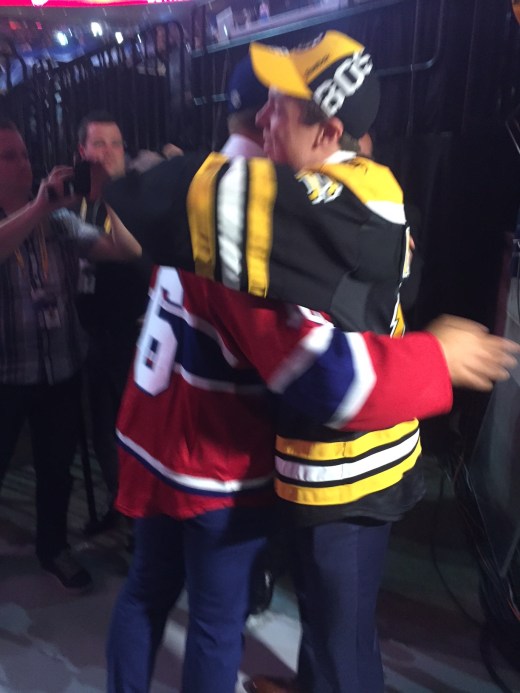
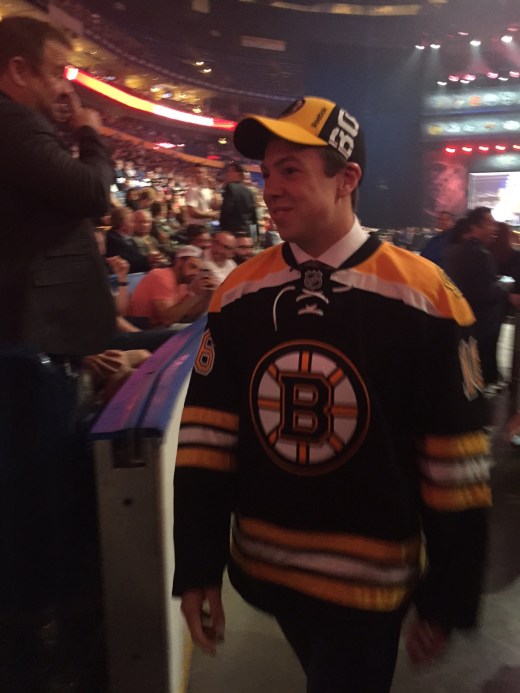
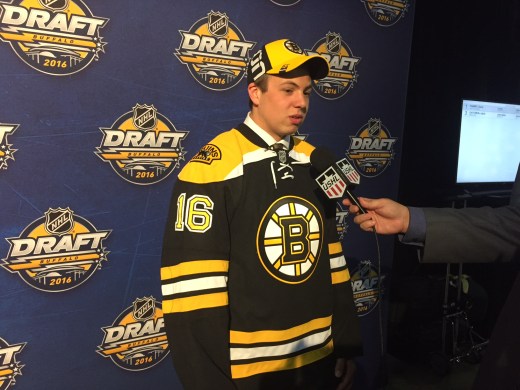
Here are three pictures of Bruins top pick Charlie McAvoy on Friday. Two of them have Montreal first selection and fellow D-man Mikhail Sergachev in them.

What do you think is going on here? What conclusion do you think we can draw from it? I got some interesting insights from both BU head coach David Quinn and Wisconsin assistant Don Granato.

I’ll provide my answer in the next “3 Amigos” podcast featuring Dom Tiano and Reed Duthie. We’re recording it on Thursday and it will go up later in the evening to beat the free agency day mad rush.

McAvoy3


McAvoy and Mikhail Sergachev (Kirk Luedeke photo)

McAvoy and Mikhail Sergachev (Kirk Luedeke photo)

McAvoy5


Getting to know Charlie McAvoy

McAvoy1

By the time the Boston Bruins and owner Charles Jacobs stepped up to the podium at First Niagara Center in Buffalo to announce the team’s first draft choice with the 14th overall selection last Friday, it was all but fait accompli that one of Boston University defenseman Charlie McAvoy or Boston University recruit defender Dante Fabbro out of Penticton was going to be the name called.

Both were available, both were right-shot defensemen, both represented not only what many would consider the top talent available at that spot, but were also filled a clear organizational need for the B’s.

He stumbled over the words, but the younger Jacobs, who was born in Buffalo as the son of Bruins owner Jeremy Jacobs- CEO of the Western N.Y. Delaware North Corporation- called McAvoy’s name and after a season of frustration and an epic meltdown over the last 30 days of a year in which the B’s had largely overachieved before crashing to earth in March and early April, Boston had their man.

“Charlie’s one of those players who can do a little bit of everything,” one NHL scout for an Eastern Conference team told the Scouting Post in Buffalo before the draft. “Some are talking top-10 for him, and I could see that. He has the talent for it. More realistically, I see him going around 15-20, but that’s not a knock on him. He’s got that wide body and a natural knack for getting up in the play. With his skating he can push it at both ends, and that’s so important in the NHL these days. He’s also a bit of a character, too. He totally rocked our interview…we’re not in a position to get him, but we all kind of looked at each other when he left and thought, that’s a good kid right there.”

McAvoy is a nice fit in Boston with his blue collar roots. He grew up on Long Island the son of a plumber and fireman who was a natural at hockey but came from a large family, and finances did not permit him to continue playing the sport at the higher levels. A staunch NY Rangers fan, hockey remained his favorite after moving onto other sports like football and baseball, but he vowed to do what it took to allow his son to stay in hockey if that’s what Charlie desired.

That desire took McAvoy through the Long Island Gulls and New Jersey Rockets minor hockey programs before he landed a spot with the U.S. National Team Development Program in Ann Arbor, Michigan (Team USA moved to Plymouth, Mich. before the start of the 2015-16 hockey season). While there, he emerged as a legitimate first-round NHL option, and carried that potential forward to fruition in his very own Empire State on June 24, 2016.

Born on December 21, 1997, the younger McAvoy missed the Rangers’ first and only Stanley Cup victory since 1940 by three-plus years. He was a Broadway Blueshirts fanatic whose first favorite player was Hockey Hall of Famer Brian Leetch. To this day, Leetch remains the player he most tries to emulate in his playing style. At the rate he’s going, it’s not outside the realm of possibility that McAvoy could develop into a successful NHL star with similar attributes.

“I’m at a loss for words; it’s an unbelievable feeling and I’m so happy to be a part of this,” McAvoy said after the selection and he made his way into the bowels of the arena to meet the press for the first time as a member of the Boston Bruins. “I’ve gotten close with (the Bruins) this year and I’m sure my friends at home are happy, but I’m kind of cutting the ties with New York sports. Boston’s an unbelievable city and it’s a great place with great people and I’m happy to be staying there.”

Although not tall, McAvoy has a thick, strong build. His BU coach, David Quinn, spoke to the Scouting Post (TSP) after the selection briefly and credited the newest Boston first-rounder with putting in a lot of weight room work to get himself into better game shape after arriving, and said that the 18-year-old made significant progress as a player in all facets from the beginning of the 2015-16 season until the end. He also talked of Charlie’s “magnetic personality” and that players want to spend time with him.

“That was something that I worked on a lot- the defensive side of the puck,” McAvoy said. “It was something I needed to grow in and get better in and I feel like I made great strides throughout the year.”

McAvoy is a natural offensive talent. In his own words, he sees himself as a threat to be effective at both ends.

“I’m a two-way defenseman,” said McAvoy. “I can play the offensive side of the puck and that’s something I like to do, but I’ve grown a lot on the defensive side of the game.”

During a pre-draft podcast, TSP likened McAvoy to one of the pirates of old who liked to set his hair on fire before plundering a hapless vessel. He’s a classic push-the-pace, aggressive defender who likes to lead the rush and has the skating and puck skills to carry the puck out of his end on his own and can make all of the key outlet passing and long leads. There are times where his riverboat gambler mentality will get him out of position, but McAvoy has the natural hockey sense to learn from that and with continued strong coaching at BU by Quinn, Albie O’Connell and Scott Young– he’s sure to get better with his reads and decisions.

His defense partner, former BU captain and future Bruin Matt Grzelcyk, had left-seat ride with McAvoy all year, watching the 17-year-old arrive on campus last summer to complete his academic requirements so he could play in the NCAA while other peers remained in high school. That maturity and self-discipline to see it through impressed Grzelcyk enough, but it was McAvoy’s poise and ability that elevated him as the season went on.

EDIT- I managed to exchange texts with Grzelcyk and this is what he has to say about his former teammate and fellow Bruins prospect:

“Playing with Charlie was an awesome experience,” Grzelcyk, who just concluded an outstanding four-year career at BU (two years as captain) after being a third-round pick by his hometown B’s in 2012, said. “Even though he was the youngest player in college hockey last year he was mature both on and off the ice as soon as he stepped foot on campus.

“He’s a great skater who’s tough to knock of the puck and was able to add a bit of an edge to his game; in my opinion, it made his impact on the game even greater. Over the course of the year, I believe he was best when he was able to simplify his game and allow his skill to take over. He was an unbelievable D partner to have, and an even better teammate. I could not be happier to see him picked by the Bruins.”

Now, with his first collegiate season under his belt (he scored three goals, but added an impressive 22 assists in 37 games, which was more than Noah Hanifin had a year ago), he’s looking to kick things up a notch on Commonwealth Ave, after the Terriers took a disappointing step back last year.

“I was joking with (Don) Sweeney, I said- Grizzy and JFK- they can’t get rid of me now,” he said. “They’re unbelievable players and great people. It’s going to be exciting to go through all this stuff with them.”

McAvoy’s national team coach, Don Granato, who left the NTDP to join his brother Tony as an assistant with the University of Wisconsin, talked to TSP about his former defenseman and said that McAvoy has one of those even-keeled yet outgoing personalities- teammates just gravitate to him because of who he is and how he conducts himself. He’s a 1st-round talent and a 1st-round person, he said, citing that McAvoy is one of the most loyal players of any he has coached in his career. “Anything we told him, he soaked up like a sponge,” said Granato. “He wanted to get better, and that kind of loyalty and dedication in a player is something that helps you go the extra mile as a coach.”

That loyalty might have been part of a small theater of the absurd that cropped up Friday night when someone got ahold of a tweet that McAvoy sent in May, 2013 at age 15. For those who might have been under a rock at that time, the Bruins were in the second round of the playoffs against McAvoy’s Rangers and had just taken a 3-0 series lead (they would win it in five games on their way to the Stanley Cup final against Chicago). The die-hard Broadway Blueshirts-supporting teen sent out a tweet expressing his hatred for all things Bruins. It’s a sad commentary when people are so thin-skinned and petty that more than three years later, some were actually holding that against him. If you’re one of those people- do yourself a favor- look in the mirror and give your head a shake. You need some perspective in life, and shame on TSN and any other media outlets who picked up on a teenager’s tweet and made it a circus sideshow on the biggest night of his young life.

“Not necessarily,” was McAvoy’s attempt at diplomacy when a reporter asked him point blank if he “hated” all Boston sports teams growing up (he even chuckled before responding). “You grow up- kinda- I guess you’re taught not to like them (Boston sports) because of the rivalry but I’ve got a Red Sox hat now, so that’s the first step and I’ve got this Bruins jersey, so that’s pretty cool. I’ll just keep growing.”

He then demonstrated what his coaches and teammates talk about when they say what a good, fun guy he is to have in the room, showing one last bastion of loyalty to his New York Giants:

“I don’t know if I can be a Pats fan,” he quipped with perfect comedic timing, drawing an instant reaction from the Boston media (pro tip- we thought it was funny). “But we’ll see. Give it a little a time.”

The Bruins, for their part, could have opted for the more defensively-polished and serious Fabbro. TSP was not shy in saying that Fabbro was the higher-rated option, but at the same time- the margin between the two was razor thin. The British Columbia-bred Fabbro went 17th overall to the Nashville Predators, and will join McAvoy at BU next season. We said it all along- if the Bruins had a choice between the two, it was win-win either way. McAvoy has a higher offensive upside, but Fabbro was a little better defensively. Both are winners, so if you felt like you were sold on Fabbro over McAvoy, just consider that perhaps playing in Boston’s back yard tipped the scales.

With four first-round picks either at BU or headed there next year (Clayton Keller, McAvoy, Fabbro and Kieffer Bellows), McAvoy said that they all got together for lunch on Friday before the draft and that he can’t wait to get going again. Assuming everyone arrives on schedule (there is talk of Keller perhaps playing in the OHL, as the Windsor Spitfires own his major junior rights), the Terriers are poised to be the beasts of the Hockey East.

“I’m excited to be Charlie’s teammate and excited about joining that BU tradition,” Fabbro told TSP before the draft. “Coach Quinn and Albie and everyone has built something special and I’m just looking forward to being a part of it and doing what I can to help the Terriers win.”

As for the Bruins, they admitted to having a tough choice between the two players, and in hindsight- it might have been easier had one or the other come off the board before 14. In the end, they simply liked McAvoy a little more, and Bruins chief scout Keith Gretzky made mention that playing well against guys as much as six years older than McAvoy was one of many factors that tilted the B’s towards him.

“We’re excited with the skill set and the upside he has as as player with and without the puck,” Sweeney told assembled reporters Friday night. “He’s a multi-tool player; we feel like he has offensive upside that will continue to get better. You know, he steps into the college game and you can track where he was in the first half of the season, second half and understand that he got acclimated.

“People had spoken about him maybe to try to do a little too much at times, and he’s playing against guys that are four or five years older in some cases and really handled himself very well. He’s a very physical player at times- we’d actually need to back him off, but it’s another very good quality he has. He can puck-separate; he finds the middle of the ice and as a matter of fact, ‘JFK’ spoke highly of that in terms of a centerman wants the puck, and he wants it in motion when he’s going up ice and I think today, it’s paramount for defensemen to be able to establish more than one option; be able to recognize it, be able to execute it and I think Charlie does it well.”

In the end, McAvoy’s selection infused some excitement at a time the team needed it. He’s headed back to BU for at least one more season, but with his advanced strength and physical maturity, don’t be surprised to see the Bruins bring him out as early as next spring when his season ends. It wouldn’t constitute the impossible to see him turn pro sooner than that depending on how he looks at the B’s development camp the week of July 11, but having him return to school for one more NCAA campaign looks more realistic at this stage. If he takes the anticipated step forward, Boston won’t wait long to get him into their system and see if he can contribute to the NHL roster sooner rather than later.

Even with the optimistic outlook, however, McAvoy knows that the work is only beginning and that he can’t afford to take anything for granted. He’s got some work to do conditioning-wise and one can only imagine that noted Boston strength coach John Whitesides is eagerly awaiting the chance to sink his teeth into McAvoy and tease even more performance out of the youngster’s impressive natural physical package.

“You can’t get caught up in it because this is one day,” he said of the excitement of being a first-round NHL draft pick. “I’m going to enjoy this with my family and my friends but I’ll be at school Monday and I’ll be working out in the morning and I’ll be back in class and that’s really where it all starts: growing and continuing to grow, and getting ready to play in the NHL every single day.”

McAvoy2