Bruins key prospect updates: Senyshyn, Heinen, Gabrielle, Carlo

Zachary Senyshyn Photo credit: Aaron Bell/OHL Images

Zachary Senyshyn Photo credit: Aaron Bell/OHL Images

We’re getting down near the end of the CHL regular season schedule, and the NCAA playoffs are firing up around the nation.  This is as good a time as any to do a deeper dive into the progress of some of Boston’s key prospects and where they stand in their development thus far.

Zach Senyshyn, RW

Thursday night served as a reminder of how productive Zach Senyshyn has been in his second full season of OHL play.

He tallied two goals to push his season total to 38 (in 59 games) and added a helper. He’s equaled his assist total from last year (19) in seven fewer games, but he’s also playing more minutes/60 so that statistic needs more context. Bottom line with Senyshyn- he’s scoring more- as to be expected from moving from bottom-line duty and no special teams to first line and first unit power play.

Senyshyn is a powerful skater who has a nifty burst for someone who is 6-foot-2- he gets out of the blocks quickly and can separate in the open ice when he gets to top speed. He’s also pretty agile in that he’ll cut across the grain to shake defenders. His signature move remains the power rush down the right side- he just turns on the jets and will often beat the defender to the corner and then cut straight to the net. I don’t know that he’ll be able to get away with that in the AHL and NHL as consistently as he does in junior, but then again- I thought teams would be able to defend him better this year because they saw him burning them as a rookie, but it hasn’t happened.

He’s taken a big step forward in scoring this year, BUT (there’s always a but isn’t there?)- that does *not* mean Senyshyn is ready to come in and play for the Bruins next season. As most inherently understand- there’s a difference between how well a player scores and whether he is playing the game effectively. I credit hockey analyst and NESN analyst Billy Jaffe on that one, because he recently asked me the same question- he acknowledged Senyshyn was scoring, but wanted to know how well he was playing.

This is not a simple answer. Senyshyn’s offense is dynamic and impressive, but he’s got substantial work to do on the other side of the puck. The good news is- he understands that and his coaches in the Soo (former NHL defender Drew Bannister is in his first year there as the head coach) are working on his shift-to-shift consistency and making sure he moves his feet and commits to his responsibilities in all zones. I’ve been told he has a penchant to disappear over stretches of play by multiple sources and Hamilton Bulldogs play-by-play man/hockey analyst Reed Duthie also said as much in his “Duthie Dish” column posted here back in January. Senyshyn has to do less hanging back and waiting for the next offensive chance and do more in puck support and bringing the same effort levels to each situation that he does when he’s exploding down the ice or forcing turnovers and burying shots into the net as he did last night.

Current assessment: Senyshyn is clearly playing like the top-15 pick he (surprisingly) was last June, but that doesn’t mean fans should expect him to be taking a regular shift in Boston next season. Another year in the OHL will help him to be the better player he’s developing into. Because he was born in 1997 and drafted out of major junior, Senyshyn is not eligible for the AHL next season, so if he doesn’t make the Bruins roster out of camp, he must go back to the OHL. Those are the rules, and unfortunately, a player like Senyshyn might be in that middle ground between being a dominant OHL forward at age 19-20 next season but not being ready for regular duty with Boston, yet unable to be optioned to Providence. This means the B’s coaches and management will have to see how Senyshyn looks at camp next fall and make the decision then. He might get the nine-game look, or he might not, but that’s not something we can predict in March, 2016.

Danton Heinen, RW/LW/C

Playing the right side of Denver University’s top scoring unit- the Pacific Rim line- comprised of three forwards from Washington, California and Heinen’s native British Columbia, he’s exploded for 21 points in his last 10 contests after the Pioneers offense struggled as a whole for much of the season.

This versatile forward can play every position. He was a center in the BCHL but then shifted to the left wing as a freshman under Jim Montgomery. In his second NCAA season, he’s been the right wing with center Dylan Gambrell and Trevor Moore. Every team loves a forward who is adaptive and can play in multiple situations, but it sure looks like the B’s are projecting him to be a wing at the pro level, and one who can slide in to take faceoffs and will understand his responsibilities at the position if needed.

On the plus side, Heinen’s vision and offensive creativity is elite- he currently has 15 goals and 35 points in 32 games, which is significant because at one point he was hovering around a .5 points/game pace. He’s really turned it on, and the lack of production was not for effort- he has been creating scoring chances throughout the season, but pucks weren’t going in for him and his line.

Heinen isn’t a blazing-fast skater, but he’s fast enough and has good quickness and directional change. He gets his share of breakaways not because he outskates a lot of the opposition but because he reads the developing play so well and anticipates, getting an extra step and then being quick enough to maintain that separation. He did that beautifully in what was the best NCAA game I saw all season last month against the University of North Dakota.

Soft hands and an underrated shot round out Heinen’s skills package and make him a forward that could project in a top-6 NHL role one day. If nothing else, he looks like a higher-end third-liner, which is not a bad thing. He’s put on weight and looks bigger out on the ice- he’s only about 6-foot in height, but the extra weight has helped him win puck battles along the boards and establish a net-front presence.

Additionally, he’s a more polished and refined three-zone player than Senyshyn is at this stage (and at two years older, he probably should be). He’s not a shutdown type of defensive forward, but he back checks diligently and uses his hockey sense and instincts to break up plays and transition back to offense.

Current assessment: I ranked Heinen Boston’s No. 2 amateur prospect in the January issue of New England Hockey Journal and he looks even better now than he did because the numbers have come up. I wouldn’t be surprised if the Bruins look to sign him and put him into the system, but that will largely depend on what the organization’s priorities are and whether they see him pushing for an NHL job in the next three years. At this point, you can go either way and returning to Denver for a third year wouldn’t be a bad thing for his development, though based on what I see, he’s ready to turn pro.

Jesse Gabrielle, LW

Wow! Where did this season come from?!

Actually, for those who charted Gabrielle’s progress in previous years and right up until the second half of 2014-15, it shouldn’t be too much of a surprise because when it came to his talent and hockey ability, the Saskatchewan native (who played some Minnesota HS hockey in there too) was projected as an early second-round pick in some circles (Red Line Report had him there as late as March 2015, for example), and that was in a strong draft class.

Gabrielle’s stumble down to the mid-fourth round allegedly had to do with commitment and effort questions, but it’s hard to question what he’s done for the Prince George Cougars this season, as he began the year like he was shot out of a cannon and has been a top performer in the WHL all season long.

His 39 goals and 72 points in 65 game tie Gabrielle with overager Chase Witala for the team lead, but he’s shattered his previous season best of 23 goals and 44 points set last season. He’s producing a high rate of P/60 and he’s playing his patented rugged, agitating style. Gabrielle is commonly compared to Brad Marchand, who also happens to be his favorite player, but he’s a taller, thicker player than Marchand and while not quite as dynamic or fast, brings the same kind of goal scoring upside as No. 63 has.

Not afraid to drop the gloves either, Gabrielle can pick fights and then will answer for his chippy play unlike other agitators. He’s not a feared heavyweight, but he’s can be a nasty opponent who plays on the edge but has the toughness to fight his own battles. He finishes his checks and hits to hurt, a widely disliked opponent but respected for how dangerous and productive he’s been. In other words- teams hate playing against him, but would embrace him on their club for his sheer effectiveness. Much like Marchand.

Now, the question I most often get on Gabrielle is- how did he end up being a fourth-round pick last June?

Well, without being in the various war rooms, I can only go by what I’ve been told in snippets here and there, but there was some obvious concern with Gabrielle, or else he would not have slipped down past 100 as he did. However, the Bruins can be glad that happened. The draft sometimes works out that way- we hear about players who rise and fall, but sometimes, the fallers aren’t indicative of the larger picture.

Based on the way Gabrielle is playing, he’s motivated to prove the teams who passed on him wrong, and at the end of the day- he’s a Bruins fan, so he was probably relieved and elated that the B’s of all clubs called his name, even if it came later than he thought.

Current assessment: Like Senyshyn, Gabrielle is in all likelihood not ready to make the NHL right away, even though he’s scoring plenty and playing a heavy, effective game on the whole. As a June 1997-born player he’s in the same boat in terms of the requirement for him to return to major junior next season if he doesn’t make Boston’s opening night roster. He’s a better fit for lower line duty at the NHL level, but the B’s have a lot of guys knocking on the door- fans should resist the “shiny new toy” urge to get Gabrielle plugged in right away. Either way, we won’t have a good handle on his situation at this point- we’ll have to reevaluate how he looks at the July development and then main training camp next fall.

Brandon Carlo, D

Boston’s best shutdown defense prospect is heading towards a possible AHL debut in Providence shortly, as his Tri-City Americans are in danger of missing the WHL playoffs, which would make him eligible to sign an amateur tryout option (ATO) and join the Baby B’s for the final games of the regular season.

Unlike Senyshyn and Gabrielle (and Jake DeBrusk is in the same boat as Carlo) he was a late 1996-born player which means he *can* spend the 2016-17 season in the AHL as opposed to going back to the WHL if he doesn’t make the Boston roster. The team could still send Carlo back to the Dub as an overager, but I would be surprised to see that. He looks to be on track to see his first AHL action here in the spring and then benefit from spending time in Providence next year in a full-time role (assuming he doesn’t crush it in camp to the point that the big club doesn’t put him in their top-six).

The biggest things (no pun intended) with Carlo are his size/reach and fluid skating for a guy so large. His 6-5 height is one thing, but he has long arms, which give him the reach of someone closer to 6-7. We see this effect often when players try to carry the puck by him on the rush- Carlo is deft with the poke check, and his active stick creates a significant advantage for him defensively. Because he’s so mobile, he’s able to square up with the puck and put himself in position to block the shot or disrupt the puck carrier’s speed and path to the net.

Carlo is not a vicious or intimidating open-ice hitter, but he does effectively use his size/strength to pin opponents to the boards and move forwards out from the front of the net and his goaltender’s sight lines. He’s not looking to crush people but he will initiate contact and will fight to defend teammates, even if he’s not someone to be feared. He’s a rugged defender but doesn’t play with that natural kind of mean streak that other more physical, tough players have made their bones doing over the years.

Offensively, he can chip in, but is not the kind of instinctive, push the pace kind of two-way threat who projects to thrive in a top 1 or 2 NHL defender role. He handles the puck well enough to make the first pass and gets a good amount of points by getting shots on net for tips or rebound scoring plays. Carlo is not a classic puck-mover who joins and even leads the rush and is capable of making nice offensive contributions but is not a player with the natural offensive hockey IQ or vision to be a regular point producer at the pro level.

Current analysis: The Colorado native gets a lot of buzz for his impressive physical package and smart, lockdown defensive acumen. There is certainly a place for him on Boston’s blue line and that time might not be too long in coming. However, fans should temper their expectations- and not view him as someone who will come in right away and stabilize the Boston defense corps. Once upon a time Zdeno Chara was not seen as a future Norris Trophy winner either- otherwise no team would have allowed him to get to the third round. So, it’s not a complete stretch to say that Carlo could develop into something more than I currently see, but it shouldn’t be expected.

That about does it for this post, I will make this a series and go down the line on other Boston prospects if you like what you’ve read.

 

World Junior Championship tourney underway- notes on B’s prospects in Helsinki

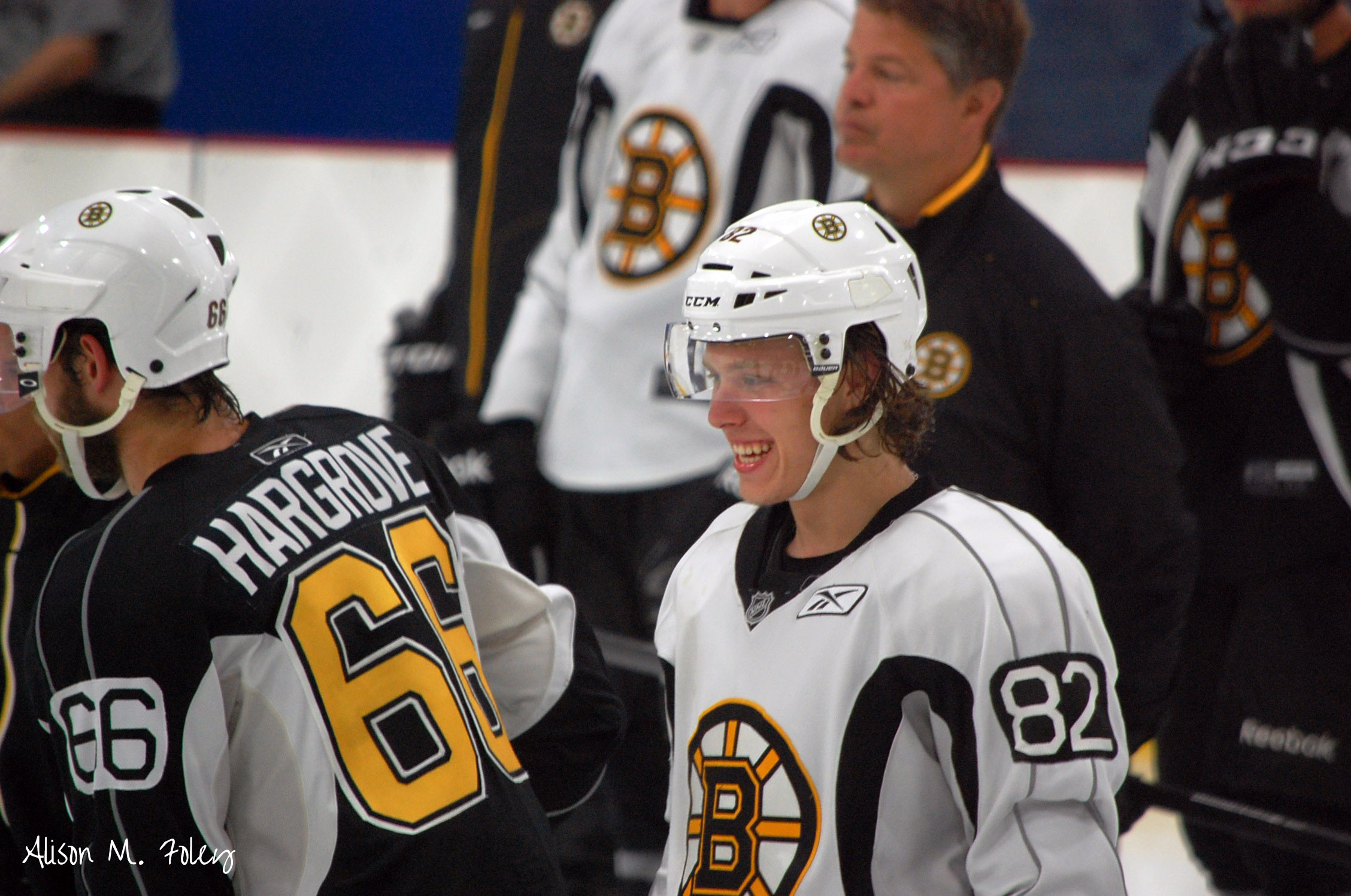
David Pastrnak, Emil Johansson and Zane McIntyre take a break during 2014 Bruins development camp (photo courtesy of Alison M. Foley)

David Pastrnak, Emil Johansson and Zane McIntyre take a break during 2014 Bruins development camp (photo courtesy of Alison M. Foley)

The 2016 World Junior (Under-20) Championship showcase is underway from Finland, as the tradition kicks off annually on the day after Christmas, better known in Canada and other parts of the world as Boxing Day.

In a rare twist, USA took on Canada, normally a match in the 2-week tourney’s round robin round reserved for New Year’s Eve, scoring a solid 4-2 victory thanks in large part to the stellar goaltending of Carolina Hurricanes prospect Alex Nedeljkovic (2nd round- 37th overall in 2014) and some opportunistic scoring by USA after falling behind 1-0 in the second period. The Americans overcame an Alex DeBrincat spearing match penalty late in the opening frame that could have put them behind the 8-ball, killing the 5-minute period between the first and second periods. After Islanders 1st-rounder Mathew Barzal scored on a jailbreak play to give Canada the first lead, Senators prospect Colin White (Hanover, Massachusetts) answered for USA. Questionable power play chances yielded goals by both sides (Zach Werenski– Blue Jackets and Dylan Strome– Coyotes). With time winding down in a 2-2 game, a Louis Belpedio (Wild- third round in 2014) shot from the point was inadvertently deflected into the Canada net by Red Wings prospect (and undrafted free agent) D Joey Hicketts past his own netminder, Mason McDonald (Calgary- 2nd round 34th overall in 2014). 2016 NHL draft top candidate Auston Matthews got an insurance goal after a puck squeaked through McDonald and lay near the goal line for the easy tap-in to close out the scoring.

In other games, Finland hammered Belarus (6-0), Russia beat the Czech Republic in a 2-1 shootout in a game where defense and the goaltending shined, while Sweden took vengeance against the Swiss by an 8-3 score but lost key players William Nylander (Leafs- 1st round, 8th overall in 2014) and Adrian Kempe (Kings- 1st round, 29th overall) to injuries. Swiss forward Chris Egli was suspended three games for his vicious blindside check to Nylander, knocking him out of the game with what is believed to be a concussion. The latest report has Sweden keeping him off skates for a ‘few days’ but hopeful the high-end forward can be back by the quarter final round.

The Boston Bruins have seven players at the tournament, with GM Don Sweeney announcing Saturday between the first intermission of the team’s 6-3 loss to Buffalo at home that David Pastrnak is being released to play for the Czech Republic and will be available when the 28 December NHL holiday roster freeze is lifted.

The Bruins have the following players at the WJC, which ties Arizona for the most players league-wide:

USA

Anders Bjork, F (5th round, 146th overall- 2014) ’96- last year of eligibility

Brandon Carlo, D (2nd round, 37th overall- 2015) late ’96 – last year of eligibility

Ryan Donato, F (2nd round, 56th overall- 2014) ’96- last year of eligibility

Czech Republic

David Pastrnak, F (1st round, 25th overall- 2014) ’96- last year of eligibility

Daniel Vladar, G (3rd round, 75th overall- 2015) 2017 WJC eligible

Jakub Zboril, D (1st round, 13th overall- 2015) 2017 WJC eligible

Sweden

Jakob Forsbacka-Karlsson, F (2nd round, 45th overall- 2015) late ’96- last year of eligibility

Defenseman Jeremy Lauzon was one of two final cuts for Team Canada. Watch for him, Zach Senyshyn, Jesse Gabrielle all to be staple players on Canada in 2017, when both are still eligible for the tournament.

David Pastrnak is the player the Boston Bruins have been waiting for. (Photo courtesy of Alison M. Foley)

David Pastrnak is the player the Boston Bruins have been waiting for. (Photo courtesy of Alison M. Foley)

On Pastrnak being released to the WJC

You may have seen me commenting on this on Twitter, so I want to clarify my position on a forum that allows me more than 140 characters:

While good news for the Czech Republic and Pastrnak, this is a risky move for the Bruins in that they stand the most to lose should something happen to him over there to affect his availability for his NHL going forward.

Too often, I think the WJC has gained an almost mythical status in the minds of hockey fans in this day and age- it’s a symbol of status that often drives opinions and perceptions of players both positively and negatively. Like some kind of video game, it seems that the more players a team has at the WJC, the bigger the bragging rights fans can claim, even though merely being a part of the carnival atmosphere is no guarantor of future NHL success. I get it- because of the prestige factor associated with the U20 WJC as the premier global showcase for the best hockey talent, many of whom have either already tasted the NHL or will be there soon, there is an expectation that if a player isn’t there, then that means something is wrong with them. Conversely, if a player is named to his country’s WJC roster, their status tends to get elevated, rightly or wrongly, and in turn, a player’s performance is often scrutinized and magnified in a way that either over-hypes them or leads to negative perceptions of their future NHL chances.

What bothers me about Pastrnak going to the WJC is that he is coming off an injury that caused him to miss 24 NHL games after he took a hard shot off the skate and received a fractured foot (or “bone bruise” as reported). On the one hand- the B’s want to rehab him and the WJC provides a way to do that. It also exposes him to risk of either aggravation of the foot or possibly another injury. To those who have tweeted at me about the “safer” aspects of the larger ice surface and more skill/finesse at the WJC, go look at film on the Egli hit on Nylander yesterday in the Sweden-Swiss match and take note. Boston accepts all the risk here- Pastrnak is now playing games that won’t help the Bruins in the standings (nor would Providence, but the similar system would be beneficial to working him back into mental shape for the big club) but he’s also playing for coaches with different priorities/agendas than Claude Julien and Bruce Cassidy over in North America.

Another argument I’ve heard is about how important the “experience” at the WJC will be for Pastrnak. Okay. Assuming that is the case, how is playing in his third WJC going to give him any more experience than he got when he appeared at the same tourney at age 17 and then again a year ago when Boston released him at 18? He played only about half a season in the AHL a year ago before going up to the NHL, so the argument that the talent and overall experience he’d get in the WJC vs. being in Providence at this stage of his career is certainly debatable. You can make good cases for each scenario, but the whole “He *needs* to be at the WJC to develop properly” is hogwash. Nor is it a matter of this being his only chance to skate for his country there- he’s already done it. Twice. And you can bet he’ll do it again, perhaps as soon as the Men’s World Championship, or at the next World Cup of Hockey.

In the end- what I think doesn’t matter, because the Bruins made the decision to send him. I suspect they are acceding to his own wishes, and I get Pastrnak’s desire to play in the WJC versus going to the AHL with the chance to play for his country providing him with a compelling alternative. They might see the WJC as a better opportunity for him to get himself back on track after missing considerable time than riding the buses in Providence will. Perhaps the B’s feel that by doing this- they are acting in good faith and will only solidify their relationship with the player who by most accounts, is probably being groomed to one day replace Patrice Bergeron as the face of the franchise. It’s completely understandable. However, what do the Bruins get if something happens to Pastrnak in his 10-day stint overseas? The answer is- absolutely nothing…aside from blistering questions and second-guesses that will swiftly follow if the team suffers a setback with their prized asset in a game he didn’t really need to be playing, some 3,000 miles away from Boston.

It’s all about risk management here, and the Bruins obviously feel it’s the right thing to do. So, we’ll cross our fingers and hope they are proven right.

B’s WJC prospect notes and updates

Anders Bjork, USA- One of the last cuts a year ago, Bjork is a top two-way forward at Notre Dame, known for his speed, hockey IQ and playmaking skills from the wing position. He played a typically solid game yesterday, showing off his effectiveness on the forecheck to deny Canada puck carriers time and space. He uses his speed to close quickly and has a quick stick to force turnovers or clog passing lanes with. He’s a highly confident, effective penalty killer- he leveraged his vision and instincts to be in the right place and prevent Canada from collapsing USA’s formations and exploiting the extended power play time on the DeBrincat major. You won’t see a great deal of offense from Bjork in the pros, but he’s the kind of player NHL clubs win with.

Brandon Carlo (Kirk Luedeke photo)

Brandon Carlo (Kirk Luedeke photo)

Brandon Carlo, USA- He was beast yesterday defensively, using his 6-5 frame and long reach to repeatedly deny lanes to the American net all game long. Guys as big and mobile as the WHL veteran from Colorado is don’t grow on trees, and he played an effective game; making good decisions, maintaining his gaps effectively and electing the right times to play the body and puck. What I like about Carlo is that he doesn’t think he’s something he isn’t- he plays a refined, disciplined game positionally- not taking himself out of the play to score a big hit, nor pinching up in the offensive zone if a play isn’t there. He’s smooth and effective- he has all the tools to evolve into a very good shutdown defender at the NHL level in the not-too-distant future. Now for the bad news… While I recognize and respect his defensive acumen, I don’t see much in the way of consistent offense from Carlo that would lead me to believe he’s going to be a legitimate two-way threat at the NHL level. He’ll chip in with points on occasion, but his repeated missed shots from the point yesterday illustrate the kind of work he has yet to do on his game. I don’t see the vision or creativity once he’s in the offensive zone to be a real No. 1 defender at the highest level, but he’s only 19, so maybe that comes out in time. As far as the game against Canada goes- he played about as well defensively as you can ask, and that’s what matters most, as it translated into a key aspect of USA’s tone-setting win.

I would only caution folks to slow the roll on the hype train and understand that he has the look of an NHL player for sure- but how much of an impact (I’m studiously avoiding the use of the term ‘upside’ in case you hadn’t noticed) he’ll have is still very much a question mark at this point. I’m not down on Carlo at all- he’s a great kid with a bright future. But for those who don’t see him but hear all these glowing reports about him- just trying to keep things in perspective. In Carlo’s case- I would be thrilled to have him wrong on this score, but when my 2016 Boston Bruins prospect ranking comes out in the New England Hockey Journal next week, you’ll understand why Carlo is not in my top-6.

Ryan Donato, F- I’ll be brief. It was not a good look for the Dexter School prep star and Harvard freshman. He seemed to struggle with the pace and might have been a victim of nerves in his first-ever WJC game against an opponent like Canada. His ice time reflected that, as he didn’t get the regular shifts to work himself into a groove and when he was out there, he made some noticeable mistakes.

Donato is an excellent prospect who often times pays a price for the perception of prep hockey and where it ranks in the developmental pecking order. A sensational season in 2013-14, and one in which I would have been fine with taking him at the end of the first round, saw him slip down to the end of the second. Even with that, I saw grumblings about him being drafted there, which I completely did not agree with. Conversely, getting Donato at 56 overall was a fine value pick for Boston if not one that will take time to develop and see the payoff for.

Ted’s eldest son is a hockey savant- his offensive hockey sense and scoring instincts are second to none. He’s not a burner like his dad was, but he’s bigger and more physically gifted to skate in the modern NHL. He’s off to a fine start in Cambridge, a year after a down season at Dexter was then punctuated by a superb finish in the USHL with the Omaha Lancers.

In other words- just as a lot of folks were eager to jump on Twitter yesterday to sing Carlo’s praises, there is absolutely no reason to pile on Donato for his subpar showing. It’s one game in one tournament. The thing to watch going forward with Donato is to see how coach Ron Wilson and the USA coaches use him and if he can settle in and find a way to do what he does best- bring offense. Given the role he had yesterday, however, that’s a tall order for any player.

Czech Republic

Daniel Vladar, G- Was a non-dress yesterday as Capitals prospect Vitek Vanecek (2nd round, 39th in 2014) got the start with Ales Stezka backing up. Vanecek played very well in a 2-1 shootout loss to Russia, so Vladar will likely have to wait for his chance to play if he even sees a sniff of action. His role will likely be to carry the mail in 2017 if he continues to progress in his development this season.

Jakub Zboril, D- Boston’s top pick in June last just 10:17 into the contest when he was assessed a match penalty and ejected for boarding on a questionable hit that looked worse in real time than it was. He was given 25 minutes in penalties on the play, but no suspension is forthcoming.

Sweden

Jakob Forsbacka-Karlsson, F- The second-rounder scored Sweden’s sixth goal in an 8-3 rout at 12:50 of the second period. No scouting report notes as I did not see the game, but it’s a good sign for the BU center, who tends to be more of a passer/playmaker than a finisher.

Jakob Forsbacka-Karlsson aka "JFK"

Jakob Forsbacka-Karlsson aka “JFK”

I will follow this blog post up later with some observations on some of the 2016 NHL draft hopefuls I saw in action yesterday.


Bruins Prospects Update 11/16/15

It has been a tough season for the goalies in Providence.

Malcolm Subban missed just about a month with a lower body injury suffered before the start of the year and has been mediocre at best (and that might be putting it mildly) since returning to the lineup. Zane McIntyre is a gamer, but he’s undergoing  a challenging transition, which only further underscores the folly and foolishness displayed by some who really thought he should just waltz into the NHL backup spot behind Tuukka Rask without having seen a single shot at the pro level. McIntyre is a terrific competitor and will eventually right the ship, but he’s struggling at the AHL level right now.

As for Subban, much bigger things are expected of him, and the 2012 first-rounder needs to start showing more consistency in his preparation and execution. If the B’s had toyed with the idea of trading him in order to get a nice return, they can shelve those plans, because Suban’s value is down is right now. He needs to get back to basics.

Austin Czarnik returned to the Providence lineup and not a moment too soon with Alex Khokhlachev now out with a bad hand. The diminutive former Hobey Baker finalist picked up where he left off, tallying a goal and assist in three games.

The NCAA prospects had another big week, which included a 2-goal, 4-point night from Ryan Fitzgerald and Wiley Sherman’s first career NCAA goal in his second year with Harvard. BU center Jakob Forsbacka-Karlsson had another strong weekend and is getting positive reviews by NHL scouts who all point to the uncommon maturity of his game for one in just his first collegiate season. NU defenseman Matt Benning got his second goal of the year, significant in that he went all of 2014-15 without scoring once, though still managed to lead the Huskies in scoring from the blue line.

AHL

Alex Khokhlachev, C Providence Bruins

GP- 11 Goals- 4 Assists- 9 Points- 13 Penalty Min- 2 +/- 6

Hand injury; did not play.

Austin Czarnik, C Providence Bruins

GP- 7 Goals- 2 Assists- 5 Points- 7 Penalty Min- 6 +/-  5

Czarnik returned to the lineup after missing seven games; if he can stay healthy, he’ll infuse the Providence lineup with much-needed speed, skill and energy.

Tommy Cross, D Providence Bruins

GP- 10 Goals- 0 Assists- 7 Points- 7 Penalty Min- 25 +/- -4

Chris Casto, D Providence Bruins

GP- 14 Goals- 0 Assists- 7 Points- 7 Penalty Min- 12 +/- -9

Seth Griffith, RW Providence Bruins

GP- 7 Goals- 2 Assists- 4 Points- 6 Penalty Min- 4 +/- -3

Colby Cave, C Providence Bruins

GP- 14 Goals- 5 Assists- 1 Points- 6 Penalty Min- 4 +/- -4

Colton Hargrove, LW Providence Bruins

GP- 11 Goals- 3 Assists- 1 Points- 4 Penalty Min- 8 +/- -2

Expected to be more of an enforcer type of forward this season, Hargrove has been one of the more consistent players providing scoring from the lower lines.

Anton Blidh, LW Providence Bruins

GP- 14 Goals- 4 Assists- 0 Points- 4 Penalty Min- 8 +/- -1

Noel Acciari, C Providence Bruins

GP- 14 Goals- 1 Assists- 2 Points- 3 Penalty Min- 7 +/- -3

Former Bishop Hendricken and Providence College captain scored his first career professional goal over the weekend.

Linus Arnesson, D Providence Bruins

GP- 14 Goals- 0 Assists- 1 Points- 1 Penalty Min- 0 +/- -2

Malcolm Subban, G Providence Bruins

GP- 5 MIN- 304 GA- 19 GAA- 3.75 Spct- ..850 W- 1 L-3 OTL 1

Zane McIntyre, G Providence Bruins

GP- 8 MIN- 480 GA- 26 GAA- 3.25 Spct- .875 W- 2 L- 3 OTL- 3


OHL

Zach Senyshyn, RW Saulte Ste Marie Greyhounds

GP- 20 Goals- 10 Assists- 5 Points- 15 Penalty Min- 2 +/- -6


QMJHL

Jeremy Lauzon, D Rouyn-Noranda Huskies

GP- 19 Goals- 3 Assists- 24 Points- 27 Penalty Min- 34 +/- +19

Jakub Zboril, D Saint John Sea Dogs

GP- 16 Goals- 3 Assists- 4 Points- 7 Penalty Min- 20 +/- 2


WHL

Jake DeBrusk, LW Swift Current Broncos

GP- 14 Goals- 6 Assists- 14 Points- 20 Penalty Min- 13 +/- -3

Groin injury; DNP

Jesse Gabrielle, LW Prince George Cougars

GP- 19 Goals- 14 Assists- 6 Points- 20 Penalty Min- 29 +/-  1

Big week for Gabrielle, who scored three goals and five points in three games and continues to turn heads in the WHL. By comparison he had 10 goals and 19 points in 33 games with the Regina Pats after a mid-season trade last season. He’s well on his way to beating all of his previous career highs.

Brandon Carlo, D Tri-City Americans

GP- 11 Goals- 1 Assists- 7 Points- 8 Penalty Min- 32 +/- -3

Carlo is injured and did not play this past week.


NCAA

Ryan Fitzgerald, F Boston College Eagles (HEA)

GP- 9 Goals- 7 Assists- 6 Points- 13 Penalty Min- 27 +/- 13

Anders Bjork, LW University of Notre Dame (HEA)

GP- 10 Goals- 2 Assists- 8 Points- 10 Penalty Min- 2 +/- 10

Danton Heinen, LW Denver University Pioneers (NCHC)

GP- 10 Goals- 4 Assists- 4 Points- 8 Penalty Min- 0 +/- 4

Jakob Forsbacka-Karlsson, C Boston University Terriers (HEA)

GP- 10 Goals- 3 Assists- 8 Points- 11 Penalty Min- 8 +/- 2

2 goals and 2 assists in 2 games over the weekend put JFK second on the team in scoring behind Sharks prospect Danny O’Regan.

Ryan Donato, C Harvard University (ECAC)

GP- 6 Goals- 3 Assists- 2 Points- 5 Penalty Min- 6 +/- 3

No points in two games played for Donato this week.

Sean Kuraly, C Miami University (NCHC)

GP- 12 Goals- 1 Assists- 4 Points- 5 Penalty Min- 12 +/- -6

The Miami captain finally got off the schneid to record his first goal of the season over the weekend.

Matt Grzelcyk, D Boston University (HEA)

GP-4 Goals 2 Assists- 2 Points- 4 Penalty Min- 10 +/- 3

Cameron Hughes, C University of Wisconsin (Big Ten)

GP- 10 Goals- 1 Assists- 3 Points- 4 Penalty Min- 2 +/- -2

Matt Benning, D Northeastern University (HEA)

GP- 11 Goals- 2 Assists- 2 Points- 4 Penalty Min- 15 +/- -9

Wiley Sherman, D Harvard University (ECAC)

GP- 6 Goals- 1 Assists- 2 Points- 3 Penalty Min- 4 +/- 2

Sherman tallied his first career NCAA goal in game No. 43 for the Crimson.


Rob O’Gara, D Yale University (ECAC)

GP- 6 Goals- 0 Assists- 2 Points- 2 Penalty Min- 8 +/- 2


Europe

Peter Cehlarik, LW Lulea (Sweden)

GP- 14 Goals- 3 Assists- 3 Points- 6 Penalty Min- 0 +/- -2

Emil Johansson, D HV71 (Sweden)

GP- 16 Goals- 0 Assists- 2 Points- 2 Penalty Min- 12 +/- -2

Maxim Chudninov, D St Petersburg SKA (Russia)

GP- 24 Goals- 5 Assists- 4 Points- 9 Penalty Min- 71 +/- -5

USHL

Jack Becker, C Sioux Falls (USHL)

GP- 15 Goals- 2 Assists- 4 Points- 6 Penalty Min- 0 +/- -3

No points in three games for the 7th rounder since last update.

Daniel Vladar, G Chicago (USHL)

GP- 9 MIN- 490 GA- 19 GAA- 2.33 Spct .912 SO- 1; 1-4-2

Vladar’s only action last week came in 21 minutes of relief of a losing effort, where he allowed no goals.

Scouting Dispatches: Twitter mailbag #4

Frank Vatrano, UMass Minutemen (Kirk Luedeke photo)

Frank Vatrano, UMass Minutemen (Kirk Luedeke photo)

Boston Bruins training camp is in full swing after the rookies had their day in Buffalo over the weekend, going 1-0-1 in 2 exhibition games against the Devils and Sabres. Frank Vatrano certainly turned heads with his performance, but now, all eyes are on the B’s veterans who are back and looking to build on last year’s disappointing non-playoff finish.

With that in mind, let’s get to your questions. As always- thanks for sending them along. I try to answer one per person, so if I didn’t get one because you sent multiple entries, try again next time.

If you had to pick one dark horse that’d surprise all and force his way onto roster (now or later in year), who would it be?– Jason Silva @JasonSilva67

Honestly, I’m not sure there are many “dark horses” who are in line for a big opportunity this year unless the bottom falls out of things injury-wise.

We’re getting a closer look at the three first-round picks from 2015 and they all look like they need to go back to junior.

Based purely on the rookie camp, my dark horse is Frank Vatrano– the former UMass standout scored three goals in two games including the OT-winner against the New Jersey rookies when he helped to force a turnover deep in the Devils’ end, then cut right to the net where linemate Austin Czarnik found him with a shot he tipped home. If the B’s suffered an unusual rash of injuries or just wanted a shakeup up front for game or two, Vantrano would be an interesting player up front because of his hands and energy. I cannot say enough how impressive he’s been over the last couple of seasons after playing just one NCAA game in 2013-14.

Realistically speaking, though- we’re probably not going to get a David Pastrnak-like breakthrough this year. Free agent Joonas Kemppainen was signed last spring on the heels of his Finnish league championship run. He’ll turn 28 this year and so I wouldn’t really call him a surprise- the B’s brought him on board I believe with every intention of getting him some time with the big club as a natural center who plays a strong three-zone game. If he makes the roster out of camp, it will be more by design than overachieving on his part.

David Pastrnak, Emil Johansson and Zane McIntyre take a break during 2014 Bruins development camp (photo courtesy of Alison M. Foley)

David Pastrnak, Emil Johansson and Zane McIntyre take a break during 2014 Bruins development camp (photo courtesy of Alison M. Foley)

Where do Pasta, Hayes and Connolly play?- Matt Kalin @katomck1981

David Pastrnak is firmly entrenched on David Krejci’s right side for now, and I think the Bruins will try to capitalize on the potential those two have together, not just as fellow Czech Republic natives but because they both bring elite creativity and offensive vision to the mix and Pastrnak’s speed and tenacity is a perfect match for what Krejci brings when on top of his game. Matt Beleskey on that left side filling the spot vacated by Milan Lucic is a good call- he’s not as big as Lucic, but will bring the physicality to help address the loss of time and space ML17 used to bring.

I’ve seen that Jimmy Hayes (normally a RW) is over on the left side flanking Ryan Spooner and Brett Connolly in early B’s camp sessions, and I think that is an intriguing trio for sure. I thought that perhaps the B’s would move Loui Eriksson over to the left side on third line to allow one of Connolly and Hayes to move up to the second line behind Pastrnak (if you slot the Krejci line at the top, that is). However, it looks like Claude Julien and Co. want to keep Eriksson with Patrice Bergeron and Brad Marchand, and Eriksson (a left shot) playing on his off-wing.

What’s interesting to me about a Hayes-Spooner-Connolly third line is that this has the potential to be a model example of the new trend towards NHL clubs icing more of a top-9 attack, with three balanced and skilled scoring lines to aggressively attack opposing defenses as opposed to the older top-six/bottom-six design. Connolly was drafted 5 years ago to be a scoring wing, while Hayes is coming off a career-best 19 goals for Florida. Spooner was taken in the same draft as Connolly, and believe me- it wasn’t to be a grinder. If the B’s can figure out how to get enough ice for all three forward units, that third line could give other teams fits, allowing a clamp-down line of Chris Kelly and Max Talbot (and Joonas Kemppainen?) to grind it out and spell the top-9 forwards.

Jared Knight – any NHL upside at all at this point ? Thanks- @pprohaska

If Knight makes the NHL, it will be as a bottom-six, grinding forward in all likelihood.

It’s been a tough road for him over the past three seasons, so the team did him a big favor by getting him out of there and providing a change of scenery. I thought he played with more confidence in the AHL when he went out West, and so I would not rule him out of eventually earning an NHL job. The issue with him is- will he ever justify his draft position as the 32nd overall selection? That might be a bridge too far, as he’s a rugged, hard-working winger but does not appear to have the natural scoring ability to be an NHL-caliber top two line guy.

The deal appeared to be one of those “my bust for your bust” things- where neither Knight nor Zack Phillips, who was quite the hot shot going into the 2011 NHL Entry Draft, sneaking into the late first round, got off on the right foot and things seemed to compound for them. Phillips is more skilled than Knight is, but his lack of pure foot speed works against him. I expect Phillips to be a key cog in Providence’s machine this year, and who knows? If he’s productive enough, he might get a brief look at some point. Realistically, though, like Knight- Phillips is an unenviable position right now as a high draft pick who still needs to prove he can play at the AHL level before we even start talking about the NHL.

I’ve known Knight since the B’s drafted him and he’s a quality person with a great attitude. If anyone can reinvent himself to be that gritty lower-line forward who skates up and down the wing and chips in some modest offense while playing a strong 200-foot game, it is him. I wish him the best.

What do you think about (Joonas) Kemppainen and his potential fit on the team?– davrion @davrion

I think the signing made sense from a pragmatic standpoint- the B’s have an opening for a bottom-line center and the 27-year-old Finn has spent nearly a decade in the pro hockey circuit there, meaning that instead of taking an NHL-inexperienced skill player who is probably ill-suited to play the fourth-line center role as Alexander Khokhlachev is, they’re hedging their bets with an older, more mature player who is more refined and has the intelligence, size and pro hockey experience to come right in and not look too out of place.

I don’t know how effective Kemppainen will be…the B’s have had mixed results when they have brought over older European forwards in the past, but I don’t buy the Carl Soderberg comparisons I’ve seen cropping up on the internet, either. Soderberg was talented, and a lot more was expected of him offensively, but he ultimately played too passive a game and his personality was not a great fit in the room. Kemppainen is quiet and perhaps shy, but I’m told by people who know him that he’ll earn respect because he’s willing to do whatever is asked of him. Plus, having Tuukka Rask around will help him adjust to North America and the B’s dressing room culture.

I like the move- it’s a no-risk attempt to infuse a winner who possesses the size and two-way game (and perhaps some underrated offensive ability) on the checking unit without taking a square peg and forcing it into a round hole. This is not an indictment of Koko, but if people are honest with themselves, they know that expecting him to thrive on the fourth line when he’s a player who is at his best in scoring role (just don’t ask me who he’s going to beat out to provide that in Boston as of today) is a tall order. You don’t call an electrician if your toilet needs fixing…the same principle applies here, so Kemppainen seems like a much better fit at least to start the year. Whether he has the ability to keep the job, however…we’ll find out soon enough.

Could you see Ryan Spooner having a 2008-09 Krejci-esque year (70 points) in his third line role w/ good line mates & PP time?– ETD51 @ETD51

I try not to set expectations on players today based on what others did in the past.

Spooner is to be lauded for seizing the opportunity presented him at the end of last year to establish himself as one of the few bright spots on the 2014-15 Boston Bruins.

Having said that, even though the two players’ (David Krejci and Spooner) numbers are similar at the same age and experience level, unless something happens to move Spooner up to the top two lines for a big chunk of the 2015-16 season, that 70 points is going to happen for him on the third line.

He’s a talented player and if he gets 50 points on that third unit, it will be a big win. Scoring is so down around the league- Jamie Benn won the NHL’s points title last year with 87- so thinking that a third-line player on any team, let alone one that struggled mightily to generate consistent offense a year ago is going to hit 70 points in this current environment (unless there is a major swing of the pendulum that is) isn’t very realistic.

Malcolm Subban (Photo courtesy of Alison M. Foley)

Malcolm Subban (Photo courtesy of Alison M. Foley)

Do you see Subban being traded or will he be the backup goalie all year?- Chris @FribbleLover

How about…neither?

I think the B’s would certainly entertain any offers they get for Malcolm Subban, but they aren’t just going to deal him for the sake of doing so.

I’m also not sure Subban wins the backup job in Boston this year after as yet not having established himself as an AHL starter.  I’m not a believer in young (and he’s not even 22 yet) goalies sitting and watching games as a backup during a critical development period in their careers, and I just don’t think the Bruins are going to put Subban in that situation when he could be starting and honing his technique/building confidence at the lower levels.

As for trading Subban, I’ve said this before- the value they would receive for him right now is not likely to justify the effort. Hold onto him and see how he performs in this important third season since he turned pro. If a team comes along and wants to give the B’s a good return for him, they’d be silly not to consider it, but while I’m sure more than a few teams would be happy to take him off of Boston’s hands for a song, that’s what I believe they want to give up. That doesn’t help Boston. Remember- the B’s once hoodwinked Toronto in getting Tuukka Rask even-Steven for Andrew Raycroft. How did that work out for the team that gave up an at-the-time unproven goalie talent for an established commodity?

Patience, young Grasshopper. Resist the urge to play fantasy hockey GM questing for shiny new toy returns and leave Subban where he is for now. The B’s used a top-30 pick on him for a reason.

I would like to know the upside/possibilities of Brandon Carlo?- Anthony Amico @anthonyamico

Carlo looks like the prototypical modern NHL defender: big at 6-foot-5, mobile, physical with a long reach and an ability to make a strong first pass.

I’m not sure that I buy into the over-the-moon excitement I’ve seen about him in some circles on the Internet, however.

Don’t misread that remark into believing I’m not high on the kid, but some fans have let the hype machine get out of control already, with some penciling him into the NHL lineup and I think we have to slow the roll on him. Given the other veteran and other pro defenders vying for spots, it would take a jaw-dropping camp and exhibition performance from the 18-year-old Colorado native to leapfrog some of the guys ahead of him on the depth chart. I fully expect he’ll be back in the WHL this year, but as a late ’96 birthdate, he’ll be eligible to play in Providence for the 2016-17 hockey season, at least.

As for Carlo’s upside, he has a big shot from the point, but I wonder about the vision and offensive creativity that is needed to emerge as a true-blue, top two-way threat at the NHL level. Instead, I see Carlo as more of a solid middle pair defenseman who can shut down opposition offenses because he moves well and uses his stick and physical strength to keep forwards to the outside. He’s also on the snarly side and will be his team’s captain this year at Tri-City, so there is a lot to like about the kid.

Just temper the expectations and don’t be in such a rush to see him in Boston- all in due time.

Brandon Carlo- "shiny new toy?" (Kirk Luedeke photo)

Brandon Carlo- “shiny new toy?” (Kirk Luedeke photo)

Boston Bruins 2015-16 season preview: Defensemen

Zdeno Chara returns for his tenth season as the captain of the Boston Bruins (photo courtesy of Alison M. Foley)

Zdeno Chara returns for his tenth season as the captain of the Boston Bruins (photo courtesy of Alison M. Foley)

In retrospect: It was a rough ride for the Boston D party in 2014-15, as former GM Peter Chiarelli traded glue guy Johnny Boychuk on the eve of the new season, a move that went on to have significant second- and third-order effects on a roster ravaged by injuries to  Zdeno Chara, Adam McQuaid and Kevan Miller. Adding to the struggles was the lackluster performance of Dennis Seidenberg, who returned from a major knee injury suffered in 2013-14, but was not the effective, shutdown presence for Boston he had been previously.

The Bruins allowed 30 more goals last season than the year before, and the lack of collective team foot speed often found them susceptible to being beaten off the rush and often collapsing into their own end while struggling to generate a transition to offense the other way. Torey Krug was a bright spot for the club, finishing second on the blue line in scoring with 12 goals and 39 points. The team’s offensive leader, Dougie Hamilton, was traded to Calgary on the day of the 2015 NHL draft in a rapidly developing (and shocking) move that sent the 22-year-old out West and left a sizable hole on the Boston depth chart that the team has yet to fill.

Younger guys like Zach Trotman and Joe Morrow showed promise in flashes, but ultimately, the disappointing non-playoff 96-point finish was reflected in a defense that lost a major on- and off-ice contributor in Boychuk and never really got a healthy Chara going for the duration, as he returned to action after missing nearly two months at well less than 100 percent.

The view from here: Chara remains the face of the franchise on the blue line, though he is past his prime at age 38 and is coming off his lowest production (8 goals, 20 points in 63 games) since the 2001-02 campaign, his first as an Ottawa Senator. He faces the prospect of playing the rest of his NHL career on a wonky knee, which essentially makes him day-to-day for life, and means that the B’s must be prepared to lose him to injury at any time.

Chara is the consummate pro and veteran, but his injury complicates the often armchair GM discussion of the team simply trading him. Even at his age and declining offensive numbers, Chara is more valuable to the Bruins than he is to other teams that might be in the position to trade for his $7 million salary (he’s signed for two more seasons- at $5M and $4M respectively before becoming an unrestricted free agent again in 2018), simply because with Hamilton out in Boston, the B’s don’t have any other legitimate player to thrust into the top role today. The onus is now on Claude Julien the Boston coaching staff to better manage Chara’s ice time and game situations to get the most of his experience and 6-9 frame with the lengthy reach. His best days are clearly behind him, but it’s not quite so simple to sit back and talk about trading Chara for cap relief and a younger talent- you’d not only need a willing buyer to give up a roster player worthy of the move, but Boston’s captain would have to waive his no-trade to go. It’s not unthinkable to consider it, but the likelihood of it happening is slim- the Bruins need Chara this year more than ever.

The team can only hope Seidenberg can rebound from as brutal a year as he’s had in his career. His struggles underscored the fact that literally days after signing his four year, $4M per extension with the B’s he suffered his knee injury and the very real possibility exists that at age 34, he’ll never get back to the player who was so instrumental in one Stanley Cup championship and a second trip to the finals in three seasons. The German has given a lot to the Bruins, but his contract, only in its second year, looms like an albatross around the team’s collective neck if he is unable to round back into form. The analytics from last season do not paint a pretty picture, however, and things may get worse before they improve.

Krug is preparing for an expanded role given Hamilton’s departure, and the B’s could greatly benefit from him taking his offensive production to the next level to help offset the loss of their former 2011 top choice’s numbers, especially on the power play. At 24, the diminutive Michigander has the heart of a lion and is embracing the challenges that await him with increased minutes at even strength, but like Chara, the team will have to manage the matchups when he’s defending against the NHL’s bigger, powerful forwards and live with the higher-risk style Krug employs when carrying the puck on his own. Krug has enough talent, hockey sense and an off-the-charts work ethic/character to compensate for his undersized frame, and the belief here is that he’s going to make it work.

The team raised eyebrows when it re-upped Adam McQuaid, the club’s resident baggage-smasher at 6-5, 210 pounds. Another quality person and teammate, McQuaid has overcome a lack of foot speed with a tenacious, pay-for-every-inch-of-real-estate approach that has served him well. When it comes to toughness, no one on the current roster can bring it better than the former Sudbury Wolf can, but he’s a pretty one-dimensional shutdown defender. One of the biggest issues with McQuaid is in his struggles to stay healthy and play a complete 82-game schedule over the course of his career. Since breaking into the NHL full-time in 2010-11, he’s never played more than 72 games, and appeared in just 93 contests over the last two seasons. If how honest, dedicated and hard-working a player was all you needed, McQuaid would be worth every cent of the 4-year, $11 million contract he signed this offseason. As it stands, the Bruins can only hope he can reverse past trends and become a durable presence. Even if he does, the debate will rage on as to how wise an investment it is for a rock-solid third-pairing defenseman.

Veteran Kevan Miller played 41 games last year before being lost to season-ending shoulder surgery. He’s a similar player to McQuaid, but at a substantially less cap hit of around $800k. A gritty, character undrafted free agent who worked his way to the NHL after captaining the University of Vermont Catamounts, Miller’s mobility and experience stand him in good stead heading into the new season, but there isn’t much in the way of offense from him.

The B’s signed free agent Matt Irwin to add to the mix from the San Jose Sharks. The 27-year-old played about 17 minutes (you’ll hear the sheltered minutes argument with both he and Krug) with the bulk of his 8 goals and 19 points coming at even strength last season. He doesn’t bring a lot of pure foot speed with him to Boston, but he’s not a substandard skater either. Irwin has NHL experience and has shown promise as a two-way contributor- he’s third on the blueline behind Krug and Chara in scoring from last season.

This leaves a trio of younger defenders with the two-way potential that Boston desperately needs, two of whom spent some time with the big club a year ago in Zach Trotman and Joe Morrow. Trotman is bigger than Morrow, but does not have the former 2011 first-round pick’s speed or puck skills. Both can hammer the puck from the point and move it effectively, but of the two, Morrow is more of the offensive threat and special teams presence, whereas Trotman is a little safer and more polished defensively. Both will battle it out for a sixth position in the regular rotation if you believe that Miller or Irwin could end up being the seventh defender. Trotman was the last pick of the 2010 draft out of Lake Superior State, and Morrow’s been a disappointment as a pro after leaving the Portland Winterhawks. He was traded to Dallas from Pittsburgh and just a few months later, flipped over to the Bruins in the Tyler Seguin trade. Given what we’ve seen from Loui Eriksson, Morrow (and Jimmy Hayes to be fair) is the last best hope the team has in getting a long-term return on that deal.

As for Colin Miller, the AHL’s reigning champ in the hardest shot and faster skater competition at the 2015 All-Star Game doesn’t have NHL experience, but he has the offensive skill set to see time and even win himself a full-time role with Boston this year. This is a huge camp for him, but at 23, it won’t be the end of the world if he’s not on Boston’s opening night roster, but given that he was part of the Milan Lucic deal, if he earns a spot, the B’s will gladly take it.

A Dennis Seidenberg rebound could be an important factor in a Boston return to the playoffs (Photo courtesy of Alison M. Foley)

A Dennis Seidenberg rebound could be an important factor in a Boston return to the playoffs (Photo courtesy of Alison M. Foley)

On the farm: Boston’s first pick in 2013, Linus Arnesson, will be playing in his first complete AHL season. The late second-rounder has good size and mobility, but he’s more of a no-frills, solid defensive presence than he is a player who will push the pace, join the rush and contribute consistent offense for his team. If he’s in the Boston lineup next year, then something has likely gone terribly wrong in terms of injuries and/or performance. Arnesson is steady and consistent, but he’s not going to wow you in any one facet of his game. Every good team needs players like him to win with, but he’s not going to be a savior.

Chris Breen is back for a second year in Boston’s system and at 6-7, 224 he certainly provides the size and reach for a defensive-minded defender.  He has some limited NHL experience and doesn’t move his feet all that well, but will be another key contributor in Providence and can help in a pinch.

Gone is David Warsofsky, but fellow New Englander Tommy Cross is back for another tour of duty in Boston’s system with Providence. If only that’s all it took to be an NHL regular… Cross is the very last piece remaining from that disastrous draft year and he’s ticketed for the AHL once again, where he could see an injury recall at some point as a reward for his hard work, but in all reality, the one-time Boston College captain will be fortunate to ever establish himself as a bottom-pairing player at the NHL level.

Chris Casto is underrated, and as a free agent signing out of University of Minnesota-Duluth back in 2013, he looked as if he might have the size and wheels to develop into a solid NHL defender, but it just hasn’t happened for him in the AHL. Nobody ever talks about him, but he’s a fluid skater with a big shot, who has at times struggled with processing the game and pace. He’s got one more year on his ELC to raise his profile in the organization.

A look to the future: The B’s drafted three defensemen in the first two rounds this past June, all of whom bring much needed skating and size to the mix. Jakub Zboril and Jeremy Lauzon are the ones the team hopes will be more complete two-way defenders who can help kickstart the attack, whereas Brandon Carlo is a huge (6-5) and mobile rearguard who is a better shutdown guy than offensive producer. All three look like players, but won’t likely help out in the short term (though with all three being products of major junior- they’ll at least be at training camp and one could pull a surprise- it’s happened before).

One player who has a shorter wait to making an impact in Boston as early as next spring is Yale senior Rob O’Gara. The fifth-rounder in 2011 has patiently and steadily progressed in the system, winning championships at both the prep (2011) and NCAA (2013) while developing his two-way game. At 6-4, he has a rangy stride and fluid footwork and pivots. He started out being a top shutdown defender, even earning that honor this season in the ECAC. He also improved his offensive production in his junior year, leading the Bulldogs’ blue line in scoring. He’s a smart, industrious 22-year-old who is expected to sign at the conclusion of Yale’s season and who knows? He might even get a quick look in Boston depending on how the defense is situated by then. If not, watch for him to help Providence down the stretch if he’s not still in school finishing up his course work.

Matt Grzelcyk is another prospect worth watching this year. The BU senior and captain is on the shelf for a while after May knee surgery, but he’s expected to be a major contributor to the Terriers’ fortunes again after posting career bests in all offensive categories a year ago. He’s undersized but brings excellent speed, vision and skill to the mix. Watch for him and O’Gara to push one another as complementary players to one another going forward. At the very least- they’ll be helping Providence in the AHL until they can push for time in Boston.

On the longer track, collegians Matt Benning and Wiley Sherman still have time in the NCAA to hone their respective games (Sherman is still a major project just entering his sophomore year at Harvard) while Swedish defender Emil Johansson will spend another season at least in HV71 before he might come over.

The wild card: Cody Franson, D. We know that Franson and Don Sweeney have both admitted that the two sides have talked contract, with Franson reportedly holding out for value and longer term than Boston is willing to give. With about $4M in available cap space, Sweeney wants to preserve as much flexibility, and as we get closer to September, Franson may have to come off plan A in favor of incentives and a chance to prove himself this season for a bigger payday next July. On the upside- Franson is an experienced NHL veteran who will help offensively and especially on the power play with his booming point shot and ability to distribute the puck. One thoughtful Twitter follower I engaged in a debate today over Franson pointed out that in Nashville after the winter trade, Franson was on the ice for just 9 even strength goals against and that he accounted for 56% of shots attempted from the blue line- good for the lead among all Predators defensemen. On the downside, he’s not a swift skater for a club in major need of getting faster and his hockey IQ at times lends itself to him running around and making bad turnovers in his own end. There is no doubt he’d make the Bruins defense better than it is today, but how much and at what cost is a question Don Sweeney has to answer. One shoe dropped today with Christian Ehrhoff agreeing with the Los Angeles Kings to a team-friendly 1-year pact at $1.5 million. If Franson’s price tag is expected to go down as he gets closer to the start of NHL camps, then other teams are likely to start sniffing around. Something’s gotta give here.

The wild card pt 2: Maxim Chudinov, D SKA St Petersburg. The KHL champ is getting ready for another year in Russia after the Bruins made him the 195th overall pick in 2010 as an undersized but speedy and feisty offensive player. Truth in lending- I don’t think Chudinov adds much more than what the Bruins already have in Krug, though he’s faster on his skates (but in my view lacks Krug’s leadership and heart). If the Bruins want to add him to the mix, that’s a call they’ll have to make and information is out there (h/t Dominic Tiano) via Chudinov’s agent that the 25-year-old is willing to give the NHL a shot. I guess we’ll see, and you can never have too much depth, but it’s hard to imagine that he’d want to sign and play in Providence, so it would have to be a similar situation to Carl Soderberg a few years back.

Adam McQuaid was extended four years in June (Photo courtesy of Alison M. Foley)

Adam McQuaid was extended four years in June (Photo courtesy of Alison M. Foley)

The verdict: I have to call it like I see it and this defense as a whole doesn’t scare many (except for perhaps some Bruins fans).

Team speed, which was the biggest need in the offseason, was addressed in the draft, but those kids won’t help this year unless the B’s luck out with another David Pastrnak-type situation. They’ll get faster with Morrow or Miller added to the mix, but the team will still have their hands full trying to generate an attack through the neutral zone or standing up opponents who can push the pace of a game.

The time has come to actively manage Chara’s role and put some constraints on what is asked of him. He’s got a lot of tread on the tire, and it’s time for others to step up and take some of the pressure off. I don’t know how much longer that troublesome knee and his huge frame will hold up. Forget trading him for now- Boston needs him and if things change (especially if he decides he’d like a change of scenery) then that can be revisited. In all reality, unless Chara wants out, it’s hard to imagine the Bruins trading their captain and getting anywhere near close to the value that would make such a move worth it.

Krug is the one player who appears primed for an important role this season. It’s a chance for him to answer questions about his ability to play upwards of 21 minutes or more a night, against top opponents and continue to carry the offensive mail for this team. Mistakes are bound to happen, but how much Julien trusts him going forward will be something to watch. Krug loves playing with McQuaid…will the two stay together or will the team break them up and try something else?

Whether the team adds Franson or goes with 1 or more of the youngsters in Trotman, Morrow and Miller- the Boston defense is not going to be much of a threat offensively, so they’ll have to take care of things in their own end. Without the requisite speed and ability to contain speed to the outside, that’s going to be a challenge.

It’s a game and gritty group- but there are a lot of if’s heading into the new season. That means the goaltending and the forwards are going to have to pick up the slack.

Final thoughts on USA World Jr. evaluation camp

The hopefuls for Team USA’s 2016 World Jr. (under 20) squad closed up shop at Lake Placid over the weekend, closing out the event with a 32-player roster (whittled down from the original 39 invites) powering USA to a 6-1 win over Finland.

Here is the final USA roster:

http://worldjuniors.usahockey.com/page/show/1909970-2015-final-u-s-national-junior-evaluation-camp-roster

Here are some random thoughts on players I feel are worth mentioning. Because of my work with Red Line Report, I can’t go into too much detail, but here’s hoping we can give you enough of a tease to get an idea of what some of these players bring to the table for the 2016 NHL draft, and for those players already drafted- more insights into what your favorite (or not so favorite) NHL club might be getting in a few years if not sooner.

2016 NHL draft candidates

Scott Eansor, C- Small, speedy undrafted buzzsaw center out of Seattle of the WHL showed some versatility and tenacity here. Watch for him to boost his production this season and get a look in next June’s draft in his final window of eligibility. He’s got some moxie to go with his opportunistic approach and did not look at all out of place in this setting.

Auston Matthews, C- He made it official last week- the Arizona wunderkind will be skating in Switzerland for the Zurich Lions of that nation’s top pro league. Matthews then gave Zurich fans a glimpse of what is in store against Finland with a highlight reel goal just 53 seconds into the final exhibition contest, skating through three defenders at the offensive blueline and then finishing off the play with a filthy backhand shot that snuck in past the short side post. The 2015-16 hasn’t even started yet, but Matthews is doing everything to justify the pre-season prediction that he’ll be the top overall pick in next June’s NHL draft.

Chad Krys, D- The youngest player on the final roster played well for Team USA, showing some impressive poise with the puck. The BU recruit (his dad also played there) ranges anywhere from being projected as a first- or second-round pick on various public lists, but if he plays the entire season like he did in Lake Placid, he looks bound for a top-30 selection.

Charlie McAvoy, D- New York native is my pick as the top Empire Stater for the NHL draft. He’s got good size, vision and keeps things pretty simple. NHL clubs are looking for two-way players on defense- it’s no longer enough to simply defend or score- the most sought-after guys are the ones who can do both. McAvoy fits that bill and will likely get better as he continues to mature and fill out.

Matthew Tkachuk, LW- This winger needs no introduction to American hockey fans who remember how big of an impact his dad, Keith, had as a premier power forward in the 1990s. He led USA with 8 points in the games and he was a shark around the net, pouncing on loose pucks and demonstrating that killer instinct that goal scorers all possess. He’s not one of those coast-to-coast types, but when the play breaks down in front of the net and the puck is pinballing around, he has that natural ease for getting his stick on it and putting it into the cage.

Drafted players

Paul Bittner, F (Blue Jackets)- Big, skilled Portland Winterhawks winger slipped to the second round and Columbus pounced. With his physical tools, he has the potential to flourish as a top-six power winger in the NHL one day- he just needs to be more consistent and use his natural size and strength to his advantage more. But, after camp, you could see why some were projecting him as a first-round pick.

Anders Bjork, F (Bruins)- The 2014 fifth-rounder closed out the event in style, bagging a pair of back-to-back goals in the second period. He’s not a high-end scorer, but there is some natural hockey sense and opportunism in his approach. He takes straight lines to the net, puts himself in areas where rebounds occur and manages to outwork opponents to loose pucks. Bjork has the makings of a solid third-line NHL winger.

Brock Boeser, F (Canucks)- Vancouver’s top selection made his bones offensively in the USHL with Waterloo, and his hot stick carried over. Whenever the offense was flowing, Boeser seemed to be involved, setting up plays or finishing them off. He’s not a dynamic, flashy player who jumps off the screen at you, but you noticed him because he’s smart and made sure he was in the middle of the play.

Jeremy Bracco, F (Maple Leafs)- The final pick of the 2015 draft’s second round is such a skilled offensive player. His vision and creativity is off the charts and he brings such a dangerous element to any line he’s skating on. I don’t even care anymore that he doesn’t have a game-breaking explosion- he looks plenty fast to me when he’s taking pucks to the net or dishing through a maze of sticks to a wide open teammate. Bracco is going to make more than a few teams sorry they passed on him.

Brandon Carlo, D (Bruins)- It was a solid camp overall for Boston’s first of three second-round picks in June. Don’t make him into something more than he is right now, which is a superb defensive player with the size and skating to perhaps develop into more of a threat offensively. I thought he looked very strong in the games he played in, and the B’s desperately need an infusion of size and fluid skating on their blue line. He was a very good value pick at 37, but let’s not put him in the Hall of Fame just yet.

Erik Foley, F (Jets)- If anyone was wondering going in who this kid is, they have a much better idea now. He showed on more than one occasion that his skill level allows him to keep up with some of the bigger names in the draft. Foley’s heart and hustle are what make him such a good prospect- he’s not afraid to do the dirty grunt work along the walls or pay the price in front of the net. But, he’ll also take the puck down the ice and beat the goalie with a wicked shot, too. Winner.

Dylan Larkin, F (Red Wings)- Man, this guy is smooth. If he isn’t tearing it up at the WJC next December/January it will be for one reason only: he’s skating for the big club in Detroit and has bigger fish to fry in the NHL. Larkin’s speed, skill and sense will make him a force to be reckoned with, and I can’t imagine the Wings will keep him in the minors for very long if at all.

Jack Roslovic, F (Jets)- This American sniper knows how to finish around the net and showed off his instincts and intelligence throughout. Another example of a player who isn’t going to make the eye-catching play but just finds ways to put the puck in the net, it’s hard to imagine that the Jets came away with Roslovic, Kyle Connor AND Foley. With that trio, they’re living that Dawes song- it’s a little bit of everything.

Jake Walman, D (Blues)- Providence College standout with dual citizenship really brought his two-way game to the mix. It’s a case of the rich getting richer with Walman, who looks about to emerge as a NCAA force after being a solid value selection in the third round in 2014.

Colin White, F (Senators)- White is looking more and more like a real nice roll of the dice at 21 for Ottawa. There’s a lot to like about him- he can skate, play a 200-foot game, is great on draws…but the offense that went missing earlier in the season is making its way back. Watch for him to be a regular story at BC with the Eagles.

Dog Days of Summer- Franson, WJC National Eval Camp & Ivan Hlinka

We’re at that point in the offseason where there simply isn’t a whole lot going on hockey-wise. The top free agents are signed and off the market, many of the 30 NHL teams’ personnel are taking what little time off they can before annual August events pull them back into rinks and onto the job for the 2015-16 season.

Here are a few notes to keep us all centered, especially as NFL training camps open up and the pending football season grabs a lot of the headlines (not touching Tom Brady or Deflategate, though folks- and many of you are probably glad for that).

Cody Franson to the Bruins would certainly bring a player with name recognition to the team, but I’m not sure it’s the right kind of move for the long term.

Now, we have both Franson and Don Sweeney admitting that the two sides are in talks (among others) and I know that back in 2005, he was high on Boston’s draft list- they contemplated taking him in the 2nd round (they went with flash in the pan Petr Kalus instead). Some of you may remember that coming out of the lockout, the ’05 lottery was a snake draft, meaning that the B’s had the 22nd selection of the first round, then the order reversed in the second, giving them 9th pick and then back to the original order in the 3rd and so on- like the fantasy drafts for those who are into that sort of thing. So, the B’s contemplated taking Franson as early as 39, and then were hoping he would fall to them with the 22nd pick of the 3rd round. They got close, but it didn’t happen and they ended up with Finnish bust Mikko Lehtonen (later traded to Minnesota as part of a package for Anton Khudobin) instead.

Getting back to Franson- he was in prime position to cash in as an unrestricted free agent at mid-season, having the best year offensively of his career, but when the wheels fell off in Toronto and he was moved to Nashville for a premium return, he was unable to get going on a playoff team. That’s a red flag, and he’s a cautionary tale for the cap era, giving teams pause in locking him up for term and value because depending on which version of Franson you get, it’s the kind of signing that can make or break a team trying to contend.

On the upside, he’s an effective power play performer and physical defender who uses his 6-5 frame and long reach well enough. On the downside, he’s not all that mobile (the B’s have enough issues with team speed, thanks) and is not the most instinctive of players. To me- he’s more of a complementary piece who looks good on paper but isn’t talented enough to be a real difference maker. Some would argue that his performance in Toronto means that he plays better on a poorer club than on a good one, but I need to take a deeper look at some analytics on this one.

Should the Bruins end up signing Franson, I’ll do just that, but for now- I think the team is better off preserving the some $4 million it has in cap space and maintaining some flexibility to make an in-stride course correction without being up against the cap ceiling, which is what signing Franson will entail.

***

The annual Team USA National Junior Evaluation Camp will get underway next week, and it’s a pretty good group of players attending this year’s event in Lake Placid August 1-8.  A complete roster of the invites can be found here. 

The Bruins have two prospects attending: 2015 second-rounder Brandon Carlo and 2014 pick Anders Bjork. Carlo played for Team USA at the 2015 World Jr. tourney and acquitted himself well as a late ’96 who had just turned 18 when he played. Bjork made it to the national evaluation camp but was cut from the squad. My guess is that the savvy two-way forward who finished his first season at Notre Dame makes it this time around because of his speed and versatility, but he’ll have his work cut out for him.

Carlo is a lock after having made the last WJC entry and with his 6-5 and condor’s wingspan, USA will need him. He’s an intriguing prospect because of his pure size and mobility (contrast that to Franson for example). It’s going to be interesting to follow the Colorado native in 2016.

Also attending are New England favorites Noah Hanifin (Hurricanes) and Johnathan MacLeod (Lightning) on defense; Colin White (Senators), Erik Foley (Jets) and Conor Garland (Coyotes).  Connecticut native Chad Krys is a 2016 draft eligible and will also be in attendance. He is my top area native for the draft class going into the season as an effective two-way defender.

Several other high-profile Americans for 2016 are at the camp as well- Auston Matthews (who made the cut a year ago at 17) will attract a ton of attention, of course. Matthew Tkachuk is on the roster as well, and is taking his game north to the OHL and Dale Hunter’s London Knights this season.

The 2016 WJC takes place from December 26, 2015-January 5, 2016 in Helsinki, Finland.

***

The Ivan Hlinka select tournament is the annual NHL draft’s 1st/2nd round primer and is happening from 10-18 August in Breclav, Czech Republic and Piestany, Slovakia.

Here’s the USA roster for the Hlinka. Many will note that the National Team Development Program kids are not in this group, so this is a good place to explain why that is. The NTDP typically competes in the bulk of the Under-18 tournaments throughout the course of a season, but the Hlinka tourney is one time that USA Hockey takes a roster from all over the country with players that are not in the NTDP.

Bruins fans may not know that Zane McIntyre was USA’s goalie at the Hlinka tourney in August 2009. For him, it was his first real taste of international competition, and he used it as a springboard to greater success at the World Jr. A Challenge in the next couple of years after Boston took him in the 6th round in 2010. And of course- Johnny Gaudreau– anything but a household name in August of 2010, tore it up for USA and led them to a silver medal (along with the stellar goaltending of Harvard star Steve Michalek).

Canada owns the Hlinka because they can send their best under-18 players from the CHL without missing out on those who are often in the playoffs during the annual under-18 championship tournament each April. If you look at Canada’s roster for the Hlinka, it is literally a “who’s who” of top-60 picks for the next draft (and in some cases, the following year).

Once the Hlinka happens, the CHL is right around the corner and before you know it, summer is over and the 2015-16 hockey season is underway.

So, enjoy the dog days– boating, backyard barbeques and whatever you enjoy in the summer months, because winter is coming.

Boston Bruins prospects update- Jr/NCAA

Boston Bruins prospects update- Amateur

Earlier, we took a look at the AHL/European pro prospects in attendance at Boston Bruins development camp this week, but the bulk of the recent draft picks from 2013, 2014 and 2015 are still playing in the major junior and NCAA ranks.

This post covers the players who were in Wilmington, Mass. this week (those who did not attend due to injury or other commitment are not included) and is intended to scratch the surface of what each brings to the table for the organization. Enjoy!

Jack Becker, C Sioux Falls (USHL); 6-3, 190

Acquired: 7th round, 2015 NHL Entry Draft

Lanky Minnesota high school product is about as raw as it gets at this stage, but could bring some long-term boom potential if he continues to progress. Felled by a bout with mononucleosis this season, he came back strong to finish the season at Mahtomedi High and then played a couple of USHL games at Sioux Falls. He lacks initial burst and agility in his skating, but crashes the net hard and scores goals the old fashioned way. Watch for this son of a former NY Islanders draft pick to make noise at Wisconsin eventually.

 Matt Benning, D Northeastern University (HEA); 6-0, 200

Acquired: 6th round, 2012 NHL Entry Draft

Vancouver GM Jim Benning’s nephew didn’t find the back of the net last season, but was one of the Huskies’ top players for his all-around game and ability to move the puck effectively. For someone with pretty average size for a defender, Benning activates smartly on offense, takes care of his own end without fanfare and has a knack for making contact in the open ice. There isn’t a whole lot here to get excited about, but the NHL needs rugged, dependable blue liners of his ilk. If you are a believer that “less is more” with defensemen, Benning fits that category as someone who makes the right plays and uses his natural hockey sense to make it look easy.

 Anders Bjork, LW University of Notre Dame (HEA); 6-0, 180

Acquired: 5th round, 2014 NHL Entry Draft

Smart, speedy two-way forward took some time last season to adjust to the NCAA with the Fighting Irish, but came on strong in the spring. Look for bigger numbers and contributions from this former U.S. NTDP star who may not have the silky hands to put up major points, but uses his speed to back defenses up and has the vision/hockey IQ to make plays offensively. He didn’t make a lot of noise at camp this summer, but for a player of Bjork’s style, that’s not necessarily a bad thing. 

Brandon Carlo-

Brandon Carlo- “shiny new toy?” (Kirk Luedeke photo)

Brandon Carlo, D Tri-City; 6-5, 210

Acquired: 2nd round, 2015 NHL Entry Draft

Enormous rearguard has an even bigger reach; this value selection (acquired with one of the picks in the Johnny Boychuk trade) brings fine mobility and agility for such a big kid. Concerns about his offensive game may have dropped him down to 37, but he skates with his head up and can advance the puck effectively enough even if the production doesn’t develop as hoped. Where Carlo’s real value lies is in his size and quickness as a player who will be very difficult for opponents to get around and make them pay for every inch of real estate with a physical, hard-nosed style. Don’t expect him to win a job with the Bruins this season, as the team will likely want him to keep playing prime minutes in the WHL under all situations. Carlo appears to be the latest example of “shiny new toy” syndrome- that phenomenon where fans glom onto a name and seem to obsess over him making the NHL right away- but if he does happen to join the Bruins out of the gate, it will take a phenomenal training camp and preseason, and not what he did at Ristuccia in July.


Jake DeBrusk, LW Swift Current (WHL); 6-1, 180

Acquired: 1st round, 2015 NHL Entry Draft

The son of former NHL enforcer Louie DeBrusk finished 6th in the WHL with 42 goals playing alongside fellow Bronco and B’s prospect Colby Cave (35 goals) last season. Much bigger things are expected of this natural finisher, who can find the back of the net from just about anywhere on the ice. DeBrusk is not a power forward, but more of a skill forward who uses his offensive instincts and quickness to make things happen around the net but is far from a finished product in terms of his complete game. He has quite a bit of physical maturing to do, but the natural scoring tools are there for him to evolve into a top prospect.


Ryan Donato, C Harvard University (ECAC); 6-1, 190 (Scituate, Mass.)

Acquired: 2nd round, 2014 NHL Entry Draft

The most dominant scorer in prep hockey a season ago took a step back offensively at Dexter School as a senior, but sacrificed numbers in leading his team to the championship game before falling to Salisbury. Ted Donato’s eldest of three sons finished the year with a flourish in Omaha of the USHL, registering more than a point per game and showing off his creativity and dynamic game-breaking ability on numerous occasions. Although his top speed is not like his dad’s, the younger Donato projects to be a more dangerous scorer, and will get a chance to prove it with the Crimson.


Ryan Fitzgerald, LW Boston College (HEA); 5-10, 180 (North Reading, Mass.)

Acquired: 4th round, 2013 NHL Entry Draft

The rising junior has two productive scoring years with the Eagles in the books, and will be even more dangerous offensively this season. Although not blessed with a lot of size or blazing speed, the nephew of Bruins assistant scouting director Scott Fitzgerald has elite vision and some of the softest hands of any Boston prospect. Because he slipped down to the end of the fourth round in his draft year, the two-time state champion with Malden Catholic doesn’t get as much attention as other players with higher draft pedigrees, nor is a development camp a great setting to display what Fitzgerald does best, but his smarts and energy will carry him far.

Jakob Forsbacka-Karlsson, C Boston University (HEA); 6-1, 185

Acquired: 2nd round, 2015 NHL Entry Draft

“JFK” wasted little time in telling media at the draft that the NHL player he most tries to emulate is Patrice Bergeron. Like Boston’s three-time Selke Trophy winner and franchise center, this Swedish import plays a polished defensive game in addition to a pretty underrated offensive skill set. He’s got quite a bit of physical developing ahead of him with the Terriers, but film study reveals a player with slick hands and a knack for making plays in key situations. A superb faceoff man, watch for Karlsson to earn David Quinn’s trust early on with key defensive zone draws. He’s been knocked for not playing with as much pace and urgency as his talent level will allow, but seems to be making strides in addressing that shortcoming as he goes forward. A recent discussion with a member of the Bruins organization kept going back to JFK’s natural smarts and intelligence- he certainly showed that at camp and should draw positive attention to himself on Comm. Ave. this year.

JFK

Jakob “JFK” Forsbacka-Karlsson, 45th overall, 2015 NHL Entry Draft (Kirk Luedeke photo)

Jesse Gabrielle, LW Regina (WHL); 6-0, 200

Acquired: 4th round, 2015 NHL Entry Draft

Built like a spark plug and with the fiery, agitating demeanor to match, this draft choice could one day turn out in similar fashion to the one NHL player Gabrielle tries to pattern his play after: Brad Marchand. He may not have Marchand’s high-end speed and stickhandling ability, but can blow the puck past goalies and has a high motor. He’s a little bigger and stronger than Marchand, and able to be more effective along the walls and down in the dirty areas, where he uses his strength to fight through checks and maintain possession. The Saskatchewan native who grew up rooting for the B’s needs to prove he can work as hard off the ice as he does on it, but was a solid value choice at 105th overall.


Danton Heinen, LW Denver University (WCHA); 6-0, 180

Acquired: 4th round, 2014 NHL Entry Draft

Perhaps one of the 2014’s draft’s true stealth picks, the former Surrey Eagles (BCHL) captain burst onto the scene for the Pioneers last year to finish 15th in the nation in scoring as a freshman. Bigger things are expected this time, which could be a challenge for the slick, heady playmaking wing who shows an excellent grasp of how to play with and without the puck. Appearing in just his first development camp (he was enrolled in classes at DU a year ago), Heinen showed the fans in attendance what the buzz building from last year was about with a standout performance, making high-end passes and plays look pretty routine.

Cameron Hughes, LW University of Wisconsin (Big Ten); 5-11, 170

Acquired: 6th round, 2015 NHL Entry Draft

If there is one player in the current Boston draft class that could pull off a surprise like Heinen did a year ago, it is Hughes, who was an offensive star for the AJHL’s Spruce Grove Saints in 2013-14 before landing with the Badgers and being relegated to a smaller role in Madison. A speedy, intelligent forward who also plays with energy and grit despite not having an abundance of size, he’s the model type of player the Bruins talk about having. If the unproductive freshman season was a reflection of a lack of opportunity, then watch for Hughes to breakout offensively as a sophomore and earn a lot more positive attention. He’s relatively undersized at present, but has room to grow and add strength in the coming years.

Sean Kuraly, C/LW Miami University (NCHC); 6-2, 200

Acquired: Trade with San Jose- 2015

The RedHawks’ captain this season was acquired along with a first-round pick in the trade that sent goaltender Martin Jones to the Sharks late last month. While not a high-end prospect the Ohio native is big, skates well, and plays a strong two-way, grinding game. He scored 19 goals a year ago, so he might be primed for a bigger offensive jump this season. Realistically, Kuraly projects more as a third-line winger in Boston if he reaches the NHL, but has the makings of a solid forward who will be tough to play against and can move around up front as the coaches need him to.

Jeremy Lauzon, D Rouyn-Noranda (QMJHL) 6-1, 195

Acquired: 2nd round, 2015 NHL Entry Draft

This Red Line Report favorite for his combination of size, skating, shot and smarts didn’t get a lot of advance billing throughout the season, but started to generate buzz before the June NHL draft. In addition to being the QMJHL’s top goal-scorer among draft eligible defenders, Lauzon also displayed a physical, edgy side to his game as well, making him the kind of ideal fit in Boston if he can translate his junior success at the pro level. The 52nd overall selection will likely spend two more years in the ‘Q’ but don’t be surprised if he makes a run for an NHL job shortly thereafter, as he appears to have the blend of skill and moxie that every team looks out for.

Rob O’Gara, D Yale University (ECAC) 6-4, 215

Acquired: 5th round, 2011 NHL Entry Draft

Like Zane McIntyre, the Long Island native is one of Boston’s longest-tenured prospects, having been chosen four drafts and five B’s development camps ago. The tall, relatively lean defenseman still has more room to add mass and will likely hit his peak playing weight at about 225 pounds as he continues to mature. At 22, O’Gara is an advanced player who has superb skating and footwork and has also continued to develop as a fine puck-mover even if he isn’t projected to put up big numbers at the pro level. A smart player and tireless worker, he’s returning to Yale for his senior season and is expected to sign with Boston after his final game. Also like McIntyre, O’Gara would qualify for the free agency loophole, but has had such a good experience with the Bruins, he’ll likely stay true to the club that has believed in him all along.

Zachary Senyshyn, RW Sault Ste. Marie (OHL) 6-2, 195

Acquired: 1st round, 2015 NHL Entry Draft

The 2015 NHL draft’s first true off-the-board pick has the natural skills to eventually justify the selection, even if the Bruins took an acknowledged risk with other more established players on the board. The good news: the Ottawa-area product is a fine skater who can beat defenders wide with his speed, takes pucks to the net and has the hands to find the back of the net with regularity. On the downside- scouts question his natural creativity and there is significant risk associated with him if he does not take the next anticipated step in the OHL with the departure of several key veterans he was playing behind. Although he isn’t an intimidating presence on the ice, Senyshyn is saying and doing all the right things and demonstrated his raw, but promising talent at development camp.

Daniel

Daniel “Darth” Vladar- 3rd round, 75th overall in 2015 (Kirk Luedeke photo)

Daniel Vladar, G Chicago (USHL) 6-5, 190

Acquired: 3rd round, 2015 NHL Entry Draft

This massive netminder from the same Czech program that produced Jaromir Jagr 25 years ago has major long-term potential, but will need to address holes in his game and refine his technique before he sets foot anywhere near NHL ice. An outstanding athlete, “Darth Vladar” has the natural quickness to make beating him on the first shot a chore, but gets into trouble when he doesn’t square up to the shooter or allows pucks to get through him/his equipment when in position to make the save. A good kid with a solid work ethic, coming to the USHL and possibly going the NCAA route will help him adapt to North American hockey, but some observers feel that he lacks a natural feel for the play, and falls prey to allowing goals because he is late reacting to where the puck is coming from. Vladar is a good flyer to take in the mid-third round, especially after the B’s watched what Mike Hutchinson, their third-rounder in 2008, did for the Winnipeg Jets this season.

Jakub Zboril, D Saint John (QMJHL) 6-2, 190

Acquired: 1st round, 2015 NHL Entry Draft

Boston’s top pick last month, 13th overall, has already signed a three-year Entry Level Contract (ELC) with the team, but that won’t affect his timeline to the NHL unless something unforeseen occurs. On the positive side, Zboril has all of the key attributes you look for in the modern big league defender, and his skating and vision in particular makes him someone who will be able to carry the puck and run the power play down the road. Reviews on his work ethic however, are mixed, and he had issues with his knees last season, something he unfortunately has in common with his father, who reportedly saw a promising athletic career cut short because of. Make no mistake- Zboril’s booming point drive and ability to distribute the puck with ease, not to mention a snarly, physical side to the way he defends made him a solid choice for the Bruins, but like the other two first-round selections, he carries some risk that will bear close watching as we go forward.

AHL contract/invites

Here are some notes on a few of the development camp invited players I’m familiar with/who stood out in live and online viewing during the past several seasons and at development camp.

Max Iafrate, D Providence (AHL) 6-3, 215

Al Iafrate’s son got a lot of attention for his family pedigree and like his dad, he can scoot-n-shoot. However, Max is not his father, and after going undrafted while playing in the OHL with the Kitchener Rangers, he signed an AHL contract with the P-Bruins. With his size and physicality, the younger Iafrate is an intriguing player to watch if he can make better decisions and keep things simple. Putting him out with someone like Tommy Cross could make for a mighty interesting duo.


Frank DiChiara, RW Yale (ECAC) 6-2, 218

The rising Yale junior has been a favorite of mine since the 2012-13 season, when the Ronkonkoma, N.Y. native helped lead the USHL’s Dubque Fighting Saints (he was on the team with Matt Benning) to the Clark Cup. Although he went undrafted, DiChiara is a big-bodied winger who uses his size and soft hands to find the back of the net and generate offense. He’s not an ideal skater, but if he can improve his initial quickness, his straight-line speed and natural strength will appeal to NHL clubs come free agency time because he has a nose for the net. In addition to Benning, DiChiara is a current and former (in minor hockey) teammate of Rob O’Gara and the two are close friends.


Brien Diffley, D Boston University (HEA) 6-2, 200 (Burlington, Mass.)

Honestly thought this ’95 defender who posted a solid freshman season with the Terriers would get drafted last month. What you see is what you get with Diffley: he skates and moves laterally well, has an active stick to disrupt passes with, fills lanes and willingly blocks shots- in other words, he does all the little things you need your back end to do. There is not much in the way of upside, but if you’re looking for a safe, steady defenseman, there aren’t many undrafted options out there better than Diffley is.


Mike Vecchione, LW Union College (ECAC) 5-10, 185 (Saugus, Mass.)

After winning a state championship at MC with Fitzgerald, this smallish but talented and creative winger spent two years in the USHL before winning an NCAA title with Union College in 2014. Speed is the name of the game with Vecchione, who has explosive initial quickness and has an impressive glide. He’s also a savvy two-way forward who shows hustle and diligence on the back check and with his defensive responsibilities. With 33 goals in his first two college seasons, he is primed for a major breakthrough this year and big bucks as a free agent.